Enhanced Efficiency Fertilizers (EEF) – Improving Crop Nutrition and Sustainability
Enhanced Efficiency Fertilizers (EEF) – Improving Crop Nutrition and Sustainability
Introduction:
The Need for Smarter Fertilizer Technologies
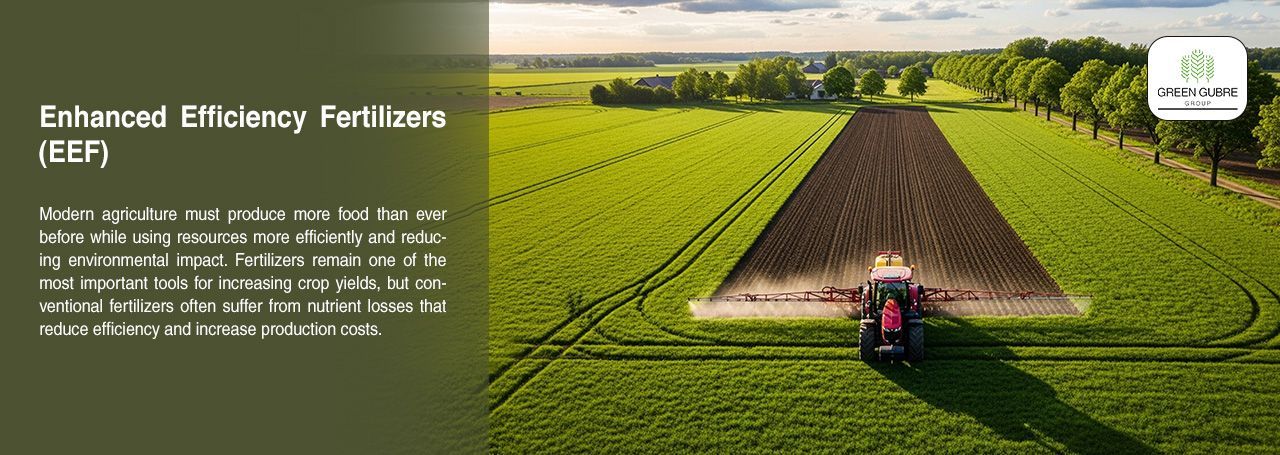
Modern agriculture must produce more food than ever before while using resources more efficiently and reducing environmental impact. Fertilizers remain one of the most important tools for increasing crop yields, but conventional fertilizers often suffer from nutrient losses that reduce efficiency and increase production costs.
Nitrogen, phosphorus, and potassium are essential for plant growth, yet significant portions of applied nutrients may be lost through volatilization, leaching, runoff, or fixation before crops can utilize them
To address these challenges, the fertilizer industry has developed a new generation of products known as Enhanced Efficiency Fertilizers (EEFs). These technologies improve nutrient availability, reduce losses, and help synchronize nutrient release with crop demand.
.Today, EEFs are becoming increasingly important in sustainable agriculture, precision farming, and environmental stewardship programs worldwide
.According to the International Fertilizer Association (IFA), enhanced-efficiency fertilizers represent a key advancement in improving nutrient use efficiency and reducing environmental impacts associated with fertilizer use
Source
International Fertilizer Association (IFA) – Enhanced Efficiency Fertilizers
What Are Enhanced Efficiency Fertilizers?
Enhanced Efficiency Fertilizers (EEFs) are fertilizer products designed to improve nutrient availability and increase nutrient use efficiency compared to conventional fertilizers.
These products work by:
- Slowing nutrient release
- Protecting nutrients from losses
- Synchronizing nutrient availability with crop demand
- Improving nutrient uptake efficiency
The goal is simple: maximize crop utilization of applied nutrients while minimizing environmental losses.
EEF technologies generally fall into three major categories:
- Controlled-Release Fertilizers (CRFs)
- Stabilized Fertilizers
- Slow-Release Fertilizers
Each category uses different mechanisms to improve fertilizer performance.
Why Nutrient Efficiency Matters
Nutrient losses are among the largest challenges in modern crop production.
Common nutrient loss pathways include:
| Nutrient Loss Mechanism | Description |
|---|---|
| Volatilizat | Conversion of nitrogen into ammonia gas |
| Leaching | Movement of nutrients below the root zone |
| Runoff | Nutrient movement across the soil surface |
| Denitrification | Conversion of nitrate into gaseous forms |
| Fixation | Nutrient binding within soil minerals |
These losses increase production costs and can contribute to environmental issues such as:
- Water pollution
- Eutrophication
- Greenhouse gas emissions
- Reduced soil fertility efficiency
The Food and Agriculture Organization (FAO) identifies nutrient use efficiency as a critical component of sustainable agricultural intensification
Controlled-Release Fertilizers (CRFs)
Controlled-release fertilizers regulate nutrient release through physical coatings or encapsulation technologies.
Common examples include:
- Polymer-Coated Urea (PCU)
- Sulfur-Coated Urea (SCU)
- Polymer-Coated NPK Fertilizers
These products release nutrients gradually over weeks or months.
Advantages of CRFs
- Reduced nutrient losses
- Improved nutrient synchronization
- Fewer fertilizer applications
- Higher nutrient recovery rates
- Better environmental performance
Controlled-release technologies are widely used in:
- Horticulture
- Turf management
- Plantation agriculture
- High-value crops
Stabilized Fertilizers
Stabilized fertilizers use chemical additives to reduce nutrient transformation in the soil.
Two common categories include:
Urease Inhibitors
These products slow the conversion of urea into ammonia.
Benefits include:
- Reduced ammonia volatilization
- Improved nitrogen retention
- Better fertilizer efficiency
Nitrification Inhibitors
These products slow the conversion of ammonium into nitrate.
Benefits include:
- Reduced nitrate leaching
- Lower denitrification losses
- Improved nitrogen availability
Stabilized fertilizers are increasingly used in large-scale field crop production.
Slow-Release Fertilizers
Slow-release fertilizers rely on chemical reactions or low-solubility nutrient compounds to release nutrients gradually.
Examples include:
- Urea-formaldehyde
- Methylene urea
- Isobutylidene diurea (IBDU)
Unlike coated fertilizers, nutrient release is controlled by microbial activity and chemical breakdown.
These products are commonly used in:
- Turf management
- Ornamental plants
- Specialty agriculture
Benefits of Enhanced Efficiency Fertilizers
Improved Nutrient Use Efficiency
EEFs help crops absorb a greater percentage of applied nutrients.
Benefits include
- Better fertilizer performance
- Higher nutrient recovery
- Reduced nutrient waste
Environmental Protection
EEF technologies help reduce:
- Nitrogen losses
- Groundwater contamination
- Greenhouse gas emissions
- Nutrient runoff
Reduced Application Frequency
Many EEFs provide extended nutrient availability.
Advantages include
- Lower labor costs
- Reduced equipment use
- Greater operational efficiency
Improved Crop Performance
EEF programs often support:
- Better root development
- Improved crop quality
- More consistent growth
- Higher yield stability
Enhanced Efficiency Fertilizers and Precision Agriculture
Precision agriculture aims to optimize nutrient application through data-driven decision making.
EEF technologies complement precision farming by:
- Improving nutrient timing
- Supporting variable-rate applications
- Enhancing fertilizer performance
- Reducing environmental risk
Many advanced agricultural systems combine EEFs with:
- GPS-guided machinery
- Soil mapping
- Remote sensing
- Digital nutrient management platforms
This integration improves both profitability and sustainability.
Crops That Benefit from EEF Technologies
Enhanced-efficiency fertilizers are suitable for many cropping systems.
Field Crops
- Corn
- Wheat
- Rice
- Soybeans
- Barley
Horticultural Crops
- Tomatoes
- Peppers
- Cucumbers
- Strawberries
Plantation Crops
- Oil Palm
- Coffee
- Tea
- Rubber
Turf and Landscaping
- Golf courses
- Sports fields
- Public parks
The specific EEF technology selected depends on crop requirements, climate, soil conditions, and management objectives.
Economic Considerations
Although EEFs generally have higher purchase costs than conventional fertilizers, they often improve overall fertilizer return on investment.
| Factor | Conventional Fertilizer | EEF |
|---|---|---|
| Nutrient Loss Risk | Higher | Lower |
| Application Frequency | Higher | Lower |
| Nutrient Recovery | Moderate | Higher |
| Environmental Compliance | More Challenging | Easier |
| Long-Term Efficiency | Moderate | Higher |
Many growers find that improved nutrient utilization offsets the higher product cost.
Challenges and Limitations
Despite their benefits, EEFs are not without challenges.
- Higher Initial Investment: Enhanced-efficiency products generally cost more than conventional fertilizers.
- Product Selection Complexity: Different technologies perform differently under varying environmental conditions.
- Limited Availability: Some advanced EEF products may not be available in all regions.
- Management Requirements: Successful implementation requires proper agronomic planning and nutrient management.
The Future of Enhanced Efficiency Fertilizers
The fertilizer industry continues investing in innovative nutrient management technologies.
Future developments include:
- Biodegradable fertilizer coatings
- Smart nutrient delivery systems
- Nanotechnology-based fertilizers
- Precision nutrient release mechanisms
- Digital agriculture integration
The increasing focus on sustainability, climate resilience, and resource efficiency is expected to accelerate global EEF adoption.
The 4R Nutrient Stewardship framework continues to promote efficient fertilizer management through the principles of applying the Right Source, at the Right Rate, at the Right Time, and in the Right Place.
Source:
4R Nutrient Stewardship Program
Green Gubre Group’s Specialty Fertilizer Solutions
Green Gubre Group supports modern agricultural production through advanced nutrient management products, including:
- Enhanced Efficiency Fertilizers (EEF)
- Controlled-Release Fertilizers
- Polymer-Coated Urea
- Sulfur-Coated Urea
- Specialty NPK Products
- Water-Soluble Fertilizers
- Micronutrient Solutions
Our objective is to help growers maximize fertilizer efficiency, improve crop productivity, and support sustainable agricultural development.
Conclusion: The Next Generation of Fertilizer Technology
Enhanced-efficiency fertilizers represent one of the most important developments in modern plant nutrition. By reducing nutrient losses and improving nutrient synchronization with crop demand, EEFs help growers achieve higher productivity while minimizing environmental impact.
As global agriculture continues moving toward greater sustainability and efficiency, enhanced-efficiency fertilizers will play an increasingly important role in supporting food security and responsible nutrient management
At
Green Gubre Group, we believe that advanced fertilizer technologies are essential to the future of profitable, sustainable farming.
References
- International Fertilizer Association (IFA) – Enhanced Efficiency Fertilizers
- Food and Agriculture Organization of the United Nations (FAO) – Sustainable Crop Production Intensification
- International Fertilizer Development Center (IFDC) – Fertilizer Best Management Practices
- ScienceDirect – Enhanced Efficiency Fertilizers Research
- USDA Natural Resources Conservation Service (NRCS) – Nutrient Management Guidelines
- 4R Nutrient Stewardship Program

Chitosan and Biopolymer Biostimulants: Improving Plant Growth, Stress Tolerance, and Crop Resilience