Water-Soluble Fertilizers (WSF): Maximizing Nutrient Efficiency in Modern Fertigation Systems
Water-Soluble Fertilizers (WSF):
Maximizing Nutrient Efficiency in Modern Fertigation Systems
Introduction: Meeting the Demands of Modern Crop Nutrition
Modern agriculture is evolving rapidly to meet the growing demand for higher crop productivity, improved resource efficiency, and sustainable farming practices. As irrigation systems become more advanced and precision agriculture gains wider adoption, fertilizer application methods are also changing.
One of the most significant innovations in plant nutrition is the use of
Water-Soluble Fertilizers (WSFs). Unlike conventional granular fertilizers, WSFs dissolve completely in water, allowing nutrients to be delivered directly to the plant root zone through irrigation systems or applied as foliar sprays.
This precise method of nutrient delivery improves nutrient use efficiency, reduces fertilizer losses, and enables growers to respond quickly to changing crop requirements.
Today, water-soluble fertilizers are widely used in greenhouse production, horticulture, fruit orchards, protected agriculture, hydroponics, and increasingly in open-field fertigation systems.
What Are Water-Soluble Fertilizers?
Water-Soluble Fertilizers (WSFs) are fertilizers that dissolve completely in water without leaving insoluble residues. Once dissolved, the nutrients become immediately available for plant uptake.
These fertilizers are specifically formulated for application through:
- Drip irrigation
- Sprinkler irrigation
- Pivot irrigation
- Fertigation systems
- Hydroponic systems
- Foliar spraying
Because they dissolve rapidly and completely, WSFs allow precise nutrient management throughout the crop growth cycle.
Unlike conventional fertilizers, which often rely on rainfall or soil moisture to dissolve, water-soluble fertilizers provide immediate nutrient availability when applied correctly.
Why Water Solubility Matters
Efficient nutrient uptake depends not only on fertilizer composition but also on nutrient availability.
Plant roots absorb nutrients primarily in dissolved ionic forms.
Water-soluble fertilizers ensure that essential nutrients are already in a form that plants can readily absorb.
This provides several advantages:
- Rapid nutrient availability
- Improved nutrient uptake
- Uniform fertilizer distribution
- Reduced nutrient fixation
- Greater flexibility in nutrient management
As a result, growers can adjust fertilizer programs according to crop growth stages and environmental conditions.
How Water-Soluble Fertilizers Work
When dissolved in irrigation water, WSFs create a nutrient solution that moves directly to the active root zone.
The process involves four basic steps:
1. Complete Dissolution
The fertilizer dissolves entirely in water, forming a homogeneous nutrient solution.
2. Uniform Distribution
The irrigation system distributes nutrients evenly across the crop.
3. Root Uptake
Roots absorb dissolved nutrients almost immediately.
4. Continuous Nutrition
Repeated fertigation applications provide nutrients in small, efficient doses throughout the growing season.
This "little and often" approach closely matches plant nutrient demand and minimizes nutrient losses.
Types of Water-Soluble Fertilizers
Water-soluble fertilizers are available in numerous formulations designed for different crops and growth stages.
Common products include:
Nitrogen Fertilizers
- Urea
- Calcium Nitrate
- Potassium Nitrate
- Ammonium Nitrate
Phosphorus Fertilizers
- Monoammonium Phosphate (MAP)
- Monopotassium Phosphate (MKP)
- Phosphoric Acid
Potassium Fertilizers
- Potassium Nitrate
- Potassium Sulfate (soluble grades)
Complete NPK Fertilizers
Examples include:
- 20-20-20
- 19-19-19
- 15-5-30
- 10-52-10
- 13-40-13
These balanced formulations are widely used in fertigation and foliar nutrition.
Key Benefits of Water-Soluble Fertilizers
Higher Nutrient Use Efficiency
Precise nutrient delivery improves crop nutrient uptake while reducing fertilizer losses.
Uniform Nutrient Distribution
Complete dissolution ensures that nutrients are distributed evenly throughout the irrigation system.
Flexible Fertilizer Programs
Growers can modify nutrient formulations throughout different crop growth stages.
Compatibility with Precision Agriculture
WSFs integrate seamlessly with:
- Fertigation
- Precision irrigation
- Digital nutrient management
- Greenhouse automation
Improved Crop Quality
Proper nutrient management supports:
- Better fruit size
- Improved color
- Higher yields
- Enhanced market quality
Water-Soluble Fertilizers vs Granular Fertilizers
| Feature | Water-Soluble Fertilizers | Granular Fertilizers |
|---|---|---|
| Solubility | Complete | Limited |
| Application | Fertigation, foliar | Soil application |
| Nutrient availability | Immediate | Gradual |
| Precision | Very high | Moderate |
| Flexibility | Excellent | Limited |
Common Applications
Water-soluble fertilizers are widely used in:
Greenhouse Production
- Tomatoes
- Cucumbers
- Peppers
- Lettuce
Fruit Crops
- Citrus
- Grapes
- Apples
- Berries
Vegetables
- Onion
- Potato
- Carrot
- Melon
Hydroponics
Because hydroponic systems rely entirely on nutrient solutions, WSFs are essential for balanced crop nutrition.
Best Management Practices
To maximize fertilizer performance:
- Use clean irrigation water.
- Verify fertilizer compatibility before mixing.
- Monitor electrical conductivity (EC) and pH.
- Calibrate injection equipment regularly.
- Apply nutrients according to crop growth stage.
- Conduct periodic soil and tissue analyses.
Challenges and Limitations
Despite their advantages, WSFs require careful management.
Potential limitations include:
- Higher cost compared with conventional fertilizers.
- Dependence on irrigation infrastructure.
- Risk of emitter clogging if incompatible products are mixed.
- Need for regular monitoring of irrigation water quality.
Proper system maintenance and nutrient management are essential for achieving the full benefits of fertigation.
Water-Soluble Fertilizers and Sustainable Agriculture
Water-soluble fertilizers support sustainable crop production by:
- Improving nutrient use efficiency.
- Reducing fertilizer waste.
- Supporting precise irrigation management.
- Minimizing nutrient losses to the environment.
When combined with fertigation and precision agriculture, WSFs help growers produce more with fewer resources.
Green Gubre Group's Water-Soluble Fertilizer Solutions
Green Gubre Group supplies a wide range of premium water-soluble fertilizers for modern agriculture.
Our portfolio includes:
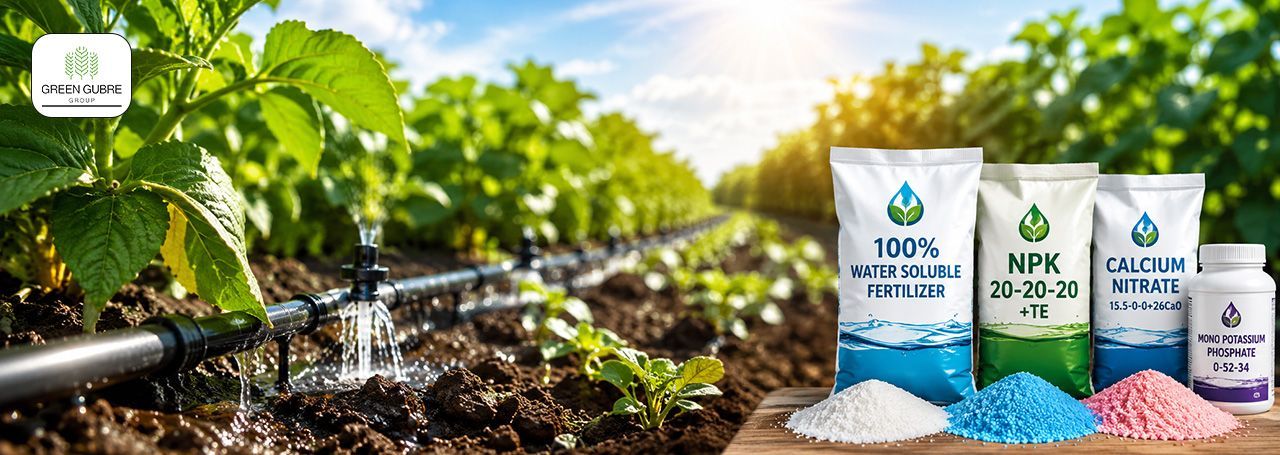
- Water-Soluble NPK Fertilizers
- Calcium Nitrate
- Potassium Nitrate
- Monoammonium Phosphate (MAP)
- Monopotassium Phosphate (MKP)
- Specialty Micronutrient Fertilizers
- Customized Fertigation Solutions
We work with trusted international manufacturers to provide high-quality fertilizer solutions tailored to diverse crops, irrigation systems, and growing conditions.
Conclusion
Water-Soluble Fertilizers have become an essential component of modern precision agriculture. Their complete solubility, rapid nutrient availability, and compatibility with fertigation systems enable growers to optimize nutrient management while improving crop performance and resource efficiency.
As agriculture continues to adopt smarter irrigation and precision farming technologies, the role of WSFs will become even more significant. By delivering nutrients exactly where and when crops need them, water-soluble fertilizers help increase productivity, improve fertilizer efficiency, and support sustainable agricultural development.
References
- Food and Agriculture Organization of the United Nations (FAO). Plant Nutrition for Food Security: A Guide for Integrated Nutrient Management
- Food and Agriculture Organization of the United Nations (FAO). Fertigation: A Tool for Efficient Fertilizer and Water Management
- Food and Agriculture Organization of the United Nations (FAO). Integrated Plant Nutrient Management Resources
- International Fertilizer Development Center (IFDC). Getting the Most Out of Fertilizer
- ScienceDirect. Fertigation – Reference Module in Earth Systems and Environmental Sciences
- ScienceDirect. Liquid Fertilizers – Overview
- ScienceDirect. A Global Meta-analysis on Surface and Drip Fertigation for Annual Crops Under Different Fertilization Levels. Agricultural Water Management, 2023
- ScienceDirect. 4R Nutrient Stewardship for Improved Nutrient Use Efficiency