Polymer-Coated Urea (PCU): Advanced Controlled-Release Nitrogen Fertilizer Technology
Polymer-Coated Urea (PCU): Advanced Controlled-Release Nitrogen Fertilizer Technology
Introduction: The Evolution of Nitrogen Fertilizer Efficiency
Nitrogen is one of the most important nutrients for agricultural productivity. It is essential for plant growth, protein formation, chlorophyll development, and achieving high crop yields. Among nitrogen fertilizers, urea remains the dominant nitrogen source worldwide because of its high nitrogen concentration, efficient production, and global availability.
However, conventional urea has an important limitation: its nutrients become available very quickly after application. While rapid nitrogen availability can benefit crops under certain conditions, it may also result in significant nutrient losses when nitrogen release exceeds plant uptake.
Major nitrogen loss pathways include:
- Ammonia volatilization
- Nitrate leaching
- Denitrification
- Nutrient runoff
These losses reduce nitrogen use efficiency, increase fertilizer costs, and may contribute to environmental challenges.
To address these limitations, the fertilizer industry has developed Enhanced Efficiency Fertilizer (EEF) technologies. Among these technologies,
Polymer-Coated Urea (PCU) represents one of the most advanced controlled-release nitrogen fertilizer solutions.
Polymer-coated urea uses a specially designed polymer membrane around urea granules to regulate nutrient release. This allows nitrogen availability to better match crop demand, improving fertilizer efficiency and reducing nutrient losses.
Today, polymer-coated urea is widely used in high-value agriculture, horticulture, turf management, professional landscaping, greenhouse production, and increasingly in field-crop systems.
What Is Polymer-Coated Urea (PCU)?
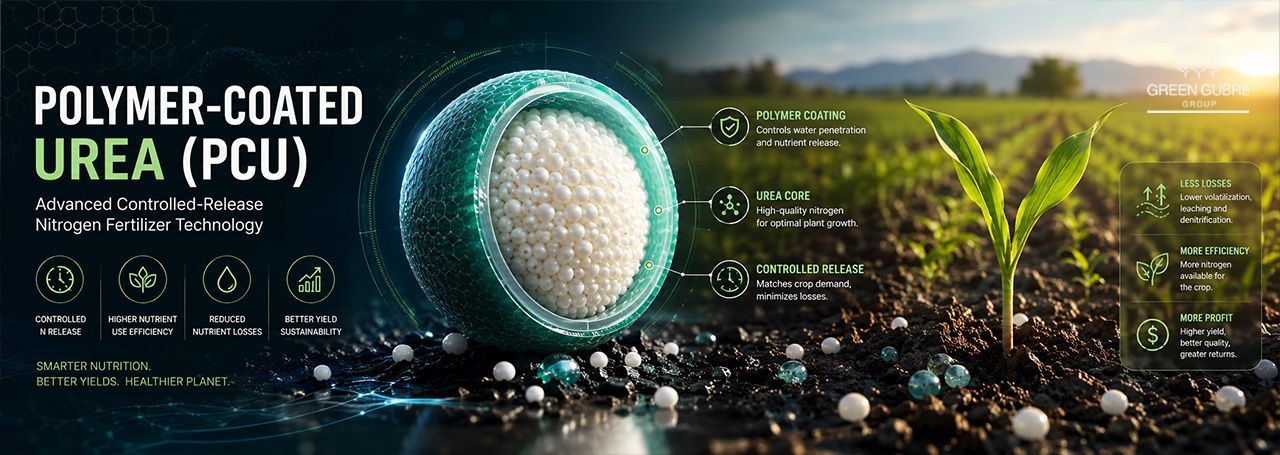
Polymer-Coated Urea (PCU) is a controlled-release fertilizer produced by applying a polymer coating around urea granules.
The polymer coating acts as a semi-permeable membrane that controls the movement of water into the granule and nitrogen release into the soil.
The basic structure includes:
| Component | Function |
|---|---|
| Urea granule | Provides nitrogen source |
| Polymer coating | Controls nutrient release |
| Optional sealant layer | Improves coating performance |
Unlike conventional urea, which dissolves immediately after application, polymer-coated urea releases nitrogen gradually over a predetermined period.
The release duration can be designed according to:
- Crop growth cycle
- Climate conditions
- Soil characteristics
- Application requirements
Depending on the formulation, PCU products can provide nutrient release periods ranging from several weeks to several months.
How Polymer-Coated Urea Works
The nutrient release mechanism of polymer-coated urea is based on controlled water movement through the coating.
The process occurs in several stages:
1. Water Penetration
After fertilizer application, soil moisture slowly moves through the polymer membrane.
The coating controls the speed of water entry into the fertilizer granule.
2. Urea Dissolution
Once water reaches the urea core, the fertilizer dissolves and creates a concentrated nitrogen solution inside the coating.
3. Controlled Diffusion
The dissolved nitrogen gradually moves through the polymer coating into the surrounding soil.
4. Plant Uptake
The released nitrogen becomes available for plant absorption throughout the growing season.
This controlled-release mechanism allows nitrogen availability to more closely follow crop nutrient demand.
Why Polymer-Coated Urea Improves Nitrogen Use Efficiency
Nitrogen use efficiency (NUE) measures how effectively crops utilize applied nitrogen.
Low NUE occurs when nitrogen becomes available too quickly or under unsuitable environmental conditions.
Polymer-coated urea improves NUE by:
- Reducing excessive nitrogen release
- Increasing nutrient availability during crop growth
- Minimizing nitrogen losses
- Improving synchronization between nutrient supply and plant demand
Nitrogen Release Comparison
| Fertilizer Type | Release Pattern |
|---|---|
| Conventional Urea | Immediate release |
| Sulfur-Coated Urea | Gradual release through sulfur coating |
| Polymer-Coated Urea | Controlled release through polymer membrane |
The predictable release characteristics of PCU make it one of the most advanced nitrogen management technologies available.
Types of Polymer-Coated Urea Technologies
Polymer-coated urea technology has evolved significantly over recent decades. Different coating materials and manufacturing methods are used to achieve specific nutrient release characteristics.
The main polymer-coated urea technologies include:
1. Thermoset Polymer-Coated Urea
Thermoset polymers are among the most widely used coating materials for controlled-release fertilizers.
Characteristics include:
- Strong coating durability
- Predictable nitrogen release
- Long nutrient availability period
- High resistance to environmental stress
These fertilizers are commonly used in:
- Turf management
- Professional landscaping
- Horticulture
- High-value crop production
2. Thermoplastic Polymer-Coated Urea
Thermoplastic coatings provide flexible nutrient release characteristics.
Advantages include:
- Adjustable release duration
- Improved coating flexibility
- Efficient manufacturing processes
These products are often designed for specific crop cycles and environmental conditions.
3. Hybrid Polymer Coatings
Some advanced controlled-release fertilizers combine multiple coating technologies.
Examples include:
- Polymer-sulfur hybrid coatings
- Multi-layer polymer systems
- Biodegradable polymer coatings
Benefits include:
- Improved release control
- Enhanced coating durability
- Reduced environmental impact
Factors Affecting Polymer-Coated Urea Release
One of the main advantages of PCU technology is its ability to provide predictable nutrient release. However, release performance is influenced by several environmental factors.
| Factor | Impact on Nitrogen Release |
|---|---|
| Soil Temperature | Major influence on release speed |
| Soil Moisture | Controls water movement through coating |
| Coating Thickness | Determines release duration |
| Polymer Structure | Affects diffusion rate |
| Soil Conditions | Influences fertilizer performance |
Soil Temperature
Temperature is generally the most important factor affecting polymer-coated urea release.
Higher temperatures increase molecular movement within the coating and accelerate nitrogen diffusion.
Lower temperatures slow nutrient release.
This characteristic helps PCU better match plant growth patterns because crop nutrient demand often increases with temperature.
Benefits of Polymer-Coated Urea
1. Precise Nitrogen Release
The most important advantage of PCU is controlled nutrient availability.
Compared with conventional urea, polymer-coated urea provides:
- More consistent nitrogen supply
- Reduced nutrient peaks after application
- Better synchronization with crop uptake
This helps reduce periods when excessive nitrogen is available but not required by plants.
2. Higher Nitrogen Use Efficiency
By controlling nitrogen release, PCU improves fertilizer utilization.
Benefits include:
- Increased nitrogen recovery
- Reduced fertilizer waste
- Improved nutrient management
- Better return on fertilizer investment
Higher nitrogen use efficiency is particularly valuable when fertilizer prices are high or environmental regulations require improved nutrient management.
3. Reduced Nitrogen Losses
Rapid nitrogen release can increase the risk of nutrient losses.
Polymer-coated urea helps reduce:
- Ammonia Volatilization: By slowing urea dissolution, PCU reduces the concentration of nitrogen available for rapid ammonia loss.
- Nitrate Leaching: Gradual nitrogen release reduces excessive nitrate accumulation in the soil.
- Denitrification: Maintaining a balanced nitrogen supply can reduce conditions that promote nitrogen loss under waterlogged soils.
4. Fewer Fertilizer Applications
Because PCU provides nitrogen over an extended period, growers may reduce application frequency.
Potential advantages:
- Lower labor requirements
- Reduced machinery use
- Improved operational efficiency
- Lower application costs
This is especially valuable in:
- Large-scale agriculture
- Greenhouse production
- Turf management
- Remote farming areas
5. Improved Crop Quality and Growth Consistency
A stable nitrogen supply supports:
- Uniform crop development
- Improved plant color
- Stronger vegetative growth
- Better yield stability
Unlike rapid-release fertilizers that may create periods of excessive and insufficient nitrogen availability, PCU provides a more balanced nutrient supply.
Agricultural Applications of Polymer-Coated Urea
Polymer-coated urea is used across many agricultural and non-agricultural sectors.
1. Horticulture and Greenhouse Production
Horticultural crops often require precise nutrient management because of their high economic value.
PCU is widely used for:
- Vegetables
- Ornamentals
- Nursery plants
- Container crops
Benefits include:
- Predictable nutrient supply
- Reduced fertilizer application frequency
- Improved plant quality
2. Turf and Landscape Management
Professional turf systems require consistent nitrogen availability to maintain quality and appearance.
Applications include:
- Golf courses
- Sports fields
- Parks
- Commercial landscapes
Advantages:
- Steady plant growth
- Reduced excessive growth flushes
- Improved turf color consistency
3. Plantation Crops
Long-cycle crops benefit from extended nutrient availability.
Applications include:
- Coffee
- Tea
- Oil palm
- Cocoa
PCU helps maintain nitrogen availability during longer growing periods where frequent fertilizer application may be difficult.
4. Field Crops
Although initially popular in specialty agriculture, PCU adoption is expanding in field-crop systems.
Potential applications include:
- Corn
- Wheat
- Rice
- Sugarcane
- Vegetables
The technology is particularly beneficial where:
- Rainfall is unpredictable
- Nitrogen losses are significant
- Labor availability is limited
Polymer-Coated Urea vs Sulfur-Coated Urea
Both PCU and SCU are controlled-release nitrogen fertilizers, but they use different release mechanisms.
| Feature | Polymer-Coated Urea (PCU) | Sulfur-Coated Urea (SCU) |
|---|---|---|
| Coating Material | Polymer membrane | Elemental sulfur coating |
| Release Control | Diffusion through polymer | Coating breakdown and diffusion |
| Release Predictability | Very high | Moderate |
| Sulfur Nutrition | No | Yes |
| Production Cost | Higher | Generally lower |
| Application | Specialty agriculture, turf, horticulture | Agriculture, turf, landscaping |
Polymer-coated urea generally provides more precise nutrient-release control, while sulfur-coated urea provides the additional benefit of sulfur nutrition.
The appropriate choice depends on:
- Crop requirements
- Soil conditions
- Fertilizer objectives
- Economic considerations
Environmental Advantages of Polymer-Coated Urea
Sustainable agriculture requires improving productivity while reducing environmental impacts.
PCU contributes to environmental stewardship by improving nutrient efficiency.
| Environmental Challenge | PCU Contribution |
|---|---|
| Nitrogen losses | Controlled nutrient release |
| Nitrate contamination | Reduced excess nitrate formation |
| Greenhouse gas emissions | Improved nitrogen management |
| Fertilizer waste | Higher nutrient recovery |
By improving nitrogen efficiency, polymer-coated urea supports responsible fertilizer management practices.
Polymer-Coated Urea and Precision Agriculture
Modern agriculture is increasingly combining fertilizer technology with digital farming systems.
PCU works effectively with:
- Soil nutrient analysis
- Variable-rate application
- GPS-guided equipment
- Crop monitoring systems
- Digital nutrient management platforms
The combination of controlled-release fertilizers and precision agriculture allows farmers to optimize:
- Fertilizer quantity
- Application timing
- Nutrient placement
- Crop-specific nutrition programs
Challenges and Limitations of Polymer-Coated Urea
Despite its advantages, PCU also has several considerations.
1. Higher Initial Cost
Polymer coating technology increases production costs compared with conventional urea.
However, economic benefits may result from:
- Reduced fertilizer losses
- Fewer applications
- Improved nutrient recovery
2. Temperature Dependency
Although temperature-responsive release is an advantage, extreme temperature conditions may influence release patterns.
Very high temperatures may accelerate nutrient release, while cold conditions may slow it.
3. Limited Flexibility After Application
Once applied, nutrient release follows the designed coating characteristics.
Unlike liquid fertilizers, release cannot easily be adjusted after application.
4. Environmental Concerns Related to Some Coating Materials
Traditional polymer coatings may raise questions regarding long-term environmental persistence.
The fertilizer industry is therefore developing:
- Biodegradable polymers
- Bio-based coatings
- Environmentally friendly release systems
Future Development of Polymer-Coated Urea Technology
The future of PCU technology is focused on improving efficiency while reducing environmental impact.
Key innovation areas include:
Biodegradable Polymer Coatings
Researchers are developing coatings made from environmentally friendly materials that maintain controlled release while reducing persistence in soil.
Smart Fertilizer Technologies
Future fertilizers may incorporate:
- Soil-responsive coatings
- Moisture-sensitive materials
- Temperature-controlled release systems
These technologies aim to deliver nutrients precisely when crops require them.
Digital Fertilizer Management
Integration with:
- Artificial intelligence
- Remote sensing
- Soil sensors
- Predictive crop models
will allow more accurate nutrient recommendations.
Green Gubre Group’s Advanced Fertilizer Solutions
Green Gubre Group supports modern agriculture by providing access to advanced fertilizer technologies designed to improve nutrient efficiency, reduce environmental losses, and support sustainable crop production.
Our fertilizer portfolio includes:
- Polymer-Coated Urea (PCU)
- Sulfur-Coated Urea (SCU)
- Controlled-Release Fertilizers (CRF)
- Enhanced Efficiency Fertilizers (EEF)
- Urease Inhibitors
- Nitrification Inhibitors
- Specialty NPK Fertilizers
- Water-Soluble Fertilizers
- Micronutrient Fertilizers
- Customized Crop Nutrition Solutions
Through cooperation with qualified international manufacturers and fertilizer suppliers, Green Gubre Group helps agricultural companies access innovative nutrient-management solutions suitable for different crops, climates, and farming systems.
Our objective is to support growers, distributors, and agricultural organizations in improving fertilizer performance while contributing to more efficient and sustainable food production.
Conclusion: Precision Nitrogen Management Through Polymer-Coated Urea Technology
Polymer-Coated Urea (PCU) represents one of the most advanced developments in nitrogen fertilizer technology. By controlling the release of nitrogen through a polymer membrane, PCU improves synchronization between fertilizer availability and crop nutrient demand.
Compared with conventional urea, polymer-coated urea provides several important advantages:
- Improved nitrogen use efficiency
- Reduced nitrogen losses
- Longer nutrient availability
- Fewer fertilizer applications
- Better crop nutrient management
Although PCU requires higher initial investment compared with traditional nitrogen fertilizers, its improved efficiency and reduced nutrient losses can provide significant agronomic and economic benefits.
As agriculture continues moving toward precision farming, sustainable nutrient management, and higher resource efficiency, polymer-coated urea is expected to play an increasingly important role in modern fertilizer strategies.
At
Green Gubre Group, we believe that advanced fertilizer technologies are essential for improving agricultural productivity, protecting natural resources, and supporting global food security.
References
- Food and Agriculture Organization of the United Nations (FAO)
- International Fertilizer Association (IFA)
- International Fertilizer Development Center (IFDC)
- Association of American Plant Food Control Officials (AAPFCO)
- USDA Natural Resources Conservation Service (NRCS)
- 4R Nutrient Stewardship Program
- ScienceDirect – Controlled Release Fertilizer Research