How to Build a Successful Plant Biostimulant Distribution Business: Supplier Selection, Pricing, and Market Entry
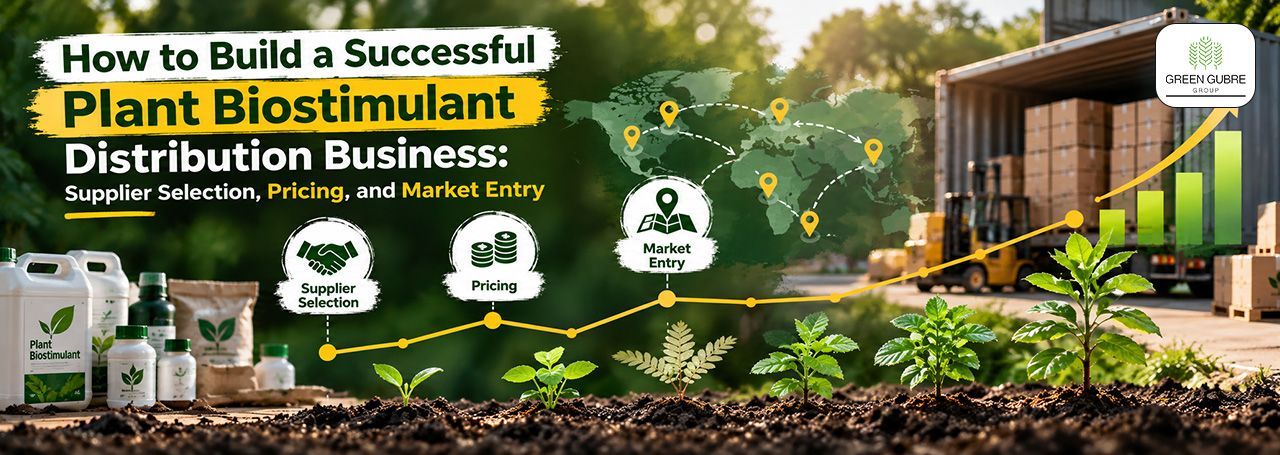
How to Build a Successful Plant Biostimulant Distribution Business: Supplier Selection, Pricing, and Market Entry
Introduction
The expanding plant biostimulant industry creates opportunities for fertilizer distributors, agricultural importers, and trading companies seeking to diversify their product portfolios.
However, distributing biostimulants requires a different commercial approach from trading conventional fertilizers.
While commodity fertilizers are generally evaluated through established nutrient specifications, biostimulants often require more detailed assessment of product composition, agronomic performance, regulatory compliance, and application conditions.
A competitively priced product is not necessarily commercially successful.
Distributors must also consider whether farmers understand the benefits, whether local conditions can demonstrate them, and whether the supplier can maintain consistent quality.
Successful biostimulant distribution depends on combining reliable suppliers, credible agronomic evidence, appropriate pricing, and effective market development.
This article presents a practical framework for building a plant biostimulant distribution business, from market research and supplier qualification to product positioning, pricing, and long-term customer relationships.
1. Understanding the Biostimulant Distribution Business
Plant biostimulants include products derived from seaweed extracts, humic substances, protein hydrolysates, microorganisms, and other biologically active materials.
They may improve nutrient use efficiency, support tolerance to abiotic stress, and enhance certain crop-quality characteristics.
Unlike conventional fertilizers, however, biostimulant performance can depend heavily on crop type, soil conditions, climate, application timing, and farm-management practices.
This creates additional responsibilities for distributors.
A biostimulant distributor must do more than purchase products and arrange delivery.
The business may also need to provide:
- Product verification and quality assurance
- Regulatory documentation
- Crop-specific recommendations
- Technical support
- Local performance demonstrations
- Storage and logistics management
- Customer education
These services can influence both customer confidence and commercial profitability.
2. Market Research: Identify Demand Before Selecting Products
One of the most common commercial mistakes is selecting a product before understanding the target market.
A distributor may identify an attractive supplier price without confirming whether local growers actually need the formulation.
A more effective strategy begins with agricultural market research.
Identify Priority Crops
Different crops create different commercial opportunities.
High-value horticultural crops may justify more expensive treatments when they deliver measurable improvements in quality or marketable yield.
Large-scale field crops generally require careful evaluation of treatment costs because profitability depends on performance across substantial cultivated areas.
Important considerations include:
- Cultivated area
- Crop value
- Fertilizer expenditure
- Irrigation practices
- Environmental stress
- Existing biostimulant adoption
- Distribution channels
Understand Grower Problems
Commercial demand is more sustainable when products address identifiable agricultural challenges.
Examples include nutrient-management inefficiencies, salinity exposure, or specific crop-quality requirements.
However, don't promote a biostimulant as a solution unless relevant evidence supports its intended function.
Start with a verified agricultural need, not a supplier's marketing claim.
3. Supplier Selection and Technical Due Diligence
Supplier selection is one of the most important decisions in biostimulant distribution.
Products within the same category may differ substantially in composition, stability, manufacturing consistency, and biological performance.
Before establishing a distribution relationship, buyers should evaluate the manufacturer's technical and commercial capabilities.
Essential Supplier Evaluation Criteria
| Evaluation Area | Key Questions |
|---|---|
| Manufacturer reliability | Does the supplier have documented production and quality-control procedures? |
| Product composition | Are ingredients and relevant specifications clearly defined? |
| Quality assurance | Are batch-specific analytical results available? |
| Product stability | Is shelf life supported by appropriate evidence? |
| Regulatory compliance | Can the supplier provide documentation for the target market? |
| Agronomic evidence | Are relevant product claims supported by credible studies? |
| Supply capacity | Can the manufacturer maintain consistent availability? |
| Commercial support | Are technical training and product information available? |
For microbial products, pay extra attention to strain identity, viable concentration, and storage requirements.
For non-microbial products, relevant analytical characteristics depend on the formulation.
As discussed in
Plant Biostimulant Quality Control, evaluate product specifications and field efficacy separately.
A Certificate of Analysis can support quality verification, but it does not automatically establish agricultural performance.
4. Regulatory Compliance Before Market Entry
Plant biostimulant regulations vary among countries.
A product legally marketed in one jurisdiction may require additional registration, documentation, or authorization elsewhere.
For example, the European Union provides a harmonized framework for qualifying EU fertilizing products under Regulation (EU) 2019/1009.
Other markets may classify products as fertilizer, microbial input, soil amendment, or under other agricultural regulations.
Before importing a product, distributors should verify:
- Legal product classification
- Ingredient eligibility
- Registration or authorization requirements
- Safety specifications
- Labeling obligations
- Permitted marketing claims
- Import documentation
Verify regulatory requirements before committing to substantial inventory.
A favorable purchase price cannot compensate for a product that cannot legally enter the intended market.
For a more detailed explanation, see
Plant Biostimulant Regulations.
5. Building a Focused Product Portfolio
A distributor doesn't necessarily need a large portfolio to build a successful business.
Introducing too many products can increase inventory costs, technical complexity, and customer confusion.
A focused portfolio helps the distributor build stronger product knowledge and a more consistent commercial position.
A practical approach is to select formulations based on:
Target crops: Which agricultural segments offer the strongest demand?
Intended functions: What specific agronomic needs can the products address?
Scientific evidence: Are the claimed benefits supported by relevant research?
Application compatibility: Can the formulations fit existing crop-management programs?
Commercial differentiation: How do the products compare with established alternatives?
For example, a distributor serving greenhouse vegetable producers may prioritize different formulations from a company supplying large-scale cereal farms.
Portfolio selection should follow customer requirements rather than simply maximizing the number of available products.
6. Pricing Strategy and Distribution Margins
Biostimulant pricing requires balancing supplier costs, distribution expenses, customer affordability, and demonstrated agricultural value.
The purchase price represents only one component of total commercial cost.
Other expenses may include:
- International freight
- Customs duties and taxes
- Registration and compliance
- Warehousing
- Product testing
- Technical demonstrations
- Sales commissions
- Marketing
- Customer support
Example: Calculating Distribution Margin
Consider a hypothetical biostimulant imported at the following costs:
| Cost Component | USD per Liter |
|---|---|
| Product purchase | 2.50 |
| Freight and insurance | 0.30 |
| Customs and import expenses | 0.20 |
| Warehousing and handling | 0.15 |
| Allocated technical and marketing costs | 0.35 |
| Total estimated cost | 3.50 |
If the distributor sells the product for USD 5.00 per liter:
Gross contribution per liter = USD 5.00 − USD 3.50 = USD 1.50
The contribution margin on sales would be:
USD 1.50 ÷ USD 5.00 × 100 = 30%
This example is illustrative.
The result represents contribution after the listed allocated costs, not necessarily final net profit. Unallocated overhead, financing costs, losses, and other expenses may still apply.
A sustainable pricing strategy should account for these costs and the value customers can reasonably expect.
7. Demonstrating Agronomic and Economic Value
Growers are more likely to adopt unfamiliar agricultural inputs when they understand the expected benefits and limitations.
Local demonstrations can support customer education, but rigorous field trials are necessary to support stronger performance claims.
Useful measurements may include:
- Marketable yield
- Crop quality
- Nutrient-use performance
- Treatment cost
- Additional revenue
- Net economic benefit
Example: Farmer Return on Investment
Assume a biostimulant treatment costs USD 40 per hectare, including application.
If a properly evaluated treatment produces an additional USD 100 per hectare in crop revenue:
Net benefit = USD 100 − USD 40 = USD 60 per hectare
The net return on treatment cost would be:
USD 60 ÷ USD 40 × 100 = 150%
This is a hypothetical calculation, not a guaranteed result.
Actual performance may vary by crop, season, and agricultural conditions.
For distributors, communicating realistic expectations is essential to building long-term customer trust.
8. Distribution Channels and Customer Acquisition
Biostimulants can reach growers through several commercial channels.
Common approaches include direct sales, agricultural retailers, regional distributors, and partnerships with agronomic service providers.
The appropriate model depends on market structure, customer concentration, and technical-support requirements.
Direct Sales
Direct relationships may suit large farms, greenhouse operators, and agricultural enterprises.
They allow closer communication and more detailed product evaluation.
However, direct sales can require substantial technical and commercial resources.
Agricultural Retailers
Retailers can provide broader geographic coverage and access to established customer networks.
Successful retailer partnerships often require product training, technical materials, and reliable inventory availability.
Regional Distributors
Regional distribution partnerships may help manufacturers and international traders enter unfamiliar markets.
However, when selecting partners, consider financial reliability, market access, technical capability, and regulatory experience.
Digital Marketing and Education
Educational content can support customer acquisition by explaining product categories, how to apply them, and how to evaluate them.
For companies operating internationally, technical articles and product documentation can also help establish credibility with potential business partners.
9. Inventory, Storage, and Logistics Management
Inventory management is particularly important for products with limited shelf life or specific storage requirements.
Microbial formulations may require additional attention because viable concentration can decline under unsuitable conditions.
Liquid formulations may also be sensitive to temperature extremes or prolonged storage.
Distributors should establish procedures for:
- Batch traceability
- Expiry-date monitoring
- Storage-temperature control
- Packaging inspection
- Inventory rotation
- Customer complaint management
A
First-Expiry, First-Out (FEFO) inventory system can help reduce losses from expired product.
However, inventory rotation cannot compensate for unsuitable storage conditions.
Incorporate technical storage requirements into commercial logistics planning.
10. Building Long-Term Competitive Advantage
A sustainable distribution business should not depend exclusively on low prices.
Price competition is hard to sustain when competing suppliers offer similar formulations.
Long-term differentiation may come from:
- Reliable product quality
- Transparent technical documentation
- Crop-specific recommendations
- Local performance evidence
- Consistent supply
- Regulatory expertise
- Technical customer support
- Strong manufacturer relationships
These capabilities can help distributors move beyond transactional sales.
For international fertilizer trading companies, biostimulants may offer an opportunity to build higher-value agricultural input portfolios.
However, market research, supplier verification, and realistic financial analysis should support expansion.
The objective is not simply to introduce another agricultural product, but to establish a commercially sustainable solution for a clearly defined customer segment.
Conclusion
Building a successful plant biostimulant distribution business requires more than identifying manufacturers and negotiating purchase prices.
Distributors must understand agricultural demand, evaluate suppliers, verify regulatory compliance, develop focused portfolios, and establish sustainable pricing strategies.
Scientific evidence and product quality matter especially because biostimulant performance can vary under different agricultural conditions.
Local market knowledge, technical support, and reliable logistics can further strengthen customer relationships.
For agricultural importers and trading companies, the best opportunities will likely come from products that combine credible agronomic value with consistent quality and commercial reliability.
Successful biostimulant distribution begins with understanding the customer, selecting the right product, and delivering measurable value—not simply offering the lowest price.
References
- European Parliament and Council (2019). Regulation (EU) 2019/1009 — EU Fertilizing Products Regulation.
- du Jardin, P. (2015). Plant Biostimulants: Definition, Concept, Main Categories and Regulation. Scientia Horticulturae, 196, 3–14.
- Rouphael, Y. & Colla, G. (2020). Biostimulants in Agriculture. Frontiers in Plant Science, 11, 40.
- Li, J., Van Gerrewey, T. & Geelen, D. (2022). A Meta-Analysis of Biostimulant Yield Effectiveness in Field Trials. Frontiers in Plant Science, 13, 836702.
- Ricci, M., Tilbury, L., Daridon, B., & Sukalac, K. (2019). General Principles to Justify Plant Biostimulant Claims. Frontiers in Plant Science, 10, 494.