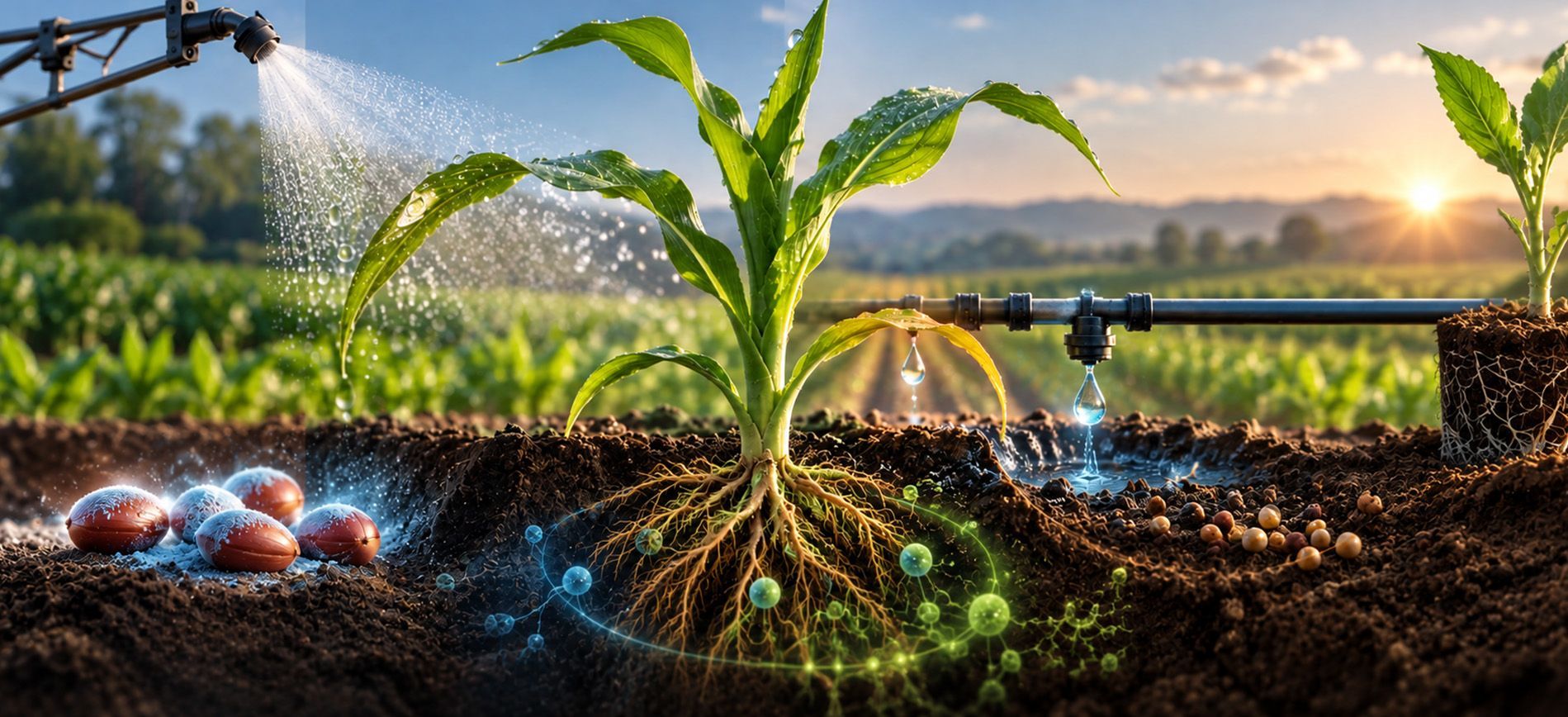
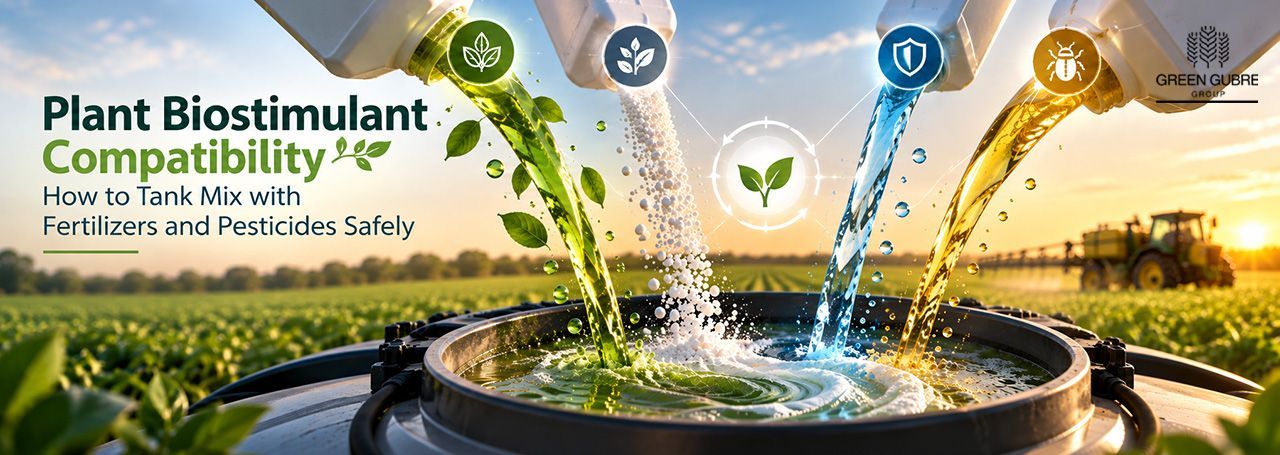
Plant Biostimulant Compatibility: How to Tank Mix with Fertilizers and Pesticides Safely
Plant Biostimulant Compatibility: How to Tank Mix with Fertilizers and Pesticides Safely
Introduction
Modern crop-management programs rarely rely on a single agricultural input.
During the same production cycle, growers may use fertilizers, micronutrients, plant biostimulants, fungicides, insecticides, herbicides, biological products, water conditioners, and other materials.
Combining compatible products in the same spray tank or fertigation system can reduce the number of field operations, save labor and fuel, and simplify crop management.
But convenience does not guarantee compatibility.
When agricultural inputs are mixed, their physical, chemical, and biological properties can interact.
A mixture may remain stable and perform as intended.
Or it may produce:
- Precipitation
- Sedimentation
- Flocculation
- Phase separation
- Excessive foam
- Changes in pH
- Reduced solubility
- Clogged filters or nozzles
- Reduced biological activity
- Microbial mortality
- Crop injury
- Reduced treatment effectiveness
This is particularly important for plant biostimulants because the category encompasses a wide range of products—from seaweed extracts and humic substances to protein hydrolysates and living microorganisms.
The practical question is therefore not:
“Can biostimulants be tank mixed?”
A better question is:
“Is this specific biostimulant compatible with these specific products, in this water, at these concentrations, and under these application conditions?”
What Does Tank-Mix Compatibility Mean?
Compatibility is often treated as a simple yes-or-no concept.
In reality, several different forms of compatibility must be considered.
Physical Compatibility
Do the products remain physically stable after mixing?
Problems may include:
- Precipitation
- Crystallization
- Separation
- Gel formation
- Excessive foam
- Sediment
- Nozzle blockage
A mixture that cannot remain physically stable should not be applied.
Chemical Compatibility
Even if a mixture looks normal, chemical interactions may occur.
Mixing can alter:
- pH
- Solubility
- Ionic balance
- Stability
- Availability of certain compounds
- Activity of formulation components
Visible appearance alone therefore cannot prove complete compatibility.
Biological Compatibility
This is especially important for microbial biostimulants.
A mixture may look perfectly stable while another component reduces the viability or activity of the microorganisms.
For example, certain pesticides may negatively affect beneficial bacteria or fungi.
A simple jar test cannot detect this type of incompatibility.
Agronomic Compatibility
Even when products are physically and chemically compatible, their biological effects on the crop may interact.
The response can potentially be:
Additive — the combined effect is broadly consistent with the effects of the individual treatments.
Synergistic — the combined effect is greater than expected from the individual treatments.
Antagonistic — one product reduces the effectiveness of another.
Tank-mixing decisions therefore require more than just observing whether two liquids can be mixed.
Why Growers Tank Mix Agricultural Inputs
Tank mixing can offer significant operational advantages.
Instead of making separate passes for a fertilizer, biostimulant, and crop-protection treatment, compatible products may sometimes be applied together.
Potential advantages include:
- Fewer field operations
- Reduced labor
- Lower machinery use
- Reduced fuel consumption
- Less traffic across the field
- Lower application cost
- More efficient use of spray windows
These advantages explain why tank mixing is common in commercial agriculture.
However, operational efficiency should never take priority over product performance or crop safety.
Saving one field pass has little value if the mixture damages the crop or reduces the effectiveness of an expensive biological product.
Why Biostimulants Require Special Attention
Plant biostimulants are not a chemically uniform category.
Under the European Union fertilizing products framework, plant biostimulants are defined by their function in stimulating plant nutrition processes rather than by a particular chemical composition.
Commercial products may therefore contain very different materials.
Examples include:
- Humic substances
- Fulvic substances
- Seaweed extracts
- Protein hydrolysates
- Amino acids and peptides
- Microbial biostimulants
- Other plant- or biologically derived compounds
A tank-mix recommendation appropriate for one formulation cannot automatically be transferred to another.
Even products belonging to the same general category may differ because of:
- Raw-material source
- Extraction method
- Concentration
- Formulation technology
- pH
- Carrier materials
- Additives
- Microbial strain
- Stabilizers
Compatibility should therefore be evaluated at the
specific product level, not simply by product category.
Water Quality Comes First
Before considering whether two agricultural products are compatible, growers should consider the material that normally makes up most of the spray solution:
Water.
Water chemistry can significantly influence tank mixtures.
Important parameters include:
- pH
- Hardness
- Bicarbonate concentration
- Electrical conductivity
- Salinity
- Dissolved minerals
- Suspended solids
- Chlorine or other disinfectants
A product that performs correctly in one water source may behave differently in another.
This is one reason why compatibility observed on one farm should not automatically be assumed to apply everywhere.
Why Water pH Matters
Many agricultural formulations are sensitive to pH.
Adding fertilizers, pesticides, biostimulants, acidifiers, or water conditioners can change the final pH of a tank mixture.
This can influence:
- Product stability
- Solubility
- Chemical reactions
- Nutrient availability
- Microbial viability
- Crop safety
The objective should not be to force every spray solution toward one supposedly ideal pH.
Different products have different requirements.
Instead, growers should determine whether the final solution remains within the acceptable range specified for the products being applied.
Water Hardness and Dissolved Minerals
Hard water contains elevated concentrations of minerals, particularly calcium and magnesium.
Depending on the products involved, these ions can interact with agricultural inputs and influence their behavior in solution.
Potential consequences can include:
- Reduced solubility
- Precipitation
- Complex formation
- Reduced performance of certain active ingredients
High bicarbonate concentrations can also influence solution chemistry and pH.
When water quality is uncertain, testing irrigation or spray water can provide useful information before developing complex tank mixtures.
Mixing Biostimulants with Fertilizers
Biostimulants are frequently used alongside fertilizer programs.
This makes fertilizer compatibility one of the most important practical considerations.
Some combinations may be straightforward.
Others can create significant chemical or physical problems.
Potential compatibility factors include:
- Fertilizer concentration
- Salt concentration
- Solution pH
- Calcium content
- Phosphate content
- Sulfate content
- Micronutrient forms
- Chelating agents
- Water temperature
- Mixing sequence
Highly concentrated nutrient solutions require particular attention.
Precipitation in Fertilizer Mixtures
One of the most obvious compatibility problems is precipitation.
When incompatible ions are combined at sufficient concentrations, poorly soluble compounds may form.
The result may appear as:
- Cloudiness
- Crystals
- Sediment
- Flakes
- Solid deposits
Precipitation creates several problems.
Nutrients may no longer remain fully available in solution.
Filters, emitters, and spray nozzles may become blocked.
The final application may also become uneven.
Adding a biostimulant to an already complex fertilizer solution introduces another formulation into this chemical environment.
Compatibility should therefore be confirmed before commercial-scale mixing.
Electrical Conductivity and Salt Concentration
Fertilizer solutions can have relatively high electrical conductivity.
This becomes particularly relevant when biostimulants are applied to sensitive plant tissues or when living microorganisms are involved.
A microbial formulation that performs well in clean water may not remain equally viable in a concentrated fertilizer solution.
Similarly, a foliar mixture containing several fertilizers and a biostimulant may result in a higher salt load than either product alone.
Under unfavorable environmental conditions, the risk of leaf injury can increase.
Tank-mix evaluation should therefore consider the
final mixture, not merely each product individually.
Mixing Biostimulants with Micronutrients
Micronutrient fertilizers may contain:
- Iron
- Zinc
- Manganese
- Copper
- Boron
- Molybdenum
Some micronutrients are supplied as inorganic salts, while others may be chelated or complexed.
Compatibility depends on formulation chemistry.
Metal ions can interact with organic compounds, phosphates, carbonates, and other components of a tank mixture.
Copper deserves particular attention when living microorganisms are involved because copper-based compounds can have antimicrobial properties.
A microbial biostimulant should therefore not automatically be mixed with a copper-containing fertilizer or crop-protection product.
Product-specific evidence is required.
Mixing Biostimulants with Pesticides
Growers often want to combine biostimulants with:
- Fungicides
- Insecticides
- Herbicides
- Acaricides
- Other crop-protection products
This can reduce the number of field operations.
But pesticide compatibility can be complex.
Scientific reviews of pesticide and fertilizer tank mixtures have documented additive, synergistic, and antagonistic interactions.
Physical compatibility alone does not establish that the biological performance of every product will remain unchanged.
Always check the labels and technical guidance for
all products in the proposed mixture.
Fungicides and Microbial Biostimulants
This combination requires particular caution.
Microbial biostimulants can contain beneficial fungi or bacteria.
Fungicides are designed to suppress fungi.
The potential conflict is obvious when the beneficial organism itself is fungal, but the situation is more complicated than simply saying:
“Never mix fungicides with microbial products.”
Compatibility depends on factors including:
- Fungicide active ingredient
- Formulation
- Microbial species
- Microbial strain
- Dose
- Exposure time
- Application method
Some combinations may be compatible.
Others may substantially reduce the viability or activity of microorganisms.
Scientific literature on microbial inoculants demonstrates that pesticide compatibility can vary considerably among products and organisms.
Insecticides and Microbial Biostimulants
Insecticides should not automatically be assumed to be harmless to beneficial microorganisms.
Although their intended targets are insects, commercial formulations contain active ingredients and formulation components that may interact with microbial cells.
Research has shown that compatibility depends on the specific pesticide, microorganism, formulation, concentration, and exposure duration.
When microbial viability is critical to product performance, manufacturer compatibility data should be consulted.
Herbicides and Biostimulants
Herbicide tank mixtures create another complex situation.
The primary purpose of an herbicide is weed control.
The primary purpose of a plant biostimulant may involve plant nutrition processes, nutrient efficiency, stress tolerance, or another claimed function.
Combining the two should not be assumed to improve crop performance.
Potential concerns include:
- Changes in herbicide performance
- Changes in spray deposition
- Formulation interactions
- Crop response
- Altered uptake
- Changes in solution chemistry
Where a tank mixture has not been validated, separate applications may be the more defensible approach.
Microbial Biostimulants Need a Different Compatibility Strategy
Living microorganisms distinguish microbial biostimulants from many non-microbial formulations.
The important question is not only:
Does the mixture remain stable?
It is also:
Are the microorganisms still alive and biologically functional?
Potentially harmful conditions include:
- Disinfectants
- Chlorinated water
- Certain fungicides
- Certain bactericidal compounds
- Extreme pH
- High salt concentration
- Prolonged contact with pesticides
- Excessive temperature
- Unsuitable tank residues
Research on microbial inoculants has shown that pesticide exposure can affect both cell survival and microbial metabolism, with outcomes depending on the active ingredient, formulation, dose, contact time, and microbial strain.
This makes microbial compatibility fundamentally different from simple physical tank-mix compatibility.
Contact Time Matters
Suppose a microbial product and pesticide are technically capable of being used within the same crop-management program.
That does not necessarily mean they should remain together in a spray tank for several hours.
For living microorganisms, the duration of exposure can influence survival.
A mixture prepared immediately before application may therefore behave differently from the same mixture left in a tank for an extended period.
This is another reason to follow product-specific instructions rather than relying on a universal mixing rule.
What Is a Jar Test?
A jar test is a small-scale physical compatibility test performed before preparing a full spray tank.
The objective is to determine whether the proposed mixture produces obvious physical problems.
A clean, transparent container can be used to reproduce the intended mixture at a much smaller scale.
The same water source intended for field application should be used.
Products should be added in the intended proportions and in the specified mixing sequence.
After mixing, observe the solution for problems such as:
- Precipitation
- Flakes
- Crystals
- Gel formation
- Separation
- Sediment
- Excessive foam
- Unexpected heat generation
- Persistent cloudiness where inappropriate
A clearly unstable mixture should not be transferred to the main spray tank.
What a Jar Test Cannot Tell You?
A jar test is useful, but it has important limitations.
It cannot prove:
- Biological compatibility
- Microbial survival
- Crop safety
- Pesticide efficacy
- Biostimulant efficacy
- Long-term chemical stability
- Absence of antagonistic interactions
A mixture can look completely normal and still reduce the activity of one component.
This distinction is particularly important with microbial products.
A jar test is therefore a
physical screening tool, not a complete compatibility assessment.
Mixing Order Matters
The order in which products enter the tank can influence the stability of the final mixture.
Different formulations disperse, dissolve, or emulsify in different ways.
There is no single mixing sequence that should override the product labels.
A professional approach is:
- Read all labels and technical instructions.
- Confirm that the proposed combination is permitted.
- Use clean water of suitable quality.
- Begin agitation where required.
- Add products according to their formulation-specific instructions.
- Maintain appropriate agitation.
- Apply within the recommended period.
Where manufacturers provide a specific mixing sequence, that guidance should take priority.
Never Add Products Directly Together as Concentrates
Two concentrated products that are compatible after dilution may react when brought into direct contact.
For example, pouring one concentrated formulation directly into another before either is adequately diluted can create localized zones of extreme:
- Concentration
- pH
- Ionic strength
This can cause precipitation, gel formation, or other reactions.
Products should therefore be introduced into the carrier water according to their application instructions rather than premixed as concentrates unless the manufacturer specifically directs otherwise.
Tank Cleanliness Matters
Residues from a previous application can interfere with the next tank mixture.
Potential residues may include:
- Herbicides
- Fungicides
- Insecticides
- Fertilizers
- Disinfectants
- Cleaning agents
This is particularly important when a microbial biostimulant is applied after a product with antimicrobial activity.
Even if the products are never intentionally mixed, residues in the tank, pump, filters, or hoses may expose the microorganisms to incompatible chemicals.
Correct sprayer cleaning is therefore part of biostimulant compatibility management.
Temperature Can Influence Compatibility
Temperature affects chemical reactions, solubility, viscosity, and microbial survival.
A mixture prepared under cool laboratory conditions may behave differently inside a spray tank exposed to intense sunlight.
High temperatures may also reduce the viability of some microbial products.
Application planning should therefore consider:
- Water temperature
- Ambient temperature
- Tank exposure to sunlight
- Time between mixing and application
Product-specific storage and application limits should always be respected.
Foliar Tank Mixes Require Crop-Safety Evaluation
A physically stable tank mixture is not necessarily safe for leaves.
Combining several products can change:
- Total salt concentration
- Surfactant concentration
- Leaf penetration
- Drying behavior
- Solution pH
This may increase the risk of phytotoxicity.
Sensitive crops, young tissues, high temperatures, low humidity, or intense sunlight can further influence crop response.
When uncertainty exists, a small treated area can provide an additional practical check before large-scale application, provided this is consistent with product instructions.
Fertigation Compatibility
Compatibility is equally important when biostimulants are applied through irrigation systems.
Potential problems include:
- Precipitation
- Filter blockage
- Emitter clogging
- Microbial mortality
- Biofilm interactions
- Chemical instability
The concentration inside a fertilizer stock tank may be much higher than the final concentration delivered to the crop.
A biostimulant compatible with the diluted irrigation solution may not be compatible with a highly concentrated stock solution.
This distinction is critical.
Unless specifically supported by technical guidance, do not assume a product can be added directly to concentrated fertilizer stock tanks.
Compatibility Is Not the Same as Synergy
Agricultural marketing sometimes uses the word "synergy" loosely.
If two products can be mixed without precipitation, that does not mean they produce a synergistic agronomic response.
Likewise, applying a fertilizer and biostimulant together does not prove that the combination performs better than applying either individually.
Demonstrating synergy requires appropriate experimental comparison.
Ideally, a trial would include:
Treatment A: Untreated or standard program
Treatment B: Product 1
Treatment C: Product 2
Treatment D: Product 1 + Product 2
Only then can the combined response be compared with the individual treatments.
Compatibility and synergy are separate concepts.
When Separate Applications Are Better
Tank mixing is not always the most efficient strategy.
Separate applications may be preferable when:
- Compatibility data are unavailable
- The products require different pH conditions
- A microbial product is sensitive to another input
- Application timings differ
- Application methods differ
- One product requires immediate application
- The crop-safety risk is uncertain
- The labels discourage mixing
- The combination has not been adequately tested
An additional field operation has a cost.
But losing the activity of an expensive product can cost more.
The Economic Side of Tank Mixing
Tank mixing is attractive partly because it can reduce application costs.
Suppose two treatments applied separately require:
Application A: USD 15 per hectare
Application B: USD 15 per hectare
If compatible products can be applied in a single operation, part of the cost of the second application may be avoided.
However, the economic calculation should include risk.
If the combined treatment reduces product efficacy, damages the crop, blocks equipment, or kills a microbial inoculant, the apparent saving may disappear quickly.
The correct economic question is therefore:
Does combining these products reduce total production cost without compromising performance, crop safety, or equipment reliability?
A Practical Compatibility Checklist
Before mixing a plant biostimulant in the tank, growers should follow a structured process.
1. Identify Every Product
Record the exact commercial formulation—not merely the product category.
2. Read the Labels
Check permitted mixtures, restrictions, water requirements, and application instructions.
3. Consult Technical Data
Look for manufacturer compatibility information.
4. Evaluate Water Quality
Consider pH, hardness, salinity, bicarbonates, and disinfectants.
5. Identify Biological Products
If living microorganisms are present, evaluate viability separately.
6. Check Concentrations
Consider the final concentration of fertilizers, salts, pesticides, and adjuvants.
7. Perform a Jar Test Where Appropriate
Look for physical instability.
8. Follow the Correct Mixing Sequence
Do not improvise mixing order when technical instructions are available.
9. Minimize Unnecessary Holding Time
Particularly when microbial products are involved.
10. Evaluate Crop Response
When uncertainty remains, avoid immediately treating the entire production area with an unvalidated combination.
Common Tank-Mixing Mistakes
Assuming Products Are Compatible Because They Are Both “Natural”
Natural origin does not guarantee chemical or biological compatibility.
Assuming Clear Liquid Means Compatible
A mixture can remain visually clear even as microorganisms lose viability or as active ingredients interact.
Mixing by Product Category
Knowing that "seaweed works with fertilizer" is not sufficient.
The exact formulations matter.
Ignoring Water
Water chemistry can determine whether a mixture remains stable.
Using Too Many Products
Complex mixtures make it increasingly difficult to identify the cause of poor performance or crop injury.
Leaving Mixed Products Overnight
Some formulations are intended for prompt application after mixing.
Microbial viability may also change with prolonged exposure.
Increasing Dose Because Products Are Combined
Each product should be used according to its validated application rate unless specific technical guidance indicates otherwise.
Compatibility and Product Quality
Compatibility begins with knowing what is actually inside the product.
A professional biostimulant supplier should provide sufficient technical information to allow users to understand:
- Product composition
- Recommended application rate
- Application method
- Suitable water conditions
- Storage requirements
- Known incompatibilities
- Tank-mix guidance
- Shelf life
For microbial products, additional information may include:
- Organism identification
- Strain identification
- Viable concentration
- Storage temperature
- Sensitivity to pesticides
- Recommended timing relative to chemical treatments
The less information available about a product, the more difficult professional compatibility management becomes.
Building an Integrated Crop-Input Program
Instead of asking whether every product can be placed in a single tank, growers can design the entire input program around compatibility.
A useful sequence is:
Crop Need → Product Selection → Application Timing → Compatibility → Mixing Strategy → Application → Evaluation
This approach may reveal that some products should be combined while others should be separated by several hours or days.
The objective is not to create the largest possible tank mixture.
The objective is to deliver each input under conditions where it can perform effectively.
The Future of Tank-Mix Management
As biological products become more common, compatibility management will become increasingly important.
Future agricultural systems may combine:
- Conventional fertilizers
- Enhanced-efficiency fertilizers
- Plant biostimulants
- Microbial inoculants
- Biocontrol products
- Conventional pesticides
- Precision irrigation
- Automated fertigation
Managing these systems will require more detailed information about interactions among products.
Digital tools may eventually help growers evaluate:
- Water chemistry
- Product formulations
- Application rates
- Mixing sequences
- Microbial sensitivity
- Crop stage
- Environmental conditions
This could shift tank-mix management from trial-and-error to evidence-based decision support.
Conclusion
Tank mixing plant biostimulants with fertilizers and pesticides can improve operational efficiency, but it should never be treated as automatically safe.
Compatibility has several dimensions.
A mixture must be:
Physically stable.
Chemically appropriate.
Biologically compatible.
Agronomically effective.
Safe for the crop and application equipment.
This is especially important with microbial biostimulants, as living organisms can lose viability even when the mixture appears physically normal.
Growers should therefore evaluate the specific products involved, water quality, concentration, application method, mixing sequence, contact time, and the manufacturer's guidance.
Jar testing can identify some physical incompatibilities, but it cannot demonstrate biological compatibility or agronomic efficacy.
The professional approach is simple:
Do not mix products merely because they can fit into the same tank.
Mix them only when there is sufficient evidence that the combination will maintain product performance, crop safety, and application reliability.
In modern crop management, compatibility is not a minor technical detail.
It is an essential part of the effective use of fertilizers, pesticides, and plant biostimulants.
References
- European Parliament and Council (2019). Regulation (EU) 2019/1009 — EU Fertilizing Products Regulation.
- Gandini, E.M.M., Costa, E.S.P., Santos, J.B., Soares, M.A., Barroso, G.M., Corrêa, J.M., Carvalho, A.G. & Zanuncio, J.C. (2020). Compatibility of pesticides and/or fertilizers in tank mixtures. Journal of Cleaner Production, 268, 122152.
- Santos, M.S., Rodrigues, T.F., Nogueira, M.A. & Hungria, M. (2021). The Challenge of Combining High Yields with Environmentally Friendly Bioproducts: A Review on the Compatibility of Pesticides with Microbial Inoculants. Agronomy, 11(5), 870.
- du Jardin, P. (2015). Plant biostimulants: Definition, concept, main categories and regulation. Scientia Horticulturae, 196, 3–14.
- Rouphael, Y. & Colla, G. (2020). Biostimulants in Agriculture. Frontiers in Plant Science, 11, 40.
- Van Oosten, M.J., Pepe, O., De Pascale, S., Silletti, S. & Maggio, A. (2017). The role of biostimulants and bioeffectors in alleviating abiotic stress in crop plants. Chemical and Biological Technologies in Agriculture, 4, 5.