How to Apply Plant Biostimulants: Foliar, Fertigation, Soil, and Seed Treatment Methods
How to Apply Plant Biostimulants: Foliar, Fertigation, Soil, and Seed Treatment Methods
Introduction
Choosing the right plant biostimulant is only part of a successful biostimulant program.
The same product can produce different results depending on
how, when, and where it is applied.
A biostimulant intended to interact with the rhizosphere may provide limited value if it never reaches the active root zone. A foliar product may perform differently depending on crop stage, spray coverage, environmental conditions, concentration, and tank-mix compatibility. Microbial products can be particularly sensitive because the organisms must remain viable during storage, mixing, application, and establishment.
Application timing is equally important.
Applying a product after severe stress has already damaged the crop is fundamentally different from applying an appropriate biostimulant before or during the early stages of a predictable stress event.
For growers and agronomists, the practical question is therefore not simply:
Which biostimulant should I use?
It is also:
How should it be applied, and when is the most appropriate time to apply it?
This article compares the major application methods—foliar spray, fertigation, soil application, seed treatment, and transplant or root-zone treatment—and explains how application timing can influence the effectiveness of a biostimulant program.
Why Application Method Matters
Plant biostimulants include highly diverse materials.
Depending on the formulation, they may contain:
- Seaweed extracts
- Humic and fulvic substances
- Protein hydrolysates
- Amino acids and peptides
- Beneficial microorganisms
- Chitosan and other biopolymers
- Plant-derived extracts
- Other bioactive compounds
These materials do not necessarily interact with crops through the same pathways.
Some formulations are intended primarily to interact with leaves.
Others target roots or the rhizosphere.
Microbial biostimulants may need to reach an environment where the microorganisms can survive, establish, and interact with the plant.
The application method should therefore be selected according to the
product formulation, intended function, crop, production system, and agronomic objective.
The application method is not merely a logistical decision.
It is part of the agronomic strategy.
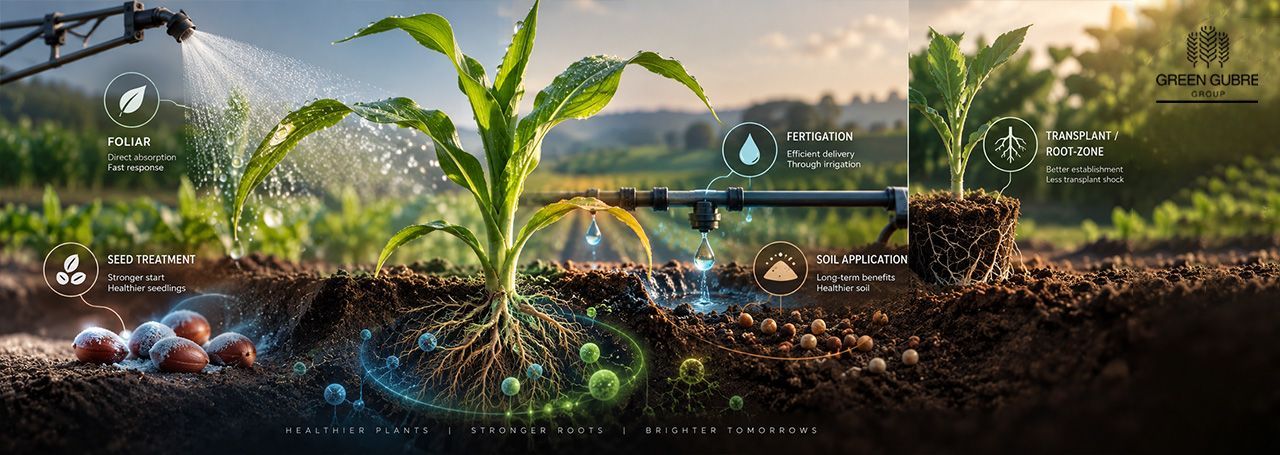
The Main Biostimulant Application Methods
Plant biostimulants can be delivered through several major routes:
Foliar application
The product is sprayed directly onto plant leaves and other above-ground tissues.
Fertigation
The product is introduced through the irrigation system and delivered primarily to the root zone.
Soil application
The product is applied directly to the soil or growing substrate.
Seed treatment
The product is applied to seeds before planting through coating, dressing, priming, soaking, or another compatible treatment.
Transplant or root treatment
Roots, seedlings, plugs, or transplant media are treated before or around transplanting.
Each method has advantages and limitations.
No application method is universally superior.
Foliar Application
Foliar spraying is one of the most common methods of applying plant biostimulants.
The product is diluted according to the manufacturer's instructions and sprayed onto plant surfaces.
Foliar application may be suitable for certain:
- Seaweed extracts
- Protein hydrolysates
- Amino-acid formulations
- Chitosan-based products
- Plant extracts
- Other non-microbial formulations
Some microbial products may also be designed for foliar application, but their biological requirements and product instructions must be considered separately.
Advantages of Foliar Application
One important advantage is operational convenience.
Biostimulants may sometimes be incorporated into existing spray programs when product compatibility and label instructions permit.
Foliar application also allows treatment to be targeted to particular crop stages.
Potential application periods may include:
- Early vegetative growth
- Pre-flowering
- Flowering
- Fruit set
- Fruit development
- Before anticipated abiotic stress
- During moderate stress
- Post-stress recovery
Foliar delivery can therefore provide considerable flexibility.
Factors Affecting Foliar Performance
Spraying a biostimulant onto a crop does not guarantee effective delivery.
Performance can depend on:
- Leaf surface characteristics
- Spray coverage
- Droplet size
- Product concentration
- Water quality
- Solution pH
- Temperature
- Relative humidity
- Wind
- Rainfall after application
- Crop growth stage
- Spray equipment
- Tank-mix partners
Leaf surfaces differ considerably among crops.
Wax layers, leaf hairs, stomatal characteristics, leaf angle, and canopy structure can influence how a spray solution behaves after application.
Product-specific instructions should therefore take priority over generic assumptions about foliar uptake.
Avoiding Excessive Foliar Concentrations
More product does not automatically produce a greater biostimulant response.
Excessive concentration can increase the risk of:
- Leaf injury
- Osmotic stress
- Residue formation
- Poor spray behavior
- Unnecessary treatment cost
Biostimulants can also exhibit dose-dependent responses.
A concentration that is effective under one set of conditions should not automatically be increased in an attempt to obtain a stronger effect.
The manufacturer's validated dose range should normally provide the starting point for commercial application.
Fertigation
Fertigation delivers agricultural inputs through an irrigation system.
For compatible biostimulants, this can be an efficient way to position the product in the active root zone.
Potential candidates may include:
- Humic substances
- Fulvic substances
- Seaweed formulations
- Protein hydrolysates
- Microbial biostimulants
- Other root-targeted products
However, not every product is suitable for fertigation.
The formulation must be compatible with the irrigation system and the other materials present in the nutrient solution.
Why Fertigation Can Be Effective
Roots are responsible for acquiring water and most mineral nutrients.
Delivering an appropriate biostimulant into the active root zone may allow it to interact directly with:
- Roots
- Root hairs
- Rhizosphere microorganisms
- Soil solution
- Nutrient availability processes
This can be particularly relevant when the agronomic objective involves:
- Root development
- Nutrient acquisition
- Nutrient use efficiency
- Rhizosphere activity
- Transplant establishment
Recent research also reinforces an important point: application strategy can materially affect outcomes. A 2026 meta-analysis of seaweed-extract biostimulants found different yield responses among foliar, fertigation, drench, seed-treatment, and combined programs.
That does not prove that fertigation is universally superior.
It demonstrates that the
application method itself can influence field performance.
Fertigation Compatibility
Before injecting a biostimulant into an irrigation system, compatibility should be checked.
Potential problems include:
- Precipitation
- Sediment formation
- Filter blockage
- Emitter clogging
- Changes in solution pH
- Chemical incompatibility
- Reduced microbial viability
Water quality can also matter.
Important parameters may include:
- pH
- Electrical conductivity
- Hardness
- Bicarbonates
- Salinity
- Disinfectants
This becomes especially important with microbial products.
Chlorine, oxidizing disinfectants, incompatible fertilizers, extreme pH, or other chemicals may reduce the viability of microorganisms.
Soil Application and Drenching
Soil-directed applications place the biostimulant directly into or onto the root-zone environment.
Methods can include:
- Soil drenching
- Band application
- In-furrow application
- Incorporation into growing media
- Application around established plants
- Irrigation-assisted root-zone delivery
Soil application may be particularly relevant for products whose intended effects involve the rhizosphere.
These can include certain:
- Microbial biostimulants
- Humic substances
- Seaweed-derived products
- Protein hydrolysates
- Root-promoting formulations
Soil Conditions Can Determine the Response
A root-zone application does not operate independently of the soil environment.
Performance can be influenced by:
- Soil pH
- Temperature
- Moisture
- Salinity
- Texture
- Organic matter
- Aeration
- Nutrient status
- Existing microbial populations
This is particularly important for microbial biostimulants.
A microorganism that performs well under controlled laboratory conditions may respond differently after introduction into a complex field soil.
Successful application therefore requires both an appropriate product and a suitable environment.
Seed Treatment
Seed treatment places a relatively small amount of biostimulant close to the plant at the earliest stage of crop establishment.
Depending on the formulation, methods can include:
- Seed coating
- Seed dressing
- Seed priming
- Soaking
- Pelleting
Potential products may include the following:
- Microbial inoculants
- Seaweed-derived materials
- Chitosan formulations
- Humic substances
- Other seed-compatible biostimulants
The objective may be to influence early processes such as germination, root establishment, seedling development, or early plant–microbe interactions.
Advantages of Seed Treatment
Seed treatment can provide several practical advantages.
Only relatively small quantities of product may be required compared with broad-field applications.
The biostimulant is also positioned directly where the developing root system begins.
This can make seed treatment attractive for large-scale crops where applying a separate foliar or soil treatment later may add operational costs.
However, performance is highly product- and crop-specific.
Seed treatment should not be assumed to outperform other application methods simply because it provides early exposure.
Seed-Treatment Compatibility
Commercial seed may already receive several treatments.
These can include:
- Fungicides
- Insecticides
- Nutrient coatings
- Polymers
- Biological inoculants
- Other seed-treatment products
Compatibility becomes especially important when living microorganisms are involved.
A pesticide applied to the same seed may affect microbial viability.
The sequence of treatment, drying conditions, storage duration, and interval between treatment and planting can also matter.
Product-specific compatibility information should therefore be checked before combining treatments.
Transplant and Root-Dip Applications
Transplanted crops create another opportunity for targeted biostimulant use.
Roots or transplant media may be treated:
- Before transplanting
- During transplanting
- Immediately after transplanting
Potential objectives include:
- Supporting root establishment
- Reducing transplant-related stress
- Encouraging rhizosphere colonization
- Supporting early nutrient acquisition
This strategy can be particularly relevant in horticultural production systems where plants are raised in nurseries before being transferred to the field or greenhouse.
As with other methods, the treatment must be compatible with the crop, formulation, and production system.
Application Timing: Why Crop Stage Matters
The biological condition of a plant changes continuously during its life cycle.
A seedling establishing its root system has different physiological priorities from a crop entering flowering or fruit development.
Biostimulant timing should therefore correspond to the intended agronomic objective.
A useful principle is:
Objective → Crop Stage → Product → Application Method → Timing
Not:
Product → Apply whenever convenient
Application During Germination and Establishment
Early crop development is critical.
Poor establishment can affect the entire production cycle.
Potential biostimulant strategies during this stage include:
- Seed treatment
- In-furrow application
- Root-zone drench
- Transplant treatment
- Early fertigation
The intended objectives may include root development, seedling establishment, nutrient acquisition, or beneficial plant–microbe interactions.
However, early applications should not be used to compensate for poor seed quality, unsuitable planting conditions, inadequate moisture, or severe nutrient deficiencies.
Application During Vegetative Growth
During rapid vegetative growth, demand for water and nutrients can increase substantially.
Depending on the crop and product, biostimulant programs during this stage may target:
- Root development
- Nutrient-use processes
- Canopy development
- Photosynthetic performance
- Preparation for later reproductive growth
Foliar, fertigation, and soil applications may all be appropriate depending on the formulation.
The timing should be linked to crop physiology rather than a generic calendar.
Application Around Flowering and Fruit Set
Flowering and fruit set can be sensitive developmental stages.
Environmental stress, nutritional imbalance, and water limitations during these periods can influence crop performance.
Certain biostimulant programs are designed for application before or during reproductive development.
However, claims involving flowering, fruit set, or yield should be supported by evidence specific to the product and crop.
A response observed in tomatoes should not automatically be assumed to occur in grapes, wheat, citrus, or another crop.
Applying Biostimulants Before Abiotic Stress
One of the most important timing decisions concerns environmental stress.
Abiotic stress can include:
- Drought
- Salinity
- Heat
- Cold
- Waterlogging
- Other unfavorable environmental conditions
Where a stress event is reasonably predictable, an appropriate biostimulant may sometimes be applied before the event.
The objective is to support plant physiological processes before severe damage develops.
This concept is particularly relevant for products intended to support tolerance to abiotic stress—one of the functions recognized for plant biostimulants under the EU fertilizing-products framework.
However, biostimulants should complement—not replace—appropriate irrigation, drainage, salinity management, crop protection, and nutrition.
Application During Stress
Applying a biostimulant while the crop is already under stress requires careful judgment.
Mild or moderate stress is fundamentally different from severe physiological damage.
Under extreme drought, for example, stomatal closure, reduced metabolic activity, impaired nutrient transport, and tissue damage may limit the crop's ability to respond to treatment.
Applying additional products during severe stress may therefore provide limited benefit or, depending on the formulation and concentration, may even increase stress.
The product label and crop condition should guide the decision.
Post-Stress Recovery
After a stress event, plants may need to rebuild:
- Root activity
- Photosynthetic capacity
- Nutrient uptake
- Metabolic activity
- New vegetative growth
Certain biostimulants may be incorporated into recovery programs where appropriate.
But recovery begins with correcting the original constraint.
After drought, restore appropriate water availability.
After waterlogging, address drainage and root-zone oxygen conditions.
After nutrient deficiency, correct the nutrient supply.
After salinity stress, address irrigation-water quality, drainage, and salt management.
A biostimulant can complement recovery management.
It cannot replace it.
Should Biostimulants Be Applied Once or Repeatedly?
There is no universal answer.
Some products are designed for a single strategic application.
Others are intended for multiple treatments during the crop cycle.
The appropriate frequency depends on:
- Product formulation
- Dose
- Crop
- Growth stage
- Application method
- Agronomic objective
- Duration of expected response
- Environmental conditions
Importantly, more applications do not necessarily produce proportionally greater benefits.
Field meta-analyses have shown that biostimulant performance can vary with application frequency and that increasing the number of applications does not necessarily improve yield response.
Repeated applications should therefore have a defined agronomic purpose.
Application Frequency and Economics
Every additional application has a cost.
For example, suppose a treatment costs:
Product: USD 20 per hectare
Application operation: USD 10 per hectare
The total cost of one application is:
USD 30 per hectare
If the crop receives four applications:
USD 30 × 4 = USD 120 per hectare
The fourth application should not be included simply because the product can be applied four times.
It should be included because evidence or field experience indicates that the additional treatment provides sufficient agronomic and economic value.
This is why application frequency should be evaluated alongside return on investment.
Tank-Mixing Biostimulants
Combining a biostimulant with fertilizers or crop-protection products may reduce application costs by avoiding an additional field operation.
However, operational convenience does not guarantee compatibility.
Potential interactions include:
- Precipitation
- Flocculation
- Changes in pH
- Reduced solubility
- Excessive salt concentration
- Loss of microbial viability
- Reduced biological activity
- Phytotoxicity
A small physical compatibility test may help identify visible problems, but it cannot demonstrate biological compatibility.
Always follow the manufacturer's tank-mix recommendations.
Special Considerations for Microbial Biostimulants
Microbial products require a different mindset from many non-microbial formulations.
The active organisms must remain viable.
Factors that may affect viability include:
- Storage temperature
- Shelf life
- Water quality
- Chlorine
- Tank residues
- Pesticides
- Fertilizer concentration
- pH
- UV exposure
- Application temperature
After application, the microorganisms must also encounter conditions that allow them to survive and interact with the plant or rhizosphere.
For this reason, the performance of microbial biostimulants can be especially sensitive to the application method and environmental conditions.
Application Method Should Match the Objective
A simple decision framework can help.
Objective: Early Root Establishment
Consider appropriate:
- Seed treatment
- In-furrow application
- Root dip
- Soil drench
- Early fertigation
Objective: Rhizosphere Interaction
Consider:
- Soil application
- Fertigation
- In-furrow treatment
- Appropriate microbial inoculation
Objective: Rapid Foliar Physiological Response
Consider compatible:
- Foliar seaweed formulations
- Protein hydrolysates
- Amino-acid products
- Chitosan formulations
Objective: Support Before Predictable Abiotic Stress
Consider an evidence-supported product applied at an appropriate pre-stress stage of the crop.
Objective: Post-Stress Recovery
First correct the underlying stress factor, then consider a suitable recovery-oriented treatment.
The correct method ultimately depends on the individual product.
Measuring Which Application Strategy Works
Growers should not assume that the most convenient application method is the most effective.
A field trial can compare application strategies.
For example:
Treatment A: Standard crop-management program
Treatment B: Standard program + foliar biostimulant
Treatment C: Standard program + root-zone application
Treatment D: Standard program + alternative timing
Measurements might include:
- Marketable yield
- Total yield
- Root development
- Nutrient status
- Crop quality
- Stress response
- Treatment cost
- Additional revenue
- Return on investment
This approach allows the grower to evaluate not only whether the product works, but
which application strategy provides the greatest commercial value.
Common Application Mistakes
Applying Without a Defined Objective
A biostimulant should not be added simply because another crop input is already being sprayed.
Assuming More Is Better
Increasing concentration or application frequency does not guarantee a stronger response.
Ignoring Crop Stage
A product intended for root establishment may provide less value when applied after the crop has already completed most root development.
Ignoring Water Quality
Poor-quality water can affect product stability, compatibility, or microbial viability.
Mixing Without Compatibility Testing
Combining fertilizers, pesticides, microorganisms, and biostimulants without checking compatibility can reduce performance or damage the crop.
Applying Too Late
Waiting until severe environmental stress has already caused substantial crop damage may limit the potential benefit of a biostimulant.
Ignoring Application Cost
A biologically effective program may still be commercially unattractive if repeated applications cost more than the value they create.
Building a Professional Biostimulant Application Program
A practical application strategy can follow this sequence:
Diagnose → Define Objective → Select Product → Select Method → Choose Timing → Check Compatibility → Apply → Measure → Evaluate ROI
Diagnose
Identify the crop condition and underlying agronomic constraints.
Define Objective
Determine exactly what the treatment is expected to accomplish.
Select Product
Choose a formulation supported by relevant evidence.
Select Application Method
Determine whether foliar, fertigation, soil, seed, or transplant treatment best matches the intended function.
Choose Timing
Link the application to crop stage, environmental conditions, and the physiological objective.
Check Compatibility
Evaluate water quality, fertilizer combinations, pesticides, and application equipment.
Apply Correctly
Follow the validated dose and application instructions.
Measure
Record crop response, yield, quality, and other relevant parameters.
Evaluate ROI
Compare the additional value generated with the total treatment and application cost.
The Future of Biostimulant Application
Biostimulant application is likely to become increasingly precise.
Future systems may combine biostimulants with:
- Weather forecasting
- Soil-moisture sensors
- Crop-stress models
- Satellite imagery
- Drone monitoring
- Tissue analysis
- Automated fertigation
- Variable-rate application
- Artificial intelligence
Instead of applying a product on a fixed calendar, growers may increasingly apply specific biostimulants when crop and environmental data indicate that a biological response is most likely to add value.
Research is also beginning to provide more detailed evidence about how formulation, extraction technology, application route, and crop conditions influence performance.
This represents an important transition.
The future of biostimulants is unlikely to be defined simply by the discovery of more products.
It will increasingly depend on learning
how to use existing products more precisely.
Conclusion
Successful biostimulant use depends on more than choosing the right product.
Application method and timing can strongly influence the final agronomic response.
Foliar sprays can provide flexible treatment of above-ground plant tissues.
Fertigation and soil applications can target the root zone and rhizosphere.
Seed treatments can position small quantities of biostimulant near the crop during early establishment.
Transplant treatments can provide targeted support during a sensitive transition period.
None of these methods is universally superior.
The correct strategy depends on the product, crop, formulation, environmental conditions, production system, and agronomic objective.
Timing is equally important.
Biostimulants should be linked to specific physiological stages or management objectives rather than applied automatically on a calendar schedule.
For growers, the practical approach is:
- Choose the right product.
- Deliver it to the right place.
- Apply it at the right stage of crop growth.
- Use the correct dose.
- Check compatibility.
- Measure the response.
- Calculate the economic return.
Biostimulants become more valuable when their application moves from routine input use toward
precision agronomic management.
References
- European Parliament and Council (2019). Regulation (EU) 2019/1009 — EU Fertilizing Products Regulation.
- Rouphael, Y. & Colla, G. (2020). Biostimulants in Agriculture. Frontiers in Plant Science, 11, 40.
- Li, J. et al. (2022). A Meta-Analysis of Biostimulant Yield Effectiveness in Field Trials. Frontiers in Plant Science, 13, 836702.
- Moustakas, M. & colleagues (2026). Regulation of Stress Tolerance in Plants by Biostimulants. Frontiers in Plant Science.
- Frontiers in Plant Science (2026). Crop yield responses to seaweed extract-based biostimulants depend on application strategy, formulation, and extraction methods: a meta-analysis.
- Van Oosten, M.J., Pepe, O., De Pascale, S., Silletti, S. & Maggio, A. (2017). The role of biostimulants and bioeffectors in alleviating abiotic stress in crop plants. Chemical and Biological Technologies in Agriculture, 4, 5.
- du Jardin, P. (2015). Plant biostimulants: Definition, concept, main categories and regulation. Scientia Horticulturae, 196, 3–14.