Plant Biostimulant Regulations: EU Compliance and International Market Access
Plant Biostimulant Regulations: EU Compliance and International Market Access
Introduction
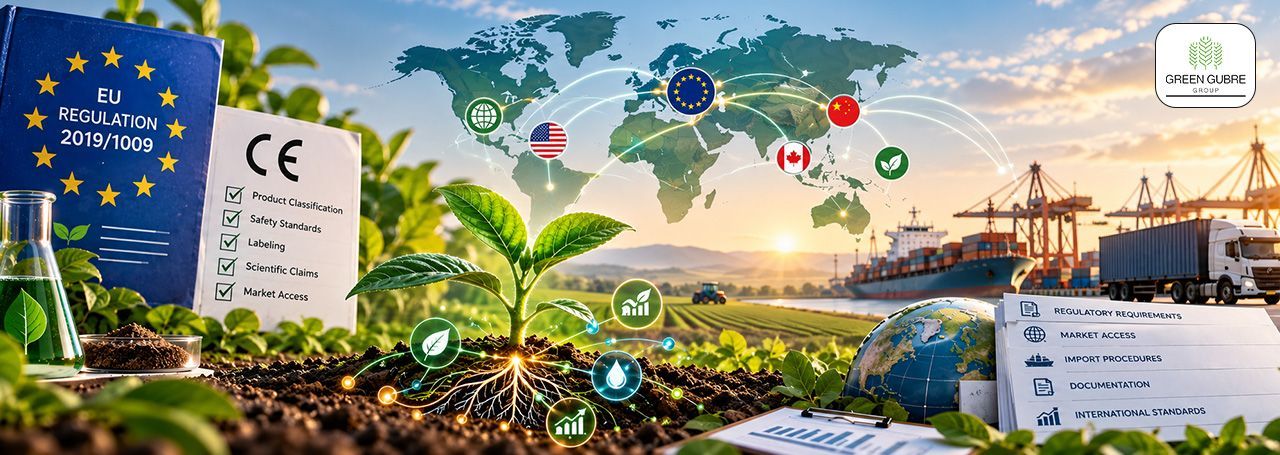
The international plant biostimulant market offers growing opportunities for manufacturers, agricultural distributors, and fertilizer trading companies. However, successful commercialization requires more than an effective formulation.
A plant biostimulant legally marketed in one country may face different regulatory requirements in another.
Markets can vary in product classification, permitted ingredients, safety standards, labeling, scientific claims, and import procedures.
For international businesses, these differences create both regulatory obligations and commercial risks.
A product may have strong field-trial results but still face difficulties if its composition, documentation, or marketing claims don't meet the destination market's requirements.
The European Union has established a harmonized framework through Regulation (EU) 2019/1009, while other jurisdictions apply their own agricultural-input regulations.
Understanding these differences is essential for manufacturers, exporters, importers, and distributors planning to enter international markets.
This guide explains the EU regulatory framework, CE marking, product documentation, and practical steps for evaluating market access for biostimulants.
1. What Makes a Product a Plant Biostimulant?
Plant biostimulants differ from conventional fertilizers and plant protection products.
Conventional fertilizers primarily supply the nutrients plants need for growth.
Plant protection products are regulated according to their intended protective functions, including pest and disease control.
By contrast, plant biostimulants are associated with stimulating plant nutrition processes and improving specific plant or rhizosphere characteristics.
Under the European Union's Regulation (EU) 2019/1009, qualifying plant biostimulants fall within Product Function Category 6 (PFC 6).
Their intended functions concern:
- Nutrient use efficiency
- Tolerance to abiotic stress
- Crop quality traits
- Availability of confined nutrients in the soil or rhizosphere
This classification is important because the intended function and claims influence the regulatory pathway.
For example, a product promoted for improving nutrient use efficiency may qualify as a biostimulant under the relevant framework.
However, claims involving direct pest or disease control may trigger different regulatory requirements.
Product classification must be based on the applicable legal definition, composition, and intended claims—not simply the commercial name printed on the label.
Eur-Lex
2. EU Regulation 2019/1009: The Main Framework
Regulation (EU) 2019/1009 became applicable on 16 July 2022 and established harmonized requirements for qualifying EU fertilizing products.
The regulation organizes products through Product Function Categories (PFCs) and Component Material Categories (CMCs).
For plant biostimulants, the main distinction is between microbial and non-microbial products.
PFC 6(A): Microbial Plant Biostimulants
These products contain microorganisms that must satisfy the applicable requirements for microbial component materials.
Under the harmonized framework, the relevant CMC provisions restrict microbial eligibility.
Therefore, a microorganism's agricultural usefulness does not automatically make it eligible for CE marking as an EU microbial plant biostimulant.
PFC 6(B): Non-Microbial Plant Biostimulants
These products contain non-microbial materials and must satisfy the relevant composition, safety, and other regulatory requirements.
Examples of commercial biostimulant categories that may fall within this group, subject to their actual composition and compliance, include seaweed extracts, protein hydrolysates, and certain humic-substance formulations.
The key requirement is that both the intended function and component materials must meet the applicable framework.
3. CE Marking: What It Means for Biostimulants
CE marking provides a harmonized route for placing qualifying EU fertilizing products on the European market.
However,
CE marking is not a general certificate of product quality or a guarantee of agricultural performance.
It indicates that the manufacturer declares the product conforms to the applicable EU requirements after completing the required conformity-assessment procedure.
For plant biostimulants, the process may involve:
- Verification of product classification
- Assessment of component materials
- Evaluation of applicable safety requirements
- Technical documentation
- Evidence supporting relevant claims
- Appropriate conformity assessment
- EU declaration of conformity
- CE marking and compliant labeling
The required conformity-assessment procedure depends on the product and its component materials.
Where applicable, involvement of a notified body is required.
Is CE Marking Mandatory for Every Biostimulant Sold in the EU?
Not necessarily.
Regulation (EU) 2019/1009 provides a harmonized market-access route for EU fertilizing products.
Other products may be marketed under applicable national frameworks where legally permitted.
Consequently, businesses should determine the appropriate regulatory route before assuming that every biostimulant must follow the same CE-marking procedure.
CE marking facilitates access under the harmonized EU framework, but it does not eliminate the need to verify all applicable product requirements.
4. Product Composition, Safety, and Quality Requirements
A biostimulant cannot qualify under the harmonized EU framework solely because its intended function matches the regulatory definition.
Its component materials must also meet the relevant requirements.
This distinction is particularly important for products containing:
- Microorganisms
- Complex organic extracts
- Processed biological materials
- Multiple functional ingredients
Manufacturers must identify the applicable Component Material Categories and verify that the formulation meets their requirements.
Contaminants and Product Safety
Regulatory compliance may require evaluation of potentially harmful contaminants.
Depending on the product and applicable provisions, these can include:
- Cadmium
- Lead
- Mercury
- Nickel
- Inorganic arsenic
- Hexavalent chromium
- Undesirable microorganisms
The EU framework establishes specific requirements for relevant product categories.
Manufacturers should use appropriate analytical procedures and maintain supporting documentation.
As explained in
Blog 332: Plant Biostimulant Quality Control, product quality and regulatory compliance are related but distinct.
A Certificate of Analysis can demonstrate compliance with specified analytical parameters, but it does not replace the complete regulatory assessment. Eur-Lex
5. Labeling and Scientific Claims
Product labeling is an important part of biostimulant compliance.
Under the EU framework, relevant labeling requirements for PFC 6 include information such as:
- Product identification
- Physical form
- Production and expiry dates
- Application methods
- Claimed effects for target plants
- Relevant instructions affecting efficacy
Additional information may be required depending on the formulation.
For microbial products, specific declarations concerning intentionally added microorganisms and their concentrations apply.
Why Marketing Claims Matter
A claim should describe a function that is legally appropriate for the product and supported by relevant evidence.
For example:
Claim: Improves nutrient use efficiency in a specified crop.
Relevant evidence: Appropriate experiments measuring nutrient-use performance under defined conditions.
A general laboratory analysis or a photograph showing greener plants does not automatically establish the claimed effect.
Ricci et al. (2019) emphasize the importance of relevant measurements and appropriate experimental design.
For manufacturers and distributors, the safest commercial approach is to ensure that marketing claims do not exceed the available scientific evidence.
6. International Regulations: Why Requirements Differ
Although the European Union provides a harmonized framework, plant biostimulant regulation varies worldwide.
Depending on the destination country, a product may be classified as:
- A plant biostimulant
- A fertilizer-related product
- A soil amendment
- A microbial agricultural input
- Another regulated agricultural product
Classification can influence registration procedures, permitted ingredients, labeling, testing, and import authorization.
For example, regulatory approaches in the United States involve federal and state requirements that may differ according to product composition and claims.
Products making pesticidal claims may fall within the scope of the Federal Insecticide, Fungicide, and Rodenticide Act (FIFRA).
Other jurisdictions may regulate biostimulants through fertilizer or agricultural-input legislation.
For international traders, the practical implication is straightforward:
Approval or compliance in one jurisdiction does not automatically authorize commercialization in another.
Importers should verify the destination country's current requirements with the relevant authority before shipment.
7. Essential Documents for International Biostimulant Trade
A well-prepared documentation package can reduce commercial and regulatory uncertainty.
The following documents are commonly relevant, although exact requirements vary by product and destination.
| Document | Main Purpose |
|---|---|
| Technical Data Sheet (TDS) | Describes composition, specifications, and technical characteristics |
| Technical Data Sheet (TDS) | Reports analytical results for specified parameters |
| Safety Data Sheet (SDS) | Provides applicable hazard and safe-handling information |
| Product Label | Communicates required product information and application instructions |
| Certificate of Origin | Documents the declared origin of goods |
| Commercial Invoice | Provides transaction information for trade and customs |
| Packing List | Identifies shipment quantities and packaging |
| Regulatory Documentation | Supports applicable registration, authorization, or conformity requirements |
| Efficacy Evidence | Supports relevant agronomic claims |
Not every document is legally mandatory for every product or shipment.
Additional documentation may also be necessary.
For example, microbial products may require information concerning microorganism identity, concentration, or biological safety.
Verify documentation before commercial shipment, not after the goods arrive at the destination port.
8. A Practical Market-Entry Checklist
Manufacturers, exporters, and distributors can reduce regulatory risk by following a structured market-entry process.
Step 1 — Classify the product. Determine its legal category based on composition, function, and claims.
Step 2 — Verify ingredient eligibility. Confirm that the formulation's components are permitted in the destination market.
Step 3 — Review safety requirements. Identify applicable contaminant limits and other product-specific obligations.
Step 4 — Establish the regulatory pathway. Determine whether registration, notification, conformity assessment, or another authorization is required.
Step 5 — Prepare technical documentation. Compile relevant specifications, analytical results, and supporting information.
Step 6 — Substantiate claims. Ensure that intended marketing claims are supported by appropriate evidence.
Step 7 — Review labeling. Verify language, product declarations, instructions, and warnings.
Step 8 — Confirm import requirements. Check customs classification, permits, and shipment documentation.
Step 9 — Establish traceability. Maintain appropriate batch and distribution records.
Step 10 — Monitor regulatory developments. Review amendments and updated requirements throughout the product's commercial life.
This approach helps companies identify regulatory obstacles before investing in distribution agreements or substantial inventory.
9. Common Regulatory Mistakes to Avoid
Several mistakes can create unnecessary costs and delay market entry.
Assuming One Approval Covers Every Market
Regulatory compliance is jurisdiction-specific.
Confusing Biostimulant and Pesticide Claims
Claims involving pest or disease control may trigger a different legal classification.
Relying Only on a COA
Analytical quality documentation does not replace registration, conformity assessment, or claim substantiation.
Ignoring Microbial Restrictions
Microorganisms permitted under one framework may not qualify under another.
Using the Same Label Worldwide
Different markets may require different languages, declarations, or warnings.
Shipping Before Regulatory Verification
Incomplete authorization or documentation can cause delays, extra costs, or shipment rejection.
For agricultural trading companies, these risks can directly affect profitability and customer relationships.
10. Regulatory Compliance as a Commercial Advantage
Regulatory compliance should not be viewed only as an administrative expense.
It can also strengthen a company's commercial position.
Suppliers that provide clear technical documentation, reliable product specifications, and appropriate regulatory evidence may give international distributors greater confidence.
Similarly, importers that establish regulatory procedures before purchasing can reduce uncertainty concerning product eligibility and market access.
A supplier's ability to support the required documentation can therefore become an important procurement criterion.
For international agricultural businesses, regulatory readiness contributes to:
- Lower transaction risk
- More predictable market entry
- Stronger supplier evaluation
- Better customer confidence
- Improved distribution planning
- Long-term commercial reliability
The objective is not simply to obtain documents.
The goal is to establish a product and supply chain that meet the intended market's requirements.
Conclusion
Plant biostimulant regulations play an increasingly important role in international agricultural trade.
The European Union's Regulation (EU) 2019/1009 provides a harmonized framework for qualifying EU fertilizing products, including microbial and non-microbial plant biostimulants.
However, you must consider product classification, component and material eligibility, safety, labeling, conformity assessment, and scientific claims.
Outside the European Union, regulatory requirements vary among jurisdictions.
For manufacturers, exporters, importers, and distributors, successful market entry therefore requires a structured approach combining technical documentation, product quality, regulatory verification, and credible efficacy evidence.
The most reliable international biostimulant strategy is to confirm regulatory eligibility before commercialization—not after a shipment or distribution agreement has already been finalized.
References
- European Parliament and Council (2019). Regulation (EU) 2019/1009 — EU Fertilizing Products Regulation.
- European Commission. Fertilizing Products — EU Regulatory Framework.
- United States Environmental Protection Agency. Federal Insecticide, Fungicide, and Rodenticide Act (FIFRA).
- Ricci, M., Tilbury, L., Daridon, B. & Sukalac, K. (2019). General Principles to Justify Plant Biostimulant Claims. Frontiers in Plant Science, 10, 494.
- du Jardin, P. (2015). Plant Biostimulants: Definition, Concept, Main Categories and Regulation. Scientia Horticulturae, 196, 3–14.