Why Plant Biostimulants Work Differently Across Crops, Soils, and Climates
Why Plant Biostimulants Work Differently Across Crops, Soils, and Climates
Introduction
One of the most important questions surrounding plant biostimulants is also one of the most misunderstood:
Why can the same biostimulant produce strong results in one field but a smaller, or even negligible, response elsewhere?
This variability is sometimes interpreted as evidence that a product either "works" or "does not work."
Agricultural biology is rarely that simple.
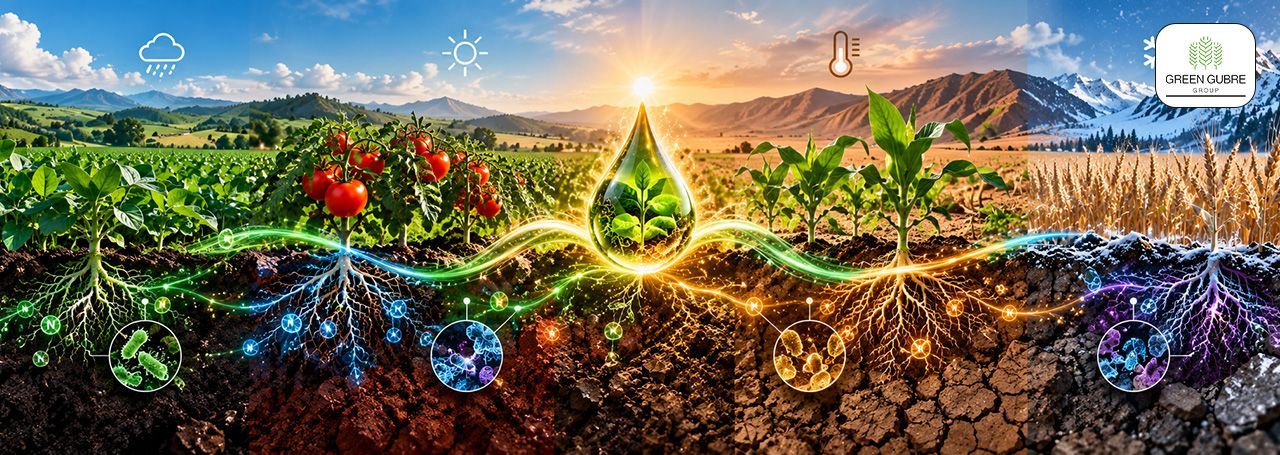
Plant biostimulants operate within a complex system involving:
- The crop
- Crop variety
- Soil
- Roots
- Soil microorganisms
- Weather
- Water availability
- Nutrient status
- Environmental stress
- Application method
- Application timing
- Product formulation
- Farm-management practices
Changing any of these factors can influence the final crop response.
Large-scale field-trial analyses have confirmed this variability. Biostimulant performance varies by crop type, climate, soil characteristics, product category, and application method.
This does not mean that biostimulants are inherently unreliable.
It means their performance is
context-dependent.
Understanding that context is essential for growers, agronomists, distributors, and agricultural businesses that want to move beyond generalized product claims and toward evidence-based biostimulant use.
Biostimulants Operate Inside a Biological System
A conventional nutrient fertilizer can often be described largely by how much nutrient it supplies.
For example, a nitrogen fertilizer supplies a measurable quantity of nitrogen.
Biostimulants are different.
Their primary function is not simply to supply a large quantity of mineral nutrients.
Under the European Union fertilizing-products framework, a plant biostimulant stimulates plant nutrition processes independently of the product's nutrient content, with the aim of improving one or more characteristics related to:
- Nutrient use efficiency
- Tolerance to abiotic stress
- Crop quality traits
- Availability of confined nutrients in the soil or rhizosphere
These functions depend heavily on biological interactions.
The same product can therefore encounter very different biological environments in different fields.
The Same Product Does Not Enter the Same System Twice
Consider two farms using the same biostimulant.
Farm A may have:
- Sandy soil
- Low organic matter
- Moderate nutrient deficiency
- Limited rainfall
- High summer temperatures
Farm B may have:
- Clay soil
- High organic matter
- Adequate fertility
- Regular rainfall
- Moderate temperatures
Even if both farms use the same product at the same application rate, the biological context differs.
Crop response depends on more than what is in the bottle.
It also depends on what happens after the product enters the crop–soil–environment system.
Soil Is One of the Major Sources of Variability
Soil conditions can strongly influence biostimulant performance.
Important soil properties include:
- Texture
- pH
- Organic matter
- Salinity
- Nutrient availability
- Water-holding capacity
- Aeration
- Biological activity
A major meta-analysis of open-field biostimulant trials found yield responses differed by soil properties.
In that analysis, stronger average responses were observed under several challenging soil conditions, including soils characterized by low organic matter, nutrient limitations, salinity, non-neutral pH, or sandy texture.
This should not be interpreted as a guarantee that biostimulants always perform better in poor soils.
Instead, it suggests an important principle:
Soil starting conditions can influence the opportunity for a biostimulant response.
Soil Texture Changes the Root Environment
Sandy and clay soils behave very differently.
Sandy soils generally have:
- Larger pores
- Faster drainage
- Lower water-holding capacity
- Greater potential for nutrient leaching
Clay-rich soils may have:
- Greater water retention
- Different nutrient-retention characteristics
- Lower aeration under some conditions
- Different root penetration patterns
These differences influence the environment in which roots and rhizosphere microorganisms operate.
A root-targeted biostimulant may therefore interact with fundamentally different physical conditions depending on soil texture.
Soil pH Can Influence the Response
Soil pH affects many processes relevant to plant nutrition.
It can influence:
- Nutrient solubility
- Nutrient availability
- Microbial activity
- Root function
- Chemical reactions in the rhizosphere
A biostimulant intended to improve nutrient acquisition may therefore produce different responses depending on the initial soil pH and which nutrients are limiting.
For example, improving root activity does not necessarily solve a nutrient constraint if the nutrient remains chemically unavailable.
Biostimulants should therefore be integrated with soil diagnosis rather than used as a substitute for it.
Organic Matter Matters
Soil organic matter influences:
- Soil structure
- Water retention
- Cation exchange
- Nutrient cycling
- Microbial activity
Fields with low organic matter may present different biological and nutritional constraints from soils with high organic matter.
The 2022 field-trial meta-analysis found stronger average biostimulant responses under lower soil organic-matter conditions.
Again, this is a population-level observation—not a universal recommendation.
The practical lesson is to record
baseline soil conditions when evaluating product performance.
Salinity Can Change the Opportunity for Response
Salinity creates several problems for plants.
These can include:
- Osmotic stress
- Ion imbalance
- Reduced water uptake
- Nutritional disturbances
- Oxidative stress
Some biostimulants are specifically investigated or marketed for supporting plant performance under abiotic stress.
A product may therefore show a stronger measurable response when the crop is exposed to an appropriate level of stress than when conditions are already near optimal.
But there is an important limitation.
A biostimulant should not be expected to make severe salinity irrelevant.
Salinity management may still require:
- Appropriate irrigation
- Drainage
- Water-quality management
- Soil amendments where appropriate
- Suitable crop selection
- Nutrient management
Biostimulants can complement good agronomy.
They do not repeal the physical and chemical limitations.
Climate Is Another Major Driver
Biostimulant performance can also vary among climates.
Important environmental variables include:
- Temperature
- Rainfall
- Humidity
- Solar radiation
- Evapotranspiration
- Frequency of extreme events
The field-trial meta-analysis reported different average yield responses among climatic environments, with particularly notable responses under arid conditions.
This makes biological sense because water limitation and other abiotic stresses can create opportunities for measurable physiological responses in some biostimulant functions.
However, climate should not be interpreted using simplistic rules.
The relationship between stress and biostimulant performance is not necessarily linear.
Stress Can Create an Opportunity for a Response
Imagine a crop growing under nearly ideal conditions.
It has:
- Adequate water
- Balanced nutrition
- Favorable temperature
- Healthy roots
- Low environmental stress
There may be less opportunity for an additional treatment to generate a large measurable improvement.
Now consider the same crop experiencing moderate drought or nutrient stress.
If an appropriate biostimulant supports physiological processes relevant to that stress, the difference between treated and untreated plants may become more visible.
This concept helps explain why biostimulant responses can sometimes be greater under suboptimal conditions.
But More Stress Does Not Always Mean a Bigger Response
This is an important distinction.
If moderate stress can trigger a biostimulant response, it may be tempting to assume severe stress will trigger an even larger response.
That is not necessarily true.
Extreme stress can cause:
- Severe tissue damage
- Root mortality
- Stomatal closure
- Loss of photosynthetic capacity
- Major metabolic disruption
- Reproductive failure
Once damage becomes severe, a biostimulant may have limited ability to restore lost yield potential.
The relationship may therefore look more like:
Low stress → limited opportunity for response
Moderate stress → potentially greater opportunity
Severe stress → biological damage may overwhelm the treatment
This is one reason application timing matters.
Weather During Application Matters Too
Climate affects more than the general growing environment.
Weather conditions at the time of application can influence delivery.
For foliar applications, relevant factors may include:
- Temperature
- Relative humidity
- Wind
- Rainfall
- Leaf wetness
- Solar radiation
A foliar application immediately followed by heavy rainfall may behave differently from one applied under conditions that allow adequate contact with the leaf.
High temperatures or intense sunlight may also influence crop response or product stability.
The same product and dose can therefore produce different outcomes depending on the application window.
Crop Species Influence Biostimulant Performance
Different crops have different:
- Root architectures
- Nutrient requirements
- Growth cycles
- Leaf structures
- Stress sensitivities
- Physiological responses
- Rhizosphere interactions
A product that performs well in tomato should not automatically be expected to produce the same response in wheat.
Likewise, evidence from maize cannot automatically establish performance in citrus.
Meta-analysis of field trials has identified crop type as an important factor influencing average biostimulant response.
For this reason, product recommendations should be supported by evidence relevant to the intended crop or an appropriately justified crop grouping.
Crop Variety Can Matter
Variation can exist even within the same crop species.
Different cultivars may vary in:
- Root architecture
- Nutrient acquisition
- Stress tolerance
- Growth rate
- Phenology
- Yield potential
Plant genetics can therefore interact with biostimulant performance.
This does not mean that every product requires completely independent evidence for every cultivar.
But it does mean crop genetics can contribute to variability and shouldn't be ignored when interpreting inconsistent trial results.
Crop Growth Stage Changes the Biological Context
A plant at the seedling stage is physiologically different from the same plant during flowering or grain filling.
At different growth stages, the crop changes its allocation of:
- Carbon
- Nutrients
- Water
- Hormonal signals
- Root growth
- Reproductive resources
The same biostimulant applied at two different stages may therefore produce different outcomes.
This is why application timing should align with a defined objective.
For example:
Early establishment
Potential focus: root development and establishment.
Vegetative growth
Potential focus: nutrient acquisition and canopy development.
Pre-stress period
Potential focus: preparation for anticipated abiotic stress.
Reproductive development
Potential focus: crop-specific quality or physiological objectives where supported by evidence.
Timing should follow crop physiology—not simply a convenient calendar date.
Nutrient Status Can Change the Response
Biostimulants and fertilizers perform different functions.
If a crop is severely deficient in an essential nutrient, a biostimulant cannot manufacture that nutrient.
Suppose nitrogen supply is inadequate.
Improving root activity or nutrient-use processes may optimize the use of available nitrogen, but it cannot provide unlimited nitrogen when the system lacks it.
At the other extreme, a crop with a fully optimized nutrient supply may respond less to a product targeting nutrient acquisition.
Baseline fertility therefore matters.
Deficiency and Efficiency Are Not the Same Thing
This distinction is essential.
Nutrient deficiency means the crop lacks sufficient access to a required nutrient.
Nutrient use efficiency concerns how effectively nutrient resources are converted into plant or crop outcomes.
A biostimulant may influence nutrient-use processes.
But correcting a genuine nutrient deficiency may still require appropriate fertilizer management.
Confusing these concepts can lead to unrealistic expectations.
Fertilizer Programs Can Influence Biostimulant Results
Suppose two trials evaluate the same biostimulant.
Trial A uses a moderate fertilizer program.
Trial B uses a very high nutrient input.
The crop's response to the biostimulant may differ because nutrient availability and physiological constraints differ.
Similarly, reducing fertilizer while simultaneously adding a biostimulant changes two variables.
If yield changes, it becomes harder to determine which factor drove the response.
Biostimulant trials should therefore document the fertilizer program carefully.
Water Management Can Influence Performance
Water availability affects nearly every aspect of plant growth.
It influences:
- Nutrient transport
- Root growth
- Photosynthesis
- Stomatal behavior
- Microbial activity
- Fertilizer movement
- Soil chemistry
Two farms using the same biostimulant may obtain different results simply because irrigation management differs.
This is especially relevant for products targeting:
- Drought tolerance
- Nutrient uptake
- Root development
- Rhizosphere activity
Irrigation should therefore be considered part of the treatment environment.
Application Method Can Change the Result
As discussed in Blog 328, biostimulants may be applied through:
- Foliar spray
- Fertigation
- Soil application
- Seed treatment
- Root or transplant treatment
Application route determines where the product first interacts with the crop system.
A root-targeted product delivered to the rhizosphere encounters a very different environment from the same or another formulation sprayed onto a leaf surface.
Field-trial meta-analyses show that application method can influence observed yield response.
This means that a product should not simply be evaluated by asking:
What is in it?
We should also ask:
How was it delivered?
Application Rate Matters
Biostimulants are biologically active products.
Their response isn't necessarily proportional to the dose.
If a recommended dose produces a response, doubling the dose does not mean the response will double.
Depending on the formulation, excessive application may:
- Provide no additional benefit
- Increase treatment cost
- Increase salt concentration
- Increase phytotoxicity risk
- Alter physiological responses
Dose-response testing is therefore an important part of product development.
Commercial growers should generally begin with validated manufacturer recommendations rather than assuming that more product is better.
Application Frequency Matters
The number of applications can also influence performance.
A product may be designed for:
- One strategic application
- Several applications at specific growth stages
- Repeated use through fertigation
Increasing application frequency without evidence can increase cost without improving crop response.
Frequency should therefore be connected to:
- Product formulation
- Crop stage
- Duration of response
- Agronomic objective
- Economic return
Product Formulation Can Be as Important as the Active Material
Two products may both be described as "seaweed extract" or "protein hydrolysate," yet behave differently.
Why?
Because formulation matters.
Products can differ in:
- Raw material
- Extraction process
- Molecular composition
- Concentration
- Stabilizers
- Carrier materials
- pH
- Solubility
- Shelf stability
The category name alone cannot fully predict field performance.
That is why evidence from one commercial formulation shouldn't automatically transfer to every other product in the same category.
Raw-Material Source Can Matter
Consider seaweed extracts.
Products may come from different seaweed species and be processed with different extraction technologies.
Likewise, protein hydrolysates can originate from different protein sources and hydrolysis processes.
Humic products may differ in source and chemical characteristics.
These differences can alter the final composition.
Therefore:
"Seaweed biostimulant" is a category—not a complete product specification.
The same principle applies to other biostimulant categories.
Storage Can Influence Product Performance
A good formulation can still perform poorly if stored incorrectly.
Relevant factors may include:
- Temperature
- Direct sunlight
- Freezing
- Excessive heat
- Moisture
- Storage duration
- Container integrity
This is especially important for microbial products because viability can decline under unsuitable storage conditions.
A field failure may therefore originate before the product ever reaches the field.
Microbial Biostimulants Add Another Layer of Complexity
Microbial products depend on living organisms.
For a microbial biostimulant to perform successfully, several steps may need to occur.
The microorganism must:
Remain viable during storage → Survive mixing → Survive application → Reach the appropriate environment → Establish or persist sufficiently → Interact with the plant or rhizosphere → Express the relevant biological function
Failure at any stage can reduce field performance.
This helps explain why microbial products can show particularly complex environment-dependent responses.
The Native Soil Microbiome Matters
Agricultural soils already contain enormous microbial communities.
An introduced microorganism does not enter an empty environment.
It enters an ecosystem containing:
- Bacteria
- Fungi
- Archaea
- Protozoa
- Other microorganisms
These organisms compete and interact for:
- Space
- Carbon
- Nutrients
- Root exudates
The introduced microorganism must function within this ecological network.
Differences in native microbial communities can therefore contribute to variation in microbial biostimulant performance.
Pesticides Can Influence Microbial Performance
A microbial biostimulant may also interact with crop-protection programs.
Certain:
- Fungicides
- Bactericides
- Insecticides
- Seed treatments
may influence microbial survival or activity depending on the active ingredient, formulation, dose, microorganism, and exposure period.
This is why compatibility was an important part of Blog 329.
A microbial product that performs well on its own may behave differently when added to a complex crop-protection program.
Tank-Mix Conditions Can Create Hidden Variability
Even non-microbial products can be influenced by tank-mix conditions.
Relevant factors include:
- Water pH
- Water hardness
- Fertilizer concentration
- Pesticides
- Adjuvants
- Mixing sequence
- Holding time
Two farms may believe they are applying the same biostimulant program while actually exposing the product to very different tank environments.
Application records should therefore include the complete mixture where possible.
Management Quality Matters
A biostimulant cannot compensate for every agronomic problem.
Poor crop performance caused by:
- Severe nutrient deficiency
- Incorrect irrigation
- Soil compaction
- Poor drainage
- Uncontrolled disease
- Severe weed competition
- Unsuitable planting date
should be addressed directly.
Biostimulants work best as part of an integrated crop-management system.
They should not replace basic agronomy.
The Limiting-Factor Principle
Imagine that crop performance is being severely limited by water.
Adding a product that targets nutrient acquisition may add little value if the crop remains critically water-stressed.
Likewise, improving root physiology may not rescue a crop suffering severe uncontrolled disease.
This leads to a useful decision rule:
Identify the primary limiting factor before selecting the biostimulant strategy.
The product should address a relevant biological opportunity rather than simply add another input to the program.
Why Greenhouse Results May Not Fully Translate to the Field
Controlled-environment experiments are extremely valuable.
Researchers can control:
- Temperature
- Irrigation
- Nutrient supply
- Growing medium
- Stress intensity
This helps identify mechanisms and compare treatments.
But field conditions introduce additional variability.
The field contains:
- Variable soils
- Weather fluctuations
- Complex microbiomes
- Pest pressure
- Management interactions
- Uneven water distribution
A strong greenhouse response therefore provides useful evidence but does not automatically guarantee identical commercial field performance.
Field validation remains important.
Why One Positive Field Trial Is Not Enough
Suppose a product increases yield by 15% in one field.
That is encouraging.
But several questions remain:
- Was the trial replicated?
- What were the soil conditions?
- Was the season unusually stressful?
- What crop variety was used?
- Was the response statistically and agronomically meaningful?
- Did the response occur elsewhere?
- Was the treatment economically profitable?
One positive trial provides evidence.
It does not establish universal performance.
Average Response Is Not a Guarantee
Meta-analysis is useful because it combines evidence across many studies.
But growers should interpret average responses correctly.
If a meta-analysis reports an average yield increase, it does
not mean every grower should expect that exact increase.
An average summarizes a distribution of responses.
Individual results can be:
- Higher
- Lower
- Neutral
- Occasionally negative
Meta-analysis is valuable partly because it identifies factors associated with this variation.
A Product Should Have an Agronomic "Use Window"
Instead of asking manufacturers to promise the same response everywhere, a more useful approach is to identify the conditions where a product is most likely to create value.
A professional recommendation might define:
Suitable crops
Target growth stages
Relevant soil conditions
Target stress conditions
Application method
Dose range
Application frequency
Known incompatibilities
Expected agronomic response
Conditions where performance may be limited
This creates an agronomic
use window.
The narrower and better understood that window becomes, the more precise the recommendation can be.
Consistency Is More Valuable Than the Largest Single Result
Consider two hypothetical products.
Product A
Field responses: +30%, +2%, −4%, +18%, 0%
Product B
Field responses: +8%, +7%, +9%, +6%, +8%
Product A produces the largest single response.
But Product B appears more consistent in this hypothetical example.
Which is more commercially valuable?
The answer depends on:
- Treatment cost
- Crop value
- Risk tolerance
- Target conditions
- Frequency of positive response
This shows why maximum yield increase shouldn't be the only metric for evaluating a biostimulant.
Response Probability Is a Better Commercial Question
Instead of asking:
"How much can this product increase yield?"
a more useful question may be:
"Under these specific conditions, how likely is this product to produce an economically meaningful response?"
That changes the decision framework.
The focus shifts from the maximum possible response to:
- Probability
- Consistency
- Target conditions
- Cost
- Risk
- Return
This more closely matches how professionals evaluate agricultural inputs.
Understanding Non-Response
When a biostimulant trial shows no measurable benefit, investigate the result rather than dismiss it.
Possible explanations include:
- The crop was already operating near its attainable performance
- The target stress was absent
- Soil conditions were unsuitable
- The application timing was incorrect
- The dose was inappropriate
- The product was stored incorrectly
- The product was incompatible with another input
- A microbial organism failed to establish
- Another agronomic factor became limiting
- Natural field variability masked a small response
- The product was simply ineffective under those conditions
The final possibility is important.
Not every unsuccessful trial requires a complicated biological explanation.
Sometimes a product simply does not create meaningful value in a particular situation.
Avoid Explaining Away Every Negative Result
Scientific evaluation requires accepting neutral and negative results.
If you attribute every positive result to the product but blame every negative result on weather, soil, application, or the farmer, the evaluation becomes biased.
A credible biostimulant program should define:
- Where the product works
- Where evidence is uncertain
- Where it has not worked
- What conditions influence performance
Transparency improves recommendations.
How Growers Can Reduce Performance Variability
Variability cannot be eliminated completely.
But it can be managed.
A practical approach includes:
Diagnose the Field
Test soil, evaluate crop nutrition, and identify major constraints.
Define the Objective
Determine exactly why the biostimulant is being applied.
Match the Product to the Objective
Select a product with evidence relevant to the intended function.
Follow the Validated Dose
Avoid arbitrary dose increases.
Choose the Correct Application Method
Match delivery to the product and target.
Apply at the Appropriate Growth Stage
Timing should reflect crop physiology and expected stress.
Check Compatibility
Consider fertilizers, pesticides, water quality, and other tank-mix components.
Record Environmental Conditions
Document weather, irrigation, and stress events.
Measure the Response
Use control treatments and quantitative measurements.
Calculate ROI
Determine whether the response creates commercial value.
How Suppliers Can Improve Product Reliability
Biostimulant suppliers also have responsibilities.
Strong technical support should provide more than a product label and a maximum yield claim.
Useful technical information includes:
- Product composition
- Target crops
- Target conditions
- Application method
- Dose
- Timing
- Compatibility
- Storage requirements
- Trial evidence
- Expected response range
- Known limitations
Where performance varies substantially with soil, temperature, crop, or another parameter, include those factors in the recommendation.
This approach aligns with scientific guidance for justifying plant biostimulant claims.
From Universal Claims to Conditional Recommendations
Weak recommendation:
"This biostimulant increases crop yield."
Better recommendation:
"Field trials indicate that this product can support marketable yield under the specified crops, application program, and production conditions."
Even better:
"Evidence indicates the strongest probability of response under defined soil, crop, stress, and application conditions, while responses under other conditions are less certain."
The more precisely you define a product's performance environment, the more useful the recommendation becomes.
The Economics of Variability
Performance variability has direct economic consequences.
Suppose a treatment costs:
USD 70 per hectare
If it generates an additional margin of:
USD 200 per hectare
in eight out of ten comparable situations, the commercial proposition may be attractive.
But if it generates the same additional margin in only two out of ten situations, the risk profile changes significantly.
This is why ROI should eventually be evaluated alongside
response frequency and
consistency.
Average ROI alone may hide variability.
Risk-Adjusted Biostimulant Decisions
A professional grower may therefore consider:
- Expected additional revenue
- Treatment cost
- Probability of response
- Magnitude of response
- Downside risk
- Crop value
- Environmental conditions
This moves biostimulant management toward risk-adjusted decision-making.
High-value horticultural crops may justify a different treatment strategy from low-margin commodity crops.
The economic threshold varies by production system.
Building a Biostimulant Response Database
Growers, distributors, and manufacturers can improve recommendations by systematically recording results.
Useful fields include:
- Product
- Batch
- Crop
- Variety
- Location
- Soil type
- Soil pH
- Organic matter
- Salinity
- Nutrient status
- Fertilizer program
- Irrigation
- Application method
- Dose
- Timing
- Weather
- Stress conditions
- Yield response
- Quality response
- Treatment cost
- ROI
Over time, this information can reveal patterns that individual trials cannot.
The question can evolve from:
"Did it work?"
to:
"Under which combinations of crop, soil, climate, and management does it work most consistently?"
Precision Agriculture Can Improve Biostimulant Targeting
Future biostimulant programs may increasingly integrate:
- Soil mapping
- Weather forecasting
- Satellite imagery
- Drone imaging
- Crop sensors
- Tissue analysis
- Soil-moisture sensors
- Yield maps
- Variable-rate technology
- Artificial intelligence
These technologies may help identify areas where a biostimulant response is more likely.
Instead of applying the same program uniformly across every field, future systems may target treatments according to actual crop and soil conditions.
Predictive Biostimulant Management
The long-term goal could be a predictive system.
Imagine a platform that knows:
- Crop variety
- Growth stage
- Soil properties
- Nutrient status
- Irrigation history
- Weather forecast
- Previous field responses
- Product characteristics
The system could estimate whether a particular biostimulant treatment has a sufficiently high probability of generating economic value.
This would represent a major shift:
From product-based agriculture to condition-based biostimulant management.
The Future Is Not "Does It Work?"
The biostimulant industry is gradually moving beyond a simple debate about whether biostimulants work.
A more mature question is emerging:
Which product works, for which crop, under which soil and environmental conditions, at what dose and timing, and with what probability of economic return?
That question is harder.
But it is also much more useful.
Advances in field experimentation, product characterization, soil science, microbiome research, precision agriculture, and data analytics should gradually make these recommendations more precise.
Conclusion
Plant biostimulants do not operate in isolation.
Their performance emerges from interactions among:
Product × Crop × Soil × Climate × Stress × Nutrition × Application × Management
This explains why the same product can generate different results across fields and seasons.
Soil texture, pH, organic matter, salinity, climate, crop genetics, nutrient status, irrigation, application method, dose, timing, formulation, storage, and management can all influence the final response.
For microbial biostimulants, another layer is added: the organism must remain viable, reach the appropriate environment, interact successfully with the existing microbiome, and express its biological function.
The correct response to this variability is not to dismiss biostimulants.
Nor should we ignore negative results.
The right response is to use biostimulants more precisely.
Growers should diagnose conditions, define the objective, select the appropriate product, apply it correctly, measure the response, and calculate economic return.
Manufacturers and suppliers should identify the conditions under which their products perform most consistently and communicate limitations transparently.
The future of biostimulants will therefore depend less on universal promises and more on
conditional, evidence-based recommendations.
The most valuable question is no longer:
"Does this biostimulant work?"
It is:
"Where, when, why, and under which conditions is this biostimulant most likely to create measurable and economically valuable results?"
References
- Li, J., Van Gerrewey, T. & Geelen, D. (2022). A Meta-Analysis of Biostimulant Yield Effectiveness in Field Trials. Frontiers in Plant Science, 13, 836702.
- Ricci, M., Tilbury, L., Daridon, B., & Sukalac, K. (2019). General Principles to Justify Plant Biostimulant Claims. Frontiers in Plant Science, 10, 494.
- European Parliament and Council (2019). Regulation (EU) 2019/1009 — EU Fertilizing Products Regulation.
- du Jardin, P. (2015). Plant Biostimulants: Definition, Concept, Main Categories and Regulation. Scientia Horticulturae, 196, 3–14.
- Rouphael, Y. & Colla, G. (2020). Biostimulants in Agriculture. Frontiers in Plant Science, 11, 40.
- Van Oosten, M.J., Pepe, O., De Pascale, S., Silletti, S. & Maggio, A. (2017). The Role of Biostimulants and Bioeffectors in Alleviating Abiotic Stress in Crop Plants. Chemical and Biological Technologies in Agriculture, 4, 5.