Sulfur-Coated Urea (SCU): A Controlled-Release Nitrogen Fertilizer for Improved Nutrient Efficiency
Sulfur-Coated Urea (SCU): A Controlled-Release Nitrogen Fertilizer for Improved Nutrient Efficiency
Introduction: Improving Nitrogen Management in Modern Agriculture
Nitrogen is one of the most important nutrients for crop production. It plays a central role in plant growth, chlorophyll formation, protein synthesis, and yield development. Among nitrogen fertilizers, urea is the most widely used source because of its high nitrogen concentration, global availability, and cost efficiency.
However, conventional urea has a major limitation: it dissolves rapidly after application. Under certain environmental conditions, nitrogen can be lost before crops can absorb it efficiently.
Common nitrogen loss pathways include:
- Ammonia volatilization
- Nitrate leaching
- Denitrification
- Surface runoff
These losses reduce fertilizer efficiency, increase production costs, and may contribute to environmental challenges such as air pollution, groundwater contamination, and greenhouse gas emissions.
To improve nitrogen use efficiency, fertilizer manufacturers have developed enhanced-efficiency fertilizer technologies. One of the earliest and most widely recognized technologies is
Sulfur-Coated Urea (SCU).
Sulfur-Coated Urea combines the high nitrogen content of urea with a protective sulfur coating that slows nutrient release. This allows nitrogen availability to better match crop demand while providing sulfur as an additional plant nutrient.
Today, SCU is used in various agricultural systems, including turf management, horticulture, landscaping, plantations, nurseries, and selected field-crop applications.
What Is Sulfur-Coated Urea (SCU)?
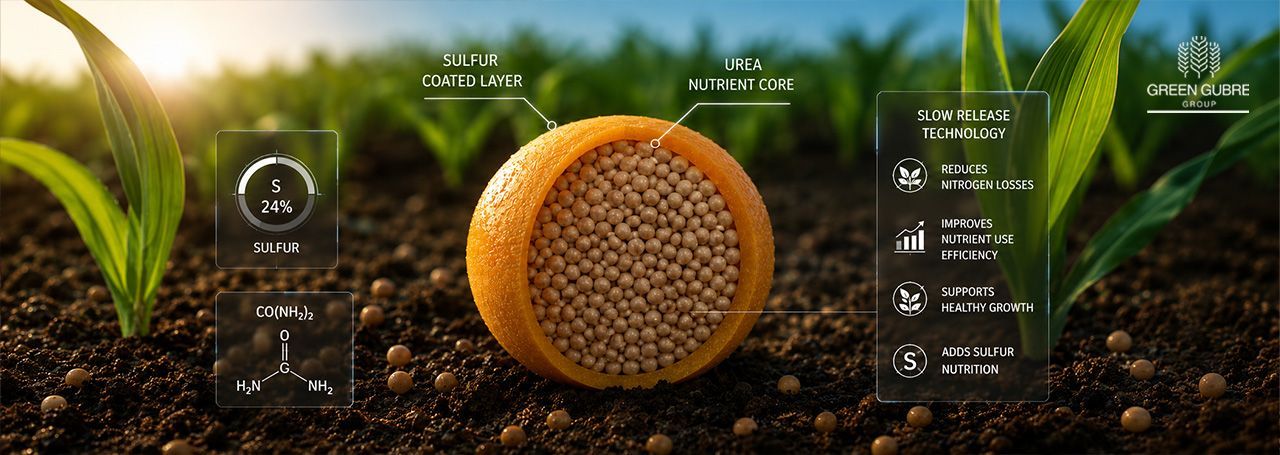
Sulfur-Coated Urea (SCU) is a controlled-release nitrogen fertilizer made by coating urea granules with elemental sulfur.
The basic structure consists of:
| Component | Function |
|---|---|
| Urea core | Provides nitrogen nutrition |
| Sulfur coating | Delays water penetration and nitrogen release |
| Sealant layer (optional) | Improves coating durability and release control |
The sulfur coating acts as a physical barrier between the urea granule and soil moisture. Instead of dissolving immediately like conventional urea, the coated granule releases nitrogen gradually as water penetrates the coating and the sulfur layer breaks down.
In addition to nitrogen, SCU supplies sulfur, which is an essential secondary nutrient required for:
- Protein synthesis
- Enzyme activity
- Oil production in crops
- Nitrogen metabolism
- Chlorophyll formation
Sulfur-coated urea is therefore considered a dual-nutrient fertilizer technology, providing both nitrogen and sulfur.
Why Nitrogen Efficiency Matters
Although nitrogen fertilizers are essential for high agricultural productivity, not all applied nitrogen is recovered by crops.
The efficiency of nitrogen use depends on several factors:
- Fertilizer type
- Application timing
- Soil conditions
- Weather conditions
- Crop demand
- Irrigation management
When nitrogen release occurs faster than plant uptake, excess nitrogen becomes vulnerable to loss.
Major Nitrogen Loss Pathways
| Nitrogen Loss Pathway | Main Cause | Impact |
|---|---|---|
| Ammonia volatilization | Warm temperatures, surface application, alkaline soils | Nitrogen loss to atmosphere |
| Nitrate leaching | Heavy rainfall, irrigation, sandy soils | Reduced nutrient availability and groundwater risk |
| Denitrification | Waterlogged soils | Nitrogen loss as gaseous compounds |
| Runoff | Poor nutrient management | Nutrient movement into waterways |
Improving nitrogen use efficiency (NUE) is therefore a major objective of modern fertilizer management.
According to the Food and Agriculture Organization (FAO), improving nutrient-use efficiency is essential for increasing agricultural productivity while reducing environmental impacts.
How Sulfur-Coated Urea Works
The main purpose of SCU is to slow nitrogen release and improve synchronization between fertilizer availability and crop demand.
The release process occurs in several stages:
1. Water Penetration
After application, soil moisture gradually penetrates the sulfur coating through:
- Small pores
- Natural cracks
- Coating imperfections
2. Urea Dissolution
Once water reaches the urea core, the fertilizer dissolves and forms a concentrated nitrogen solution inside the coating.
3. Gradual Nitrogen Release
The dissolved nitrogen slowly moves through openings in the sulfur layer into the surrounding soil.
4. Soil Nitrogen Transformation
The released urea is converted into ammonium and nitrate forms that plants can absorb.
5. Crop Uptake
Plants gradually absorb available nitrogen throughout the growing season.
Compared with conventional urea, SCU reduces the amount of nitrogen immediately exposed to environmental losses.
Factors Affecting Sulfur-Coated Urea Performance
The effectiveness of SCU depends on both product quality and environmental conditions.
| Factor | Effect on Performance |
|---|---|
| Sulfur coating thickness | Controls release duration |
| Coating uniformity | Influences consistency |
| Soil temperature | Higher temperatures may accelerate release |
| Soil moisture | Controls water penetration |
| Granule damage | May cause faster nitrogen release |
| Soil microbial activity | Influences sulfur breakdown |
| Application method | Affects coating integrity |
A high-quality SCU product requires consistent coating technology to achieve predictable nutrient release.
Products with damaged or uneven coatings may release nitrogen too quickly and provide less benefit compared with properly manufactured controlled-release fertilizers.
Benefits of Sulfur-Coated Urea
1. Extended Nitrogen Availability
The main advantage of SCU is its ability to provide nitrogen over a longer period compared with conventional urea.
Benefits include:
- Improved nitrogen synchronization with crop demand
- Reduced nutrient losses
- Better fertilizer utilization
- More stable plant nutrition
2. Improved Nitrogen Use Efficiency
By reducing rapid nitrogen release, SCU can increase the proportion of applied nitrogen available for crop uptake.
This may result in:
- Better nutrient recovery
- Improved fertilizer performance
- More efficient nitrogen management
3. Reduced Application Frequency
Because nitrogen is released gradually, growers may reduce the number of fertilizer applications required.
Potential advantages include:
- Lower labor requirements
- Reduced machinery operation
- Lower application costs
- Improved field management flexibility
4. Additional Sulfur Nutrition
Sulfur deficiency has become increasingly common in some agricultural systems due to:
- Reduced atmospheric sulfur deposition
- Increased crop yields
- Higher sulfur removal from soils
SCU provides sulfur together with nitrogen, supporting balanced crop nutrition.
5. Improved Crop Growth Consistency
A more stable nitrogen supply can support:
- Uniform crop development
- Improved leaf color
- Better biomass production
- Higher yield stability
Sulfur-Coated Urea vs Conventional Urea
Conventional urea remains the most widely used nitrogen fertilizer worldwide because of its high nitrogen concentration (46% N), availability, and competitive cost.
However, conventional urea releases nitrogen rapidly after application. Under unfavorable conditions, this rapid release can increase nitrogen losses before crops can utilize the nutrient.
Sulfur-Coated Urea addresses this challenge by introducing a controlled-release mechanism.
Comparison Between SCU and Conventional Urea
| Feature | Conventional Urea | Sulfur-Coated Urea (SCU) |
|---|---|---|
| Nitrogen Content | Approximately 46% N | Approximately 30–40% N depending on coating |
| Release Pattern | Rapid release | Gradual release |
| Nitrogen Availability | Short-term | Extended availability |
| Loss Risk | Higher under unfavorable conditions | Lower due to delayed release |
| Sulfur Supply | None | Provides sulfur nutrition |
| Application Frequency | Often requires multiple applications | Can reduce application frequency |
| Best Use | General crop nutrition | Crops requiring longer nutrient availability |
Conventional urea remains an effective fertilizer when properly managed. However, SCU provides additional advantages in situations where nitrogen loss risk is high or where long-term nutrient availability is desired.
Sulfur-Coated Urea vs Polymer-Coated Urea
Both sulfur-coated urea and polymer-coated urea are classified as controlled-release fertilizers. However, they use different coating technologies.
Comparison Between SCU and Polymer-Coated Urea
| Feature | Sulfur-Coated Urea | Polymer-Coated Urea |
|---|---|---|
| Coating Material | Elemental sulfur | Polymer materials |
| Release Control | Through sulfur coating breakdown | Through polymer membrane diffusion |
| Release Predictability | Moderate | High |
| Sulfur Supply | Yes | No |
| Production Cost | Generally lower | Generally higher |
| Common Applications | Agriculture, turf, landscaping | High-value crops, horticulture, professional turf |
Polymer-coated fertilizers generally provide more precise nutrient-release control, while sulfur-coated urea offers the additional benefit of sulfur nutrition at a lower production cost.
The selection between these technologies depends on:
- Crop requirements
- Growing conditions
- Nutrient management objectives
- Economic considerations
Agricultural Applications of Sulfur-Coated Urea
Sulfur-Coated Urea is used in a wide range of agricultural and non-agricultural applications where improved nitrogen efficiency is required.
1. Turf and Landscaping
SCU has been widely used in:
- Golf courses
- Sports fields
- Parks
- Residential lawns
- Landscape management
The gradual nitrogen release helps maintain steady plant growth while reducing excessive vegetative growth caused by rapid nitrogen availability.
2. Horticultural Crops
High-value horticultural crops often benefit from controlled nitrogen supply.
Applications include:
- Vegetables
- Ornamentals
- Nursery plants
- Greenhouse production
Benefits include:
- Improved nutrient consistency
- Reduced fertilizer application frequency
- Better plant quality
3. Plantation Crops
Long-duration crops require continuous nutrient availability throughout extended growing cycles.
SCU can support crops such as:
- Coffee
- Tea
- Oil palm
- Cocoa
These crops benefit from a stable nitrogen supply and reduced nutrient losses caused by rainfall and irrigation.
4. Field Crops
Although traditionally associated with specialty agriculture, SCU can also be used in selected field-crop systems.
Potential applications include:
- Corn
- Wheat
- Rice
- Barley
- Sugarcane
The greatest benefits are generally observed where:
- Nitrogen loss risk is high
- Multiple fertilizer applications are difficult
- Extended nutrient availability is required
Environmental Benefits of Sulfur-Coated Urea
Modern agriculture increasingly focuses on improving productivity while reducing environmental impacts.
SCU contributes to sustainable nutrient management by improving fertilizer efficiency.
Environmental Advantages
| Environmental Challenge | SCU Contribution |
|---|---|
| Nitrogen losses | Slower nutrient release |
| Ammonia volatilization risk | Reduced rapid nitrogen exposure |
| Nitrate leaching | Improved nitrogen synchronization |
| Fertilizer waste | Higher nutrient recovery |
| Excessive fertilizer application | Reduced application frequency |
By improving nitrogen retention and reducing nutrient losses, SCU supports more efficient fertilizer use.
Sulfur-Coated Urea and Sustainable Agriculture
Sustainable agriculture requires balancing three major objectives:
- Maintaining crop productivity
- Improving resource efficiency
- Reducing environmental impacts
Sulfur-coated urea supports these goals by improving nitrogen management.
The technology aligns with the principles of the
4R Nutrient Stewardship Framework:
- Right Source: Using an appropriate fertilizer technology based on crop requirements.
- Right Rate: Applying nutrients efficiently to avoid over-application.
- Right Time: Providing nitrogen when crops require it most.
- Right Place: Ensuring nutrients remain available within the crop root zone.
Combining SCU with proper agronomic practices helps growers maximize fertilizer value while protecting natural resources.
Challenges and Limitations of Sulfur-Coated Urea
Although SCU provides important advantages, it also has certain limitations.
1. Higher Cost Compared with Conventional Urea
The additional coating process increases production costs.
However, the higher initial price may be offset by:
- Reduced nitrogen losses
- Fewer applications
- Improved fertilizer efficiency
2. Variable Release Performance
Nitrogen release depends on:
- Coating quality
- Soil temperature
- Moisture conditions
- Granule integrity
Lower-quality coatings may result in inconsistent nutrient release.
3. Limited Control Compared with Advanced Polymer Coatings
Polymer-coated fertilizers generally provide more precise release characteristics compared with sulfur coatings.
SCU performance may vary more depending on environmental conditions.
4. Crop and Soil Suitability
SCU is not automatically the best choice for every agricultural system.
The most suitable application depends on:
- Crop duration
- Soil characteristics
- Climate conditions
- Nutrient management strategy
Proper product selection is essential for achieving maximum benefit.
Future Development of Sulfur-Coated Fertilizer Technology
The fertilizer industry continues to improve controlled-release technologies.
Future developments include:
1. Advanced Coating Technologies
Research is focused on:
- More uniform sulfur coatings
- Improved sealing technologies
- Hybrid sulfur-polymer coatings
These improvements aim to provide more predictable nutrient release.
2. Environmentally Friendly Materials
New developments include:
- Biodegradable coatings
- Bio-based materials
- Sustainable fertilizer formulations
These technologies aim to improve efficiency while reducing environmental impact.
3. Integration with Precision Agriculture
Future fertilizer management will increasingly combine:
- Controlled-release fertilizers
- Soil sensors
- Digital farming platforms
- Variable-rate application
- Artificial intelligence-based recommendations
This integration will allow growers to apply nutrients more accurately and efficiently.
Green Gubre Group’s Advanced Fertilizer Solutions
Green Gubre Group supports modern agriculture by supplying a broad portfolio of fertilizer products and nutrient management solutions.
Our fertilizer solutions include:
- Sulfur-Coated Urea (SCU)
- Enhanced Efficiency Fertilizers (EEF)
- Controlled-Release Fertilizers (CRF)
- Urease Inhibitors
- Nitrification Inhibitors
- Specialty NPK Fertilizers
- Water-Soluble Fertilizers
- Micronutrient Fertilizers
- Customized Crop Nutrition Solutions
Through cooperation with qualified international manufacturers and suppliers, Green Gubre Group helps agricultural companies access efficient fertilizer technologies designed to improve nutrient utilization and support sustainable crop production.
Conclusion: Improving Nitrogen Efficiency Through Controlled Release
Sulfur-Coated Urea (SCU) represents an important advancement in nitrogen fertilizer technology. By combining high-quality urea with a sulfur-based protective coating, SCU provides a more gradual nutrient-release pattern than conventional urea.
The technology helps:
- Improve nitrogen use efficiency
- Reduce nutrient losses
- Provide sulfur nutrition
- Support sustainable fertilizer management
- Improve crop performance
As agriculture continues to focus on higher productivity, resource efficiency, and environmental responsibility, controlled-release fertilizers such as SCU will remain an important part of modern nutrient management.
Green Gubre Group believes that advanced fertilizer technologies are essential for building a more efficient, productive, and sustainable agricultural future.
References
- Food and Agriculture Organization of the United Nations (FAO)
- International Fertilizer Association (IFA)
- International Fertilizer Development Center (IFDC)
- Association of American Plant Food Control Officials (AAPFCO)
- USDA Natural Resources Conservation Service (NRCS)
- 4R Nutrient Stewardship Program
- ScienceDirect – Controlled Release Fertilizers Resear