Fertilizers and Root Architecture – Shaping the Foundation for Crop Success
Fertilizers and Root Architecture – Shaping the Foundation for Crop Success
Introduction: Roots First, Yield Follows
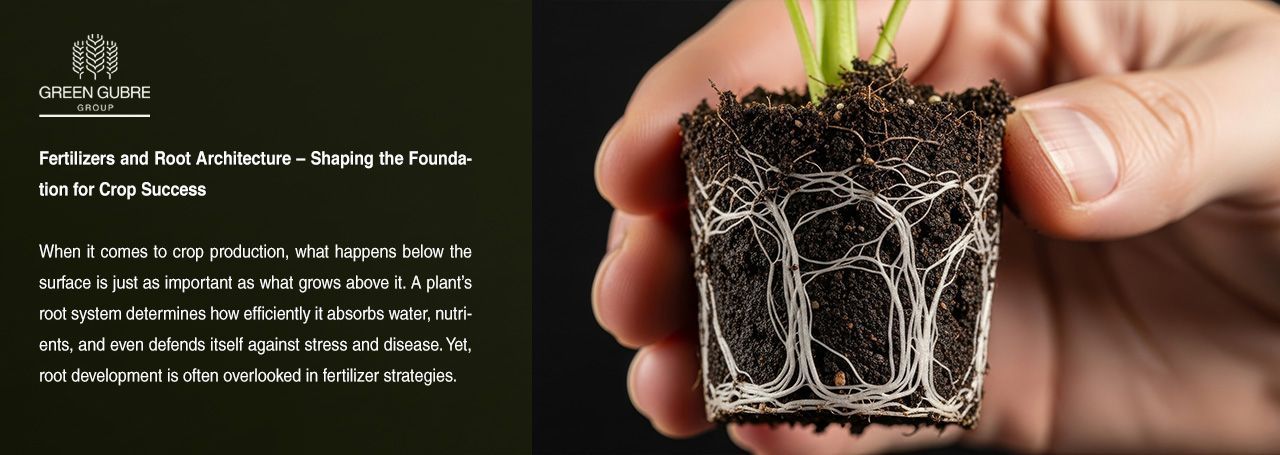
What happens below the surface is just as crucial as what grows above. A crop’s root system determines how efficiently it absorbs water and nutrients—and even how it responds to stress and disease. Yet fertilizer strategies often focus solely on above-ground growth.
Modern fertilizers are now engineered to support root optimization, not just yield. By promoting deeper, denser, and more active root systems, these formulations help build a stronger foundation for crop performance, resilience, and long-term soil health.
Why Root Architecture Matters in Agriculture
Root architecture refers to the depth, spread, and activity of a plant’s roots. A healthy root system helps crops to:
- Explore more soil volume for water and nutrients
- Anchor against wind and lodging
- Store energy and support shoot growth
- Tolerate stresses like drought, salinity, and compaction
Without strong root development, yield potential may suffer—even under ideal surface conditions.
🔗 ScienceDirect – The Significance of Root Architecture for Crop Performance
How Fertilizers Influence Root Growth
| Nutrient | Role in Root Architecture |
|---|---|
| Phosphorus (P) | Promotes early root growth and lateral expansion |
| Calcium (Ca) | Strengthens root membranes, supports root branching |
| Zinc (Zn) | Stimulates root hair formation via auxin pathways |
| Potassium (K) | Enhances root-to-shoot communication and water uptake |
| Magnesium (Mg) | Activates key enzymes for root metabolism and energy use |
Application method matters:
- Starter fertilizers promote early root vigor.
- Localized placement encourages directional root expansion.
- Chelated micronutrients remain plant-available in the rhizosphere.
Fertilizer Strategies to Optimize Root Systems
1.Starter Fertilizers at Sowing
- High in phosphorus and zinc
- Applied close to the seeds to stimulate priming
- Ideal for wheat, maize, cotton, and legumes
2. Phosphite-Based Products
- Stimulate root branching and mycorrhizal associations
- Act as indirect biostimulants
3. Biostimulants & Amino Acids
- Boost root respiration and increase root hair density.
4. Mycorrhiza-Enhanced Fertilizers
- Expand nutrient absorption zones
- Improve soil texture and organic interaction
5. Silicon & Calcium Formulations
- Fortify cell walls
- Boost tolerance to root diseases and salinity
Green Gubre Group’s Root-Enhancing Fertilizer Solutions
We offer a complete portfolio of root-focused fertilizers designed to unlock crop resilience from seed to harvest:
- RootPrime™ – Starter NPK + Zn for cereals and legumes
- BioRoot™ – Phosphite + amino acids for vegetables and orchards
- RhizoSmart™ – Mycorrhiza-loaded formulation for long-cycle crops
- CalMax™ – Ca + Mg complex for membrane strength and stress response
- Phos-Kel™ – Seaweed + phosphorus blend for early root activation
We also offer:
- Root zone mapping
- Soil compaction diagnostics
- Compatibility support with fertigation/irrigation systems
Benefits of Root-Focused Fertilization
| Benefit | Result |
|---|---|
| Stronger anchoring | Reduces lodging risk in cereals and sugarcane |
| Improved drought tolerance | Access to deeper moisture reserves |
| Enhanced nutrient uptake | Lower fertilizer input, better plant growth |
| Early canopy closure | Enhances weed suppression and radiation use efficiency |
| Yield stability | Mitigates the impact of abiotic and soil stress |
Conclusion: Grow From the Ground Up
In agriculture, success starts underground. A robust root system is the foundation for water absorption, nutrient transport, and resilience.
By adopting root-enhancing fertilizer strategies, growers can maximize productivity, water-use efficiency, and return on input investments.
🌱 At Green Gubre Group, we don’t just feed crops—we grow them from the roots.