How to Choose the Right Plant Biostimulant for Crops, Soil Conditions, and Environmental Stress
How to Choose the Right Plant Biostimulant for Crops,Soil Conditions, and Environmental Stress
Introduction
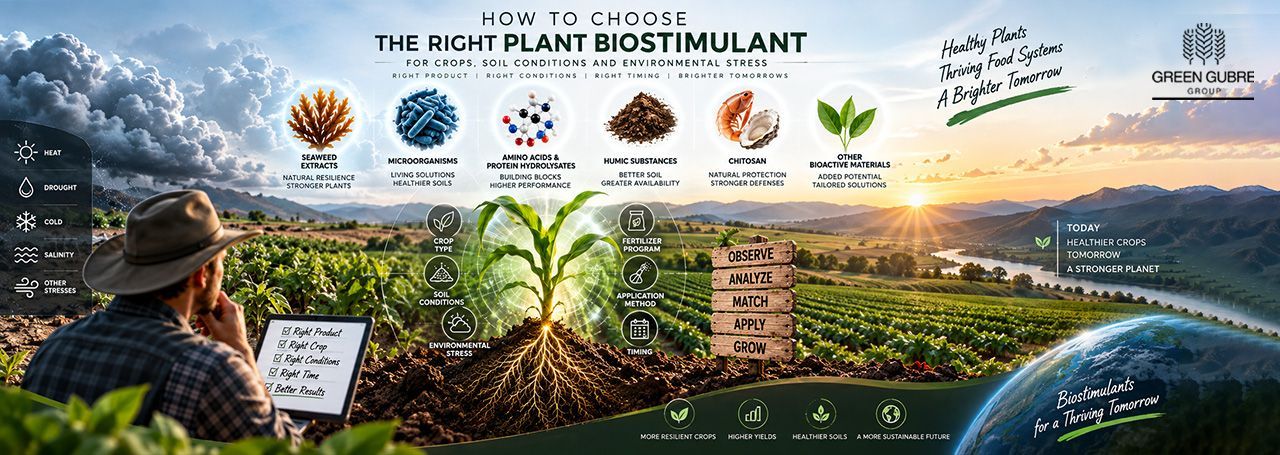
The global plant biostimulant market has expanded rapidly, giving growers access to an increasingly diverse range of products based on seaweed extracts, microorganisms, amino acids, protein hydrolysates, humic substances, chitosan, and other bioactive materials.
This creates an important practical question:
Which biostimulant should a grower choose?
There is no universal answer.
A product designed to support root establishment may not be the best choice for salinity stress. A microbial inoculant may perform differently depending on soil conditions, while a foliar seaweed extract may be applied at specific crop stages or in anticipation of environmental stress.
The effectiveness of a plant biostimulant depends on the interaction between the
product, crop, soil, environment, fertilizer program, application method, and timing.
Selecting a biostimulant should therefore be an agronomic decision rather than simply a purchasing decision.
For growers, agronomists, fertilizer distributors, and agricultural-input companies, understanding how the major biostimulant categories differ is essential for building efficient and scientifically defensible crop-management programs.
What Is a Plant Biostimulant?
A plant biostimulant is not simply another type of fertilizer.
Under the European Union's fertilizing products framework, a plant biostimulant is defined as a product that stimulates plant nutrition processes, independent of its nutrient content.
The intended objectives include improving one or more characteristics such as:
- Nutrient-use efficiency
- Tolerance to abiotic stress
- Crop-quality traits
- Availability of nutrients in the soil or rhizosphere
This functional definition is important.
Traditional fertilizers primarily
supply nutrients.
Biostimulants primarily
influence biological or physiological processes associated with plant nutrition and performance.
The distinction explains why selecting a biostimulant solely based on its nitrogen, potassium, amino acid, or organic matter content can be misleading.
The Major Categories of Plant Biostimulants
The biostimulant sector includes products with very different origins and modes of action.
Understanding these categories is the first step toward appropriate selection.
Humic and Fulvic Substances
Humic substances originate from the transformation of organic matter and include humic acids and fulvic acids.
Their agronomic effects may involve interactions with:
- Root development
- Nutrient availability
- Nutrient transport
- Soil properties
- Plant metabolism
Humic substances are particularly associated with root-zone and soil applications, although specific formulations may also be suitable for other application methods.
They can be useful when the agronomic objective is to improve interactions among plant roots, nutrients, and the soil environment.
Seaweed Extracts
Seaweed biostimulants are produced primarily from marine macroalgae.
Brown seaweeds such as Ascophyllum nodosum are widely used in commercial formulations.
Seaweed extracts contain complex mixtures of compounds that may influence:
- Root development
- Plant signaling
- Antioxidant activity
- Nutrient-use processes
- Physiological responses to environmental stress
They are commonly used during critical developmental stages and periods of anticipated drought, salinity, temperature stress, or transplant stress.
Protein Hydrolysates
Protein hydrolysates are produced by breaking plant, animal, or microbial proteins into smaller peptides and amino acids.
Their activity can involve:
- Root development
- Nutrient acquisition
- Nitrogen metabolism
- Plant signaling
- Stress responses
- Metabolic processes
The hydrolysis technology and raw-material source can significantly influence product characteristics.
Protein hydrolysates should therefore not be evaluated only according to their total amino-acid percentage.
Amino Acid Biostimulants
Amino acid-based formulations are widely used in commercial agriculture.
Individual amino acids participate in numerous plant metabolic pathways and can contribute to physiological processes associated with growth and stress response.
However, formulations differ significantly.
Some products contain predominantly free amino acids, while others may contain peptides, additional nutrients, and bioactive compounds.
The actual composition should therefore be evaluated before comparing products.
Microbial Biostimulants
Microbial biostimulants contain beneficial microorganisms that interact with plants or the rhizosphere.
Depending on the organism and formulation, their effects may involve:
- Nutrient mobilization
- Nutrient acquisition
- Root development
- Rhizosphere interactions
- Stress responses
Examples include certain plant-growth-promoting bacteria and beneficial fungi such as mycorrhizal fungi.
Microbial products require special consideration because their effectiveness depends on the ability of living organisms to survive, establish, and interact with the crop.
Storage, soil conditions, temperature, moisture, pesticide compatibility, and application method can therefore strongly influence performance.
Chitosan and Other Biopolymers
Chitosan is derived primarily from chitin and can interact with plant signaling and defense-related pathways.
Potential effects include:
- Root development
- Stress responses
- Antioxidant activity
- Plant signaling
- Natural defense mechanisms
Chitosan is also being investigated for seed coatings, nutrient-delivery systems, and advanced agricultural formulations.
Molecular weight, degree of deacetylation, concentration, and formulation can all influence biological activity.
Step 1: Define the Agronomic Problem
The first question should never be:
“Which biostimulant is best?”
It should be:
“What problem are we trying to solve?”
Without a defined objective, selecting a biostimulant becomes largely speculative.
Possible objectives include:
- Improving root establishment
- Supporting nutrient-use efficiency
- Managing moderate drought stress
- Supporting crops under salinity
- Improving transplant recovery
- Supporting flowering or fruit development
- Improving crop-quality parameters
- Supporting nutrient acquisition
- Improving rhizosphere activity
Different objectives may require different products, application methods, and timings.
Step 2: Diagnose the Crop Before Selecting a Product
Biostimulants should not be used to hide fundamental agronomic problems.
Before selecting a product, growers should evaluate the crop environment.
Useful diagnostic information can include:
- Soil analysis
- Tissue analysis
- Irrigation-water analysis
- Soil pH
- Electrical conductivity
- Nutrient availability
- Root condition
- Irrigation performance
- Historical yield data
- Current environmental stress
For example, a crop showing poor growth because of severe nitrogen deficiency requires nitrogen.
Applying a biostimulant without correcting the deficiency does not address the primary problem.
Similarly, a crop suffering from severe root-zone salinity requires appropriate management of water, drainage, soil, and nutrients.
A biostimulant may complement these measures, but it cannot replace them.
Step 3: Match the Biostimulant to the Objective
Once the agronomic constraint has been identified, the product category can be evaluated.
For Root Establishment
Products associated with root development may include:
- Humic substances
- Seaweed extracts
- Protein hydrolysates
- Certain microbial biostimulants
- Chitosan-based formulations
The correct choice depends on crop stage, application system, soil conditions, and formulation.
For Nutrient-Use Efficiency
Potential options may include:
- Humic substances
- Protein hydrolysates
- Certain microbial biostimulants
- Seaweed extracts
However, nutrient-use efficiency must be measured in relation to the underlying fertilizer program.
A biostimulant cannot improve the utilization of nutrients that are absent or severely deficient.
For Drought or Heat Stress
Products investigated for abiotic-stress support include:
- Seaweed extracts
- Protein hydrolysates
- Amino-acid formulations
- Chitosan-based products
- Selected microbial biostimulants
Application timing can be particularly important.
In many situations, preparing the crop before predictable stress may be more effective than attempting to recover plants after severe damage has occurred.
For Salinity
Salinity management requires an integrated approach.
Biostimulants that may support physiological responses include certain:
- Seaweed extracts
- Protein hydrolysates
- Amino-acid formulations
- Microbial products
- Chitosan formulations
But none replaces appropriate irrigation and water management, drainage, soil amendments where required, or suitable fertilizer strategies.
For Rhizosphere Management
Microbial biostimulants and certain humic substances may be particularly relevant when the objective involves the root-soil interface.
Microbial products, however, require appropriate environmental conditions for successful establishment.
This makes compatibility and application conditions particularly important.
Step 4: Consider the Application Method
A high-quality product applied through an unsuitable method may provide limited benefit.
Foliar Application
Foliar applications are often suitable for products intended to interact rapidly with plant tissues.
Common examples include certain:
- Seaweed extracts
- Amino-acid formulations
- Protein hydrolysates
- Chitosan products
Foliar performance can depend on concentration, spray coverage, environmental conditions, crop stage, water quality, and tank-mix compatibility.
Fertigation
Fertigation can position products directly within the root zone.
This can be particularly appropriate for certain:
- Humic substances
- Seaweed products
- Protein hydrolysates
- Microbial formulations
Compatibility with fertilizers, irrigation-water chemistry, pH, and filtration systems should be evaluated.
Seed Treatment
Seed treatment allows small quantities of biostimulant material to be placed in close proximity to the developing plant.
Depending on the formulation, microbial products, chitosan, seaweed-derived materials, or other biostimulants may be suitable for seed applications.
Soil Application
Products intended to influence the rhizosphere generally require delivery into or near the root environment.
Soil properties become especially important when living microorganisms are involved.
Step 5: Evaluate Product Quality, Not Just the Label
One of the largest challenges in the biostimulant sector is product variability.
Two products belonging to the same category may perform very differently.
For
seaweed extracts, evaluate factors such as seaweed species, extraction technology, raw-material source, and formulation.
For
protein hydrolysates, consider the protein origin, hydrolysis method, amino acid composition, and peptide profile.
For
microbial biostimulants, evaluate organism identification, viable concentration, shelf life, storage requirements, formulation stability, and compatibility.
For
chitosan, consider molecular weight, degree of deacetylation, purity, and formulation.
For
humic substances, consider source material, extraction process, composition, and product characterization.
The percentage printed in large numbers on a product label rarely tells the complete story.
Step 7: Check Compatibility
Biostimulants are rarely applied in isolation.
Commercial growers may already be using fertilizers, micronutrients, pesticides, water conditioners, biological products, and other inputs.
Tank mixing without checking compatibility can create problems such as:
- Precipitation
- Reduced solubility
- pH changes
- Microbial mortality
- Reduced biological activity
- Nozzle blockage
- Crop injury
Microbial biostimulants require particular care because fungicides, bactericides, disinfectants, or unsuitable fertilizers may reduce organism viability.
Always follow product-specific compatibility guidance.
Step 8: Choose the Correct Timing
Biostimulant timing should correspond to plant physiology and the intended objective.
Potential application windows include:
- Seed treatment
- Germination
- Transplanting
- Early root establishment
- Rapid vegetative development
- Pre-flowering
- Fruit set
- Fruit development
- Before anticipated environmental stress
- Post-stress recovery
Repeated applications without a defined physiological objective can increase production costs without necessarily increasing crop performance.
A professional biostimulant program therefore links
product, dose, timing, crop stage, and agronomic objective.
Step 9: Run a Commercial Trial
Even strong research evidence does not guarantee identical results across all production environments.
Before adopting a new product across an entire farm, commercial growers can conduct controlled field comparisons.
A practical evaluation may compare:
Control: standard fertilizer and crop-management program.
Treatment: the same standard program plus the selected biostimulant.
Where appropriate, additional treatments can be used to evaluate alternative products or application timings.
Measurements should focus on parameters relevant to the original objective, such as:
- Marketable yield
- Total yield
- Root biomass
- Crop quality
- Nutrient concentration
- Stress recovery
- Water-use efficiency
- Fertilizer-use efficiency
- Revenue
- Treatment cost
- Return on investment
This approach helps separate genuine product performance from natural field variability.
Step 10: Calculate the Economic Return
A biostimulant should ultimately justify its place within the production system.
A simple commercial evaluation can be expressed as:
Additional Revenue = Additional Marketable Yield × Crop Selling Price
Then:
Net Benefit = Additional Revenue − Total Biostimulant Program Cost
And:
ROI (%) = Net Benefit ÷ Biostimulant Program Cost × 100
The calculation should include the complete treatment cost, including product, labor, machinery, water, and, where relevant, additional application expenses.
For high-value crops, relatively small improvements in marketable yield or quality may justify treatment costs.
For lower-value bulk crops, the required economic response may be substantially larger.
Common Mistakes When Selecting Biostimulants
Choosing by Marketing Claims
Statements such as "stronger roots," "maximum yield," or "stress protection" provide little technical information without supporting evidence.
Choosing by Concentration Alone
A product containing a higher percentage of amino acids, humic substances, or seaweed extract is not automatically more effective.
Biological activity depends on composition, formulation, processing, dose, and plant response.
Expecting Biostimulants to Replace
Fertilizers
Biostimulants and fertilizers perform different functions.
A crop requiring nitrogen, phosphorus, potassium, or micronutrients still needs adequate nutrition.
Ignoring Application Timing
The correct product applied at the wrong physiological stage may provide little benefit.
Ignoring Local Conditions
Results from one crop, climate, soil type, or production system should not automatically be assumed to apply everywhere.
Using Too Many Products Simultaneously
Applying several biostimulants together can make it impossible to determine which product produced the observed response.
Complex programs should be built progressively and evaluated scientifically.
Building an Integrated Biostimulant Strategy
A professional strategy can be summarized as a sequence:
Diagnose → Define Objective → Select Category → Evaluate Product → Check Evidence → Verify Compatibility → Choose Timing → Trial → Measure → Calculate ROI → Scale
This approach changes the role of biostimulants.
Instead of being optional products added to an already complex spray program, they become targeted tools used to address clearly defined agronomic objectives.
The same principle applies to fertilizer management.
The future of crop nutrition is unlikely to depend on one "miracle" input.
It will increasingly involve integrating:
Soil science + plant nutrition + biostimulation + irrigation management + biological processes + crop monitoring + precision agriculture
The Future of Biostimulant Selection
As the industry matures, biostimulant selection is likely to become increasingly precise.
Future programs may use information from:
- Soil sensors
- Tissue analysis
- Weather forecasting
- Satellite imagery
- Crop models
- Root-zone monitoring
- Artificial intelligence
- Precision-application equipment
Instead of applying a generic biostimulant on a fixed calendar, growers may increasingly select products based on specific crop conditions and predicted stress events.
Scientific advances may also make it easier to identify which microorganisms, peptides, polysaccharides, metabolites, or other compounds produce particular physiological responses.
This could shift the industry from broad product categories to
function-specific biostimulants tailored to specific crops, environments, and agronomic objectives.
Conclusion
Choosing the right plant biostimulant begins with understanding the crop—not the product catalog.
Seaweed extracts, humic substances, amino acids, protein hydrolysates, microbial biostimulants, and chitosan-based products each have different characteristics and potential applications.
No single category is universally superior.
The appropriate choice depends on the agronomic objective, crop species, growth stage, soil conditions, environmental stress, fertilizer program, application system, product quality, and scientific evidence.
Most importantly, biostimulants should not be used as substitutes for sound agronomy.
Diagnose the problem first. Supply adequate nutrition. Select a biostimulant for a defined purpose. Apply it at the appropriate time. Measure the response. Calculate the economic return.
This evidence-based approach allows growers and agricultural businesses to move beyond marketing claims and integrate biostimulants into modern crop-management programs in a more scientific, efficient, and commercially responsible way.
References
- European Parliament and Council (2019). Regulation (EU) 2019/1009 — EU Fertilizing Products Regulation. Official EUR-Lex Regulation
- du Jardin, P. (2015). Plant biostimulants: Definition, concept, main categories, and regulation. Scientia Horticulturae, 196, 3–14. DOI: 10.1016 /j.scienta.2015.09.021
- Rouphael, Y. & Colla, G. (2020). Editorial: Biostimulants in Agriculture. Frontiers in Plant Science, 11, 40. DOI: 10.3389/fpls.2020.00040
- Calvo, P., Nelson, L. & Kloepper, J.W. (2014). Agricultural uses of plant biostimulants. Plant and Soil, 383, 3–41. DOI: 10.1007/s11104-014-2131-8
- Yakhin, O.I., Lubyanov, A.A., Yakhin, I.A. & Brown, P.H. (2017). Biostimulants in Plant Science: A Global Perspective. Frontiers in Plant Science, 7, 2049. DOI: 10.3389/fpls.2016.02049
- Van Oosten, M.J., Pepe, O., De Pascale, S., Silletti, S. & Maggio, A. (2017). The role of biostimulants and bioeffectors in alleviating abiotic stress in crop plants. Chemical and Biological Technologies in Agriculture, 4, 5. DOI: 10.1186/s40538-017-0089-5
- Colla, G., Rouphael, Y., Canaguier, R., Svecova, E. & Cardarelli, M. (2014). Biostimulant action of a plant-derived protein hydrolysate produced through enzymatic hydrolysis. Frontiers in Plant Science, 5, 448. DOI: 10.3389/fpls.2014.00448
- Pichyangkura, R. & Chadchawan, S. (2015). Biostimulant activity of chitosan in horticulture. Scientia Horticulturae, 196, 49–65. DOI: 10.1016 /j.scienta.2015.09.031
Chitosan and Biopolymer Biostimulants: Improving Plant Growth, Stress Tolerance, and Crop Resilience