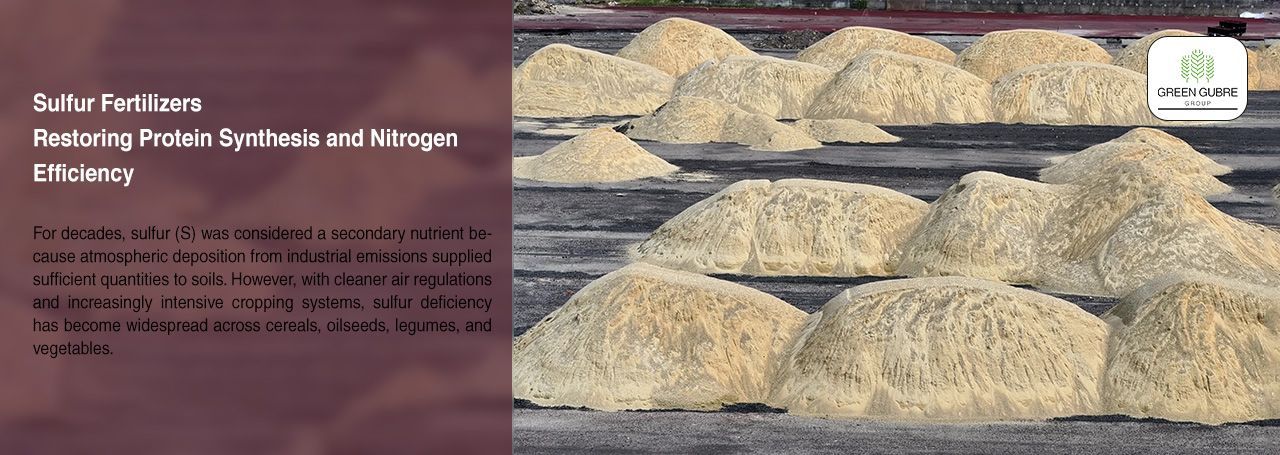
Sulfur Fertilizers – Restoring Protein Synthesis and Nitrogen Efficiency
Sulfur Fertilizers – Restoring Protein Synthesis and Nitrogen Efficiency
Introduction: Sulfur – The Forgotten Partner of Nitrogen
For decades, sulfur (S) was considered a secondary nutrient because atmospheric deposition from industrial emissions supplied sufficient quantities to soils. However, with cleaner air regulations and increasingly intensive cropping systems, sulfur deficiency has become widespread across cereals, oilseeds, legumes, and vegetables.
Sulfur is not just another nutrient—it is the key partner of nitrogen. Without adequate sulfur, plants cannot efficiently convert nitrogen into proteins, enzymes, or chlorophyll. As a result, even well-fertilized fields may suffer hidden yield loss.
This blog explores sulfur’s physiological role, deficiency symptoms, fertilizer options, and best management strategies for modern agriculture.
Why Sulfur Is Essential for Crops
Sulfur plays structural and metabolic roles in plant development:
- Protein Formation – Sulfur is a component of amino acids cysteine and methionine.
- Nitrogen Use Efficiency (NUE) – Sulfur enables the conversion of absorbed nitrogen into usable proteins.
- Chlorophyll Production – Supports photosynthesis and green leaf development.
- Oil Formation – Critical for oilseed crops like canola and sunflower.
- Enzyme Activation – Required for numerous metabolic enzymes.
- Stress Resistance – Improves tolerance to drought and cold stress.
Unlike nitrogen, sulfur is relatively immobile in plants, meaning deficiencies appear first in young leaves.
According to the FAO’s nutrient management guidelines, balanced sulfur nutrition is essential for maximizing nitrogen efficiency in modern cropping systems.
Sulfur Deficiency Symptoms by Crop
| Crop | Symptoms |
|---|---|
| Wheat | Pale yellow young leaves, reduced tillering |
| Canola | Stunted growth, poor pod formation |
| Maize | Uniform yellowing of new leaves |
| Soybean | Reduced nodulation, light green foliage |
| Onion | Thin leaves, low bulb size |
| Rice | Delayed maturity, pale seedlings |
Sulfur deficiency is common in:
- Sandy soils (leaching prone)
- Low organic matter soils
- High rainfall areas
- Intensively cropped systems
- Fields receiving high nitrogen rates
Research shows sulfur deficiency reduces protein content and grain quality even when nitrogen supply is adequate.
Types of Sulfur Fertilizers
| Fertilizer Type | Sulfur Content | Application | Notes |
|---|---|---|---|
| Ammonium Sulfate | 24% S | Soil | Provides both N and S |
| Gypsum (CaSO₄) | 16–18% S | Soil | Improves structure & sodic soils |
| Elemental Sulfur | 85–99% S | Soil | Slow-release, requires microbial oxidation |
| Potassium Sulfate (SOP) | 17–18% S | Soil | Chloride-free K source |
| Magnesium Sulfate | 13% S | Soil/Foliar | Supplies Mg + S |
| Liquid Thiosulfates | 10–26% S | Fertigation | Fast-acting in irrigation systems |
Elemental sulfur must oxidize to sulfate (SO₄²⁻) before plant uptake, which slows uptake but extends its duration.
Scientific literature confirms that sulfate-based forms offer immediate correction, while elemental sulfur supports long-term soil health.
Source: ScienceDirect – Sulfur Deficiency and Crop Yield Response
Sulfur and Nitrogen: The Critical Ratio
The ideal N:S ratio in plant tissue is approximately 10–15:1, depending on crop type.
Excess nitrogen without sulfur results in:
- Poor protein synthesis
- Accumulation of unused nitrate
- Lodging in cereals
- Reduced oil content in oilseeds
Balanced fertilization improves:
- Grain protein quality
- Oilseed yield
- Legume nodulation
- Overall nitrogen efficiency
The 4R Nutrient Stewardship framework promoted by IFA emphasizes matching sulfur rates with nitrogen demand for sustainable crop nutrition.
Best Practices for Sulfur Fertilization
1. Soil Testing: Test sulfate-S levels before planting, especially in sandy soils.
2. Early Application: Apply sulfur at planting or the early vegetative stage for cereals and oilseeds.
3. Split Applications: In high rainfall areas, split sulfur applications to reduce leaching losses.
4. Combine with Nitrogen: Use ammonium sulfate or blended fertilizers to ensure synchronized N and S uptake.
5. Improve Soil Biology: Sulfur oxidation depends on microbial activity—maintain organic matter for efficiency.
USDA NRCS soil health technical notes emphasize sulfur’s importance in balanced soil fertility programs.
Green Gubre Group’s Sulfur Solutions
Our sulfur portfolio includes:
- GreenSulf Ammonium Sulfate – High-efficiency N+S source
- GreenGypsum – Soil conditioner with sulfur supply
- GreenS Elemental – Controlled oxidation sulfur granules
- GreenSOP – Potassium sulfate for chloride-sensitive crops
- Liquid Sulfur Solutions – For fertigation systems
All products include:
- COA & MSDS documentation
- Compatibility charts
- Crop-specific dosage programs
- Regional agronomic support
Conclusion: Sulfur – Small Nutrient, Big Impact
Modern agriculture demands precision. As nitrogen rates increase and atmospheric sulfur declines, sulfur fertilization becomes essential—not optional.
Balanced sulfur nutrition improves nitrogen efficiency, protein synthesis, crop quality, and overall yield stability.
At
Green Gubre Group, we promote integrated nutrient programs that optimize both primary and secondary nutrients—because sustainable yield depends on balanced soil chemistry.