Water-Conditioned Fertilizers – Ensuring Efficiency in Hard Water Environments
Water-Conditioned Fertilizers – Ensuring Efficiency in Hard Water Environments
Introduction: The Hidden Impact of Water Quality on Fertilization
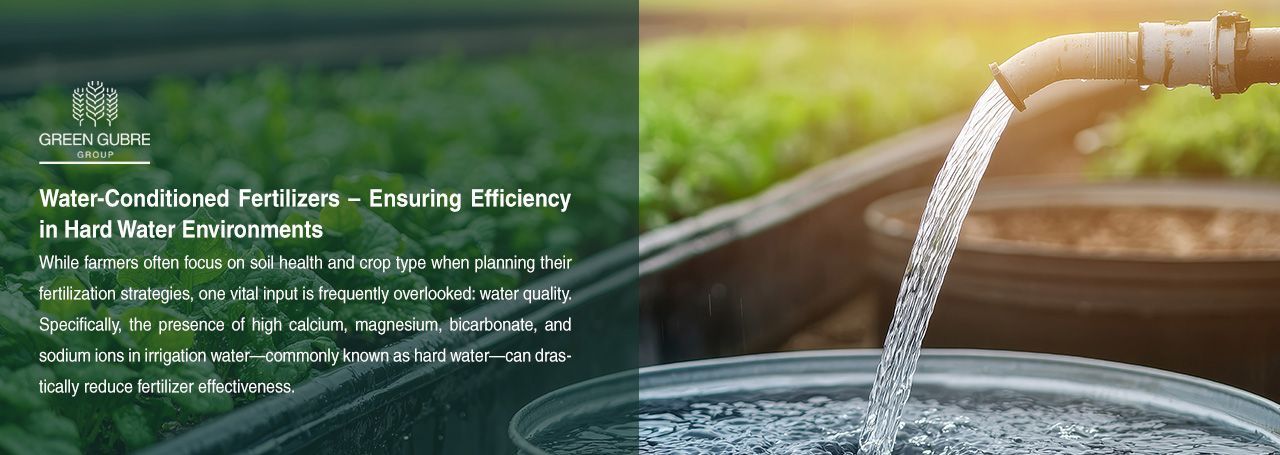
While farmers often focus on soil health and crop type when planning their fertilization strategies, one vital input is frequently overlooked: water quality. Specifically, the presence of high calcium, magnesium, bicarbonate, and sodium ions in irrigation water—commonly known as hard water—can drastically reduce fertilizer effectiveness.
Water-conditioned fertilizers are specially formulated to perform optimally in hard water conditions, helping prevent nutrient lockout, clogging, and application inefficiency.
In modern agriculture, addressing water quality is not optional—it’s essential for unlocking full nutrient potential.
What Are Water-Conditioned Fertilizers?
Water-conditioned fertilizers are nutrient solutions or blends that include stabilizing agents, acidifiers, chelates, or surfactants to maintain solubility and effectiveness even in alkaline or ion-rich water.
These fertilizers resist precipitation reactions that can render nutrients—especially phosphorus, calcium, magnesium, and micronutrients—unavailable to plants.
They typically include:
- pH regulators to acidify alkaline water
- Anti-scale agents to prevent emitter clogging in drip systems
- Chelated micronutrients that remain soluble in high-Ca/Mg waters
- Buffered phosphate sources that resist reaction with bicarbonates
Why Water Quality Affects Fertilizer Efficiency
| Water Issue | Effect on Fertilizer | Agronomic Consequence |
|---|---|---|
| High pH | Nutrient precipitation | Lower micronutrient availability |
| Calcium/Bicarbonates | React with phosphates | Formation of insoluble scale |
| Sodium/Chlorides | Compete for uptake | Crop toxicity and salt stress |
| Suspended solids | Clogging of nozzles/drip lines | Uneven application |
Even minor pH increases can cause phosphorus to form insoluble compounds, while iron and manganese oxidize rapidly, becoming unavailable to roots.
Source: Fertilizer Focus – Managing Water Quality in Fertigation
Benefits of Water-Conditioned
Fertilizers
| Benefit | Practical Impact |
|---|---|
| Maintains nutrient solubility | Prevents loss of essential elements like P, Fe, Mn, Zn |
| Reduces emitter clogging | Ensures uniform fertigation in drip and pivot systems |
| Improves nutrient uptake | More nutrients reach the plant in bioavailable form |
| Protects soil structure | Limits sodium buildup and pH drift |
| Enhances system longevity | Prevents corrosion and buildup in irrigation lines |
Farms using pH-adjusted or chelated formulations report 10–25% higher nutrient uptake and 30–50% reduction in irrigation system maintenance.
Source: International Fertilizer Association – Fertigation and Water Conditioning
When to Use Water-Conditioned Fertilizers
- Hard water (>120 ppm CaCO₃) or high bicarbonate levels
- Alkaline water (pH > 7.5)
- Micronutrient-heavy fertilization programs
- Greenhouses, hydroponics, and drip irrigation systems
- Crops sensitive to pH or salt (e.g., lettuce, citrus, berries)
For hydroponic growers and precision farms, adjusting water chemistry is critical to success.
Green Gubre Group’s Water-Smart Fertilizer Line
At Green Gubre Group, we’ve developed water-compatible formulations that ensure consistent performance across a range of irrigation systems:
- pH-Balanced Liquid NPKs for alkaline water
- Chelated Micronutrient Blends (EDTA/DTPA) stable at high pH
- Buffered Phosphate Solutions (UP, APP) for hard water conditions
- Water Conditioner Additives to pre-treat irrigation water
We also offer:
- Water testing and compatibility analysis
- Customized fertigation schedules based on your water profile
- Technical support for clog-free fertigation design
Conclusion: Clean Water, Clean Results
Fertilization is only as adequate as the water that delivers it. By investing in water-conditioned fertilizers, farmers safeguard nutrient integrity, irrigation performance, and crop health—especially in hard water environments.
As precision farming expands, ignoring water chemistry is no longer an option—partner with Green Gubre Group to optimize every drop.