Fertilizers and Soil Structure – Enhancing Porosity, Aeration, and Root Health
Fertilizers and Soil Structure – Enhancing Porosity, Aeration, and Root Health
Introduction: Fertilizer’s Silent Role in Soil Architecture
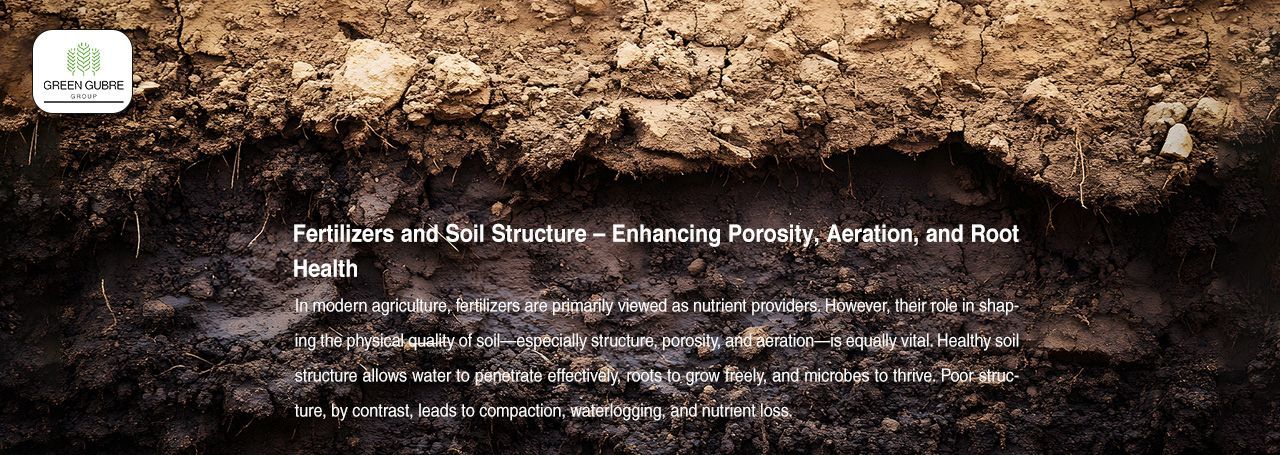
In modern agriculture, fertilizers are primarily viewed as nutrient providers. However, their role in shaping the physical quality of soil—especially structure, porosity, and aeration—is equally vital. Healthy soil structure allows water to penetrate effectively, roots to grow freely, and microbes to thrive. Poor structure, by contrast, leads to compaction, waterlogging, and nutrient loss.
Surprisingly,fertilizers can either improve or degrade soil structure, depending on how they’re formulated and applied. This blog dives into how different fertilizers interact with soil architecture and what farmers can do to promote a
resilient, well-aerated root zone that supports long-term productivity.
What Is Soil Structure and Why Does It Matter?
Soil structure refers to how individual soil particles bind together into aggregates. These aggregates form pores—spaces in the soil where air, water, and roots move. Ideal soil structure supports:
- Water infiltration and drainage
- Gas exchange for root respiration
- Robust root penetration
- Microbial habitat and activity
Without these physical attributes, crops may suffer even with high nutrient availability. Compacted or poorly aggregated soils limit water retention and nutrient uptake, increase runoff, and encourage erosion.
How Fertilizers Influence Soil Structure
Positive Effects
- Gypsum (Calcium Sulfate): Helps displace sodium ions (Na⁺) in sodic soils, improving structure by encouraging flocculation and better particle aggregation.
- Organic–Mineral Blends: Incorporating compost or humic acids with NPK fertilizers supports microbial activity and boosts soil aggregate stability.
- Biofertilizers: Microbes such as Azotobacter, Bacillus, and mycorrhizae
exude sticky substances (like glomalin) that bind particles and build structure.
Negative Effects
- Excessive Nitrogen (especially ammonium forms): Speeds up organic matter breakdown and lowers pH, which can destroy soil aggregates.
- High-Salt Fertilizers: Products containing chloride or sodium increase electrical conductivity (EC), promoting dispersion and breaking up compacted soil layers.
- Repeated Application of Water-Soluble Fertilizers (WSFs): Can lead to crusting and salinization without proper leaching and pH control.
🔗 ScienceDirect – Impact of Fertilizer Salts on Soil Structure
Soil-Friendly Fertilizer Strategies
| Strategy | Practice | Structural Benefit |
|---|---|---|
| Apply Gypsum in Sodic Soils | 1–5 tons/ha to displace sodium ions and improve infiltration | aRestores porosity, improves tilth |
| Use Humic Acid Blends | Combine with NPK or foliar nutrients | Boosts microbial glue and carbon content |
| Apply Biofertilizers | Introduce mycorrhizae and soil bacteria | Enhances aggregation and microbial networks |
| Avoid Nitrogen Overuse | Match with carbon-rich inputs | Prevents compaction and rapid SOM loss |
Microbial Activity: The Hidden Architect of Soil Health
Microorganisms are the unsung heroes of soil structure. They:
- Bind particles into aggregates via extracellular polysaccharides
- Improve porosity through tunneling and organic matter cycling.
- Enhance root-soil contact via symbiotic relationships (e.g., mycorrhizae)
- Balance redox conditions, maintaining proper oxygen and moisture regimes
Fertilizer programs that stimulate soil biology tend to improve both chemical and physical fertility—a win-win for productivity and sustainability.
Green Gubre Group’s Structure-Friendly Fertilizer Range
Our product line is designed to support both nutrient delivery and soil regeneration. Options include:
- GreenGypsum – Calcium-based gypsum to reclaim sodic soils and enhance aeration
- GreenNPK-Humic – Granular NPK infused with humic acids for structure and CEC improvement
- GreenBioBoost – Inoculated biofertilizer with Azospirillum, Mycorrhizae, and Bacillus
- Low-Salt WSFs – Chloride-free formulas designed to maintain soil porosity during fertigation
All products are COA-certified and supported with:
- Crop-specific application charts
- Compatibility & solubility guidelines
- Regional agronomic consultation
Conclusion: Fertile Soil Must Also Be Structured Soil
Soil health is more than nutrients—it’s the architecture that holds the system together. A well-structured soil enhances everything from root development and water management to fertilizer efficiency. By integrating gypsum, biofertilizers, and humic-rich products into your fertilization plan, you build soils that feed plants today and support yields tomorrow.
At
Green Gubre Group, we champion a
holistic approach to soil fertility, treating physical, biological, and chemical health as an integrated system.


Chitosan and Biopolymer Biostimulants: Improving Plant Growth, Stress Tolerance, and Crop Resilience