Amino Acid Biostimulants – Supporting Plant Growth, Nutrient Efficiency and Stress Tolerance
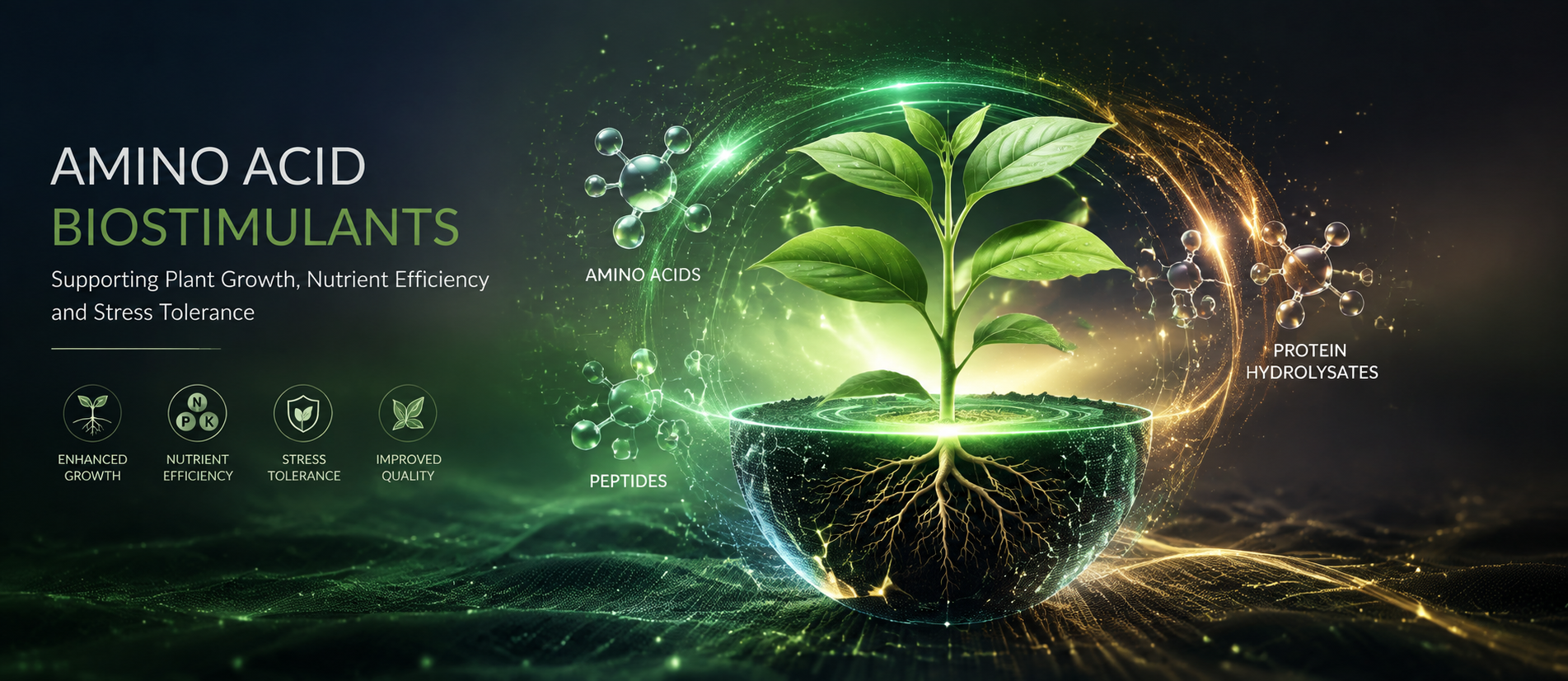
Amino Acid Biostimulants
Supporting Plant Growth, Nutrient Efficiency, and Stress Tolerance
Introduction: Amino Acids Beyond Their Role in Plant Proteins
Amino acids are fundamental components of plant life.
They are the building blocks of proteins and participate in numerous physiological processes related to plant growth, metabolism, nutrient assimilation, and responses to environmental stress.
Plants naturally produce amino acids through complex metabolic pathways. However, agricultural products containing
free amino acids, peptides, and protein hydrolysates are increasingly being used as plant biostimulants.
These products are designed not primarily to supply conventional fertilizer nutrients, but to stimulate processes that can improve nutrient-use efficiency, crop quality, and tolerance to abiotic stress.
Under the European Union Fertilizing Products Regulation, plant biostimulants are defined by their functional effects rather than by their nutrient content. Amino acid and protein hydrolysate products are widely recognized within the scientific literature as an important category of non-microbial biostimulants.
Frontiers
As agriculture faces increasing pressure from drought, salinity, temperature extremes, and the need to improve fertilizer efficiency, amino acid-based biostimulants are attracting growing attention in both research and commercial crop production.
What Are Amino Acid Biostimulants?
Amino acid biostimulants are agricultural formulations containing free amino acids, peptides, or mixtures produced from the breakdown of proteins.
Commercial products may contain amino acids such as:
- Glycine
- Glutamic acid
- Proline
- Alanine
- Aspartic acid
- Arginine
- Serine
- Valine
- Leucine
- Other naturally occurring amino acids
Many agricultural amino acid products are produced as
protein hydrolysates.
Protein hydrolysates are mixtures of peptides and free amino acids obtained by breaking down proteins through enzymatic, chemical, or other hydrolysis processes. Their characteristics vary according to the original protein source and the production method. ScienceDirect
This distinction is important because two products marketed as amino acid biostimulants may have significantly different compositions and agronomic effects.
What Are Protein Hydrolysates?
Proteins consist of long chains of amino acids.
Through hydrolysis, these proteins can be broken into smaller components, producing:
- Polypeptides
- Oligopeptides
- Short peptides
- Free amino acids
The resulting mixture is known as a
protein hydrolysate (PH).
Protein hydrolysates used in agriculture can originate from both plant and animal materials.
Plant-Derived Sources
Potential raw materials include:
- Legumes
- Alfalfa
- Seeds
- Cereals
- Plant residues
- Agro-industrial by-products
Animal-Derived Sources
Sources may include:
- Collagen
- Gelatin
- Fish by-products
- Feathers
- Other protein-rich animal materials
Recent research also highlights growing interest in producing protein hydrolysates from agricultural and food-industry by-products, potentially connecting biostimulant production with the
circular bioeconomy.
ScienceDirect
How Are Protein Hydrolysates Produced?
The production method significantly influences the characteristics of the final product.
Two important approaches are:
Chemical Hydrolysis
Acids or alkalis may be used to break proteins into smaller peptides and amino acids.
This can be an efficient production method, but harsh processing conditions may alter or destroy certain amino acids.
Enzymatic Hydrolysis
Specific enzymes are used to break peptide bonds within proteins.
Enzymatic processing can allow greater control over the resulting peptide profile and generally operates under milder conditions.
The choice of raw material and hydrolysis process influences:
- Amino acid composition
- Peptide size
- Biological activity
- Solubility
- Final product characteristics
Therefore, the agricultural performance of a protein hydrolysate cannot be predicted simply from its total amino acid percentage.
How Do Amino Acid Biostimulants Work?
Amino acid and protein hydrolysate biostimulants may affect plants through several interconnected mechanisms.
Research has associated these products with effects on:
- Carbon and nitrogen metabolism
- Nutrient uptake
- Root development
- Photosynthetic processes
- Antioxidant systems
- Osmotic regulation
- Gene expression
- Plant signalling
- Rhizosphere microorganisms
A 2025 review of protein hydrolysates reported that their biostimulant activity involves multiple pathways rather than a single mechanism, including antioxidant defense, osmotic regulation, signaling, nutrient uptake, and interactions with the plant microbiome.
ScienceDirect
This complexity helps explain why crop responses can differ significantly among products and growing conditions.
Amino Acids and Plant Metabolism
Plants normally synthesize amino acids using carbon compounds and absorbed nitrogen.
This process requires energy.
Amino acids then contribute to the formation of:
- Proteins
- Enzymes
- Chlorophyll-related compounds
- Hormones and signaling molecules
- Secondary metabolites
- Structural components
Exogenously applied amino acids can enter plant metabolic processes, although their practical contribution depends on concentration, application method, crop physiology, and environmental conditions.
This is why amino acid biostimulants should be viewed as
physiologically active agricultural inputs, rather than simply as another source of fertilizer nitrogen.
Supporting Nutrient Use Efficiency
Improving Nutrient Use Efficiency (NUE) is one of the major objectives of modern agriculture.
Fertilizer efficiency can be reduced by:
- Leaching
- Volatilization
- Nutrient fixation
- Poor root development
- Drought
- Salinity
- Unfavorable soil conditions
Protein hydrolysates have been investigated for their ability to influence nutrient uptake and assimilation.
Scientific literature reports potential improvements in the uptake or utilization of nutrients such as nitrogen and other mineral elements following appropriate protein hydrolysate treatments. ScienceDirect
However, this does
not mean that amino acid biostimulants can replace the need for conventional fertilizers.
A crop requiring nitrogen, phosphorus, potassium, or micronutrients must still receive an adequate nutrient supply.
The biostimulant's role is primarily to support the processes through which plants use available resources.
Amino Acids and Root Development
Root architecture plays a major role in nutrient and water acquisition.
Protein hydrolysates have been associated in research with changes in:
- Root length
- Lateral root development
- Root density
- Root biomass
- Nutrient uptake activity
A stronger root system can potentially explore a larger volume of soil, improving access to both nutrients and water.
This makes root stimulation particularly relevant in intensive agriculture, transplant production, greenhouse crops, and situations where plants experience environmental stress.
Amino Acids and Abiotic Stress
One of the most important areas of amino acid biostimulant research concerns abiotic stress.
Abiotic stresses include:
- Drought
- Salinity
- Heat
- Cold
- Nutrient stress
- Excessive light
- Environmental contamination
These conditions can disrupt plant metabolism, reduce photosynthesis, damage cellular structures, and ultimately decrease crop yield.
Protein hydrolysates and amino acid-based products have demonstrated potential to support plant responses to several of these stresses, although effects vary substantially among formulations and crops. ScienceDirect
Proline and Plant Stress
Among individual amino acids, proline receives considerable attention because plants naturally accumulate it under certain stress conditions.
Proline participates in processes associated with:
- Osmotic adjustment
- Cellular protection
- Redox balance
- Stress responses
However, the presence of proline in a commercial formulation does not automatically guarantee improved stress tolerance.
The crop, concentration, timing, formulation, and environmental conditions all influence the response.
This illustrates an important principle in biostimulant management:
individual ingredients should not be evaluated in isolation from the complete formulation and application strategy.
Amino Acids Under Salinity Stress
Salinity is a major agricultural challenge, particularly in arid regions, greenhouse systems, and areas dependent on saline irrigation water.
Excessive salt can interfere with:
- Water uptake
- Ion balance
- Photosynthesis
- Nutrient acquisition
- Plant growth
Research involving tomato plants under hydroponic salinity conditions has found that foliar application of selected amino acids can influence physiological and nutritional responses to salt stress.
ScienceDirect
Such findings have contributed to increasing interest in amino acid formulations for stress-management programs.
However, biostimulants cannot correct the underlying cause of excessive soil or irrigation-water salinity and should be integrated with proper water and soil management.
Drought and Water Stress
Drought reduces plant growth through several mechanisms.
As soil moisture declines:
- Root water uptake becomes more difficult.
- Stomata may close.
- Photosynthesis declines.
- Nutrient transport becomes restricted.
- Oxidative stress may increase.
- Biomass and yield can decline.
Protein hydrolysates have been investigated for their ability to influence physiological responses associated with drought tolerance.
Research summarized in recent scientific reviews suggests potential effects on photosynthesis, antioxidant defense, stomatal behavior, and plant metabolism.
ScienceDirect
They should nevertheless be considered a complementary stress-management tool—not a substitute for adequate irrigation.
Foliar Application of Amino Acids
Foliar application is one of the most common methods for applying amino acid biostimulants.
Plants can absorb certain amino acids and small peptides through leaf tissues, although absorption depends on several factors.
These include:
- Molecular characteristics
- Concentration
- Leaf surface properties
- Temperature
- Humidity
- Spray-water quality
- Application timing
- Formulation
Foliar applications are commonly positioned around:
- Vegetative development
- Flowering
- Fruit development
- Transplant stress
- Heat or drought periods
- Recovery following environmental stress
Research confirms that amino acids and protein hydrolysates can be applied through both foliage and roots.
ScienceDirect
Root and Fertigation Application
Protein hydrolysates can also be delivered through the root zone.
Applications may include:
- Drip irrigation
- Fertigation
- Soil drenching
- Hydroponic nutrient solutions
Root-applied products may interact not only with plants but also with the
rhizosphere microbiome.
Recent research suggests that amino acids and peptides may influence microorganisms associated with plant roots, potentially contributing to nutrient cycling and stress responses.
ScienceDirect
This plant–microbe interaction represents an important emerging area of biostimulant research.
Amino Acid Biostimulants vs Conventional Fertilizers
The distinction between biostimulants and fertilizers is essential.
| Characteristic | Amino Acid Biostimulants | Conventional Fertilizers |
|---|---|---|
| Primary purpose | Stimulate plant processes | Supply essential nutrients |
| Main components | Amino acids and peptides | N, P, K, and other nutrients |
| Typical application rate | Relatively low | Generally higher |
| Stress-management role | Potentially important | Generally higher |
| Nutrient supply | Secondary | Primary |
| Replaces fertilizer program | No | Primary |
Amino acid biostimulants may contain nitrogen, but their agricultural purpose should not be confused with supplying the bulk nitrogen requirement of a crop.
Plant-Derived vs Animal-Derived Protein Hydrolysates
One increasingly important commercial distinction is the source of the hydrolysate.
Plant-Derived Protein Hydrolysates
These may be produced from legumes, alfalfa, seeds, and other plant materials.
They are receiving considerable attention in modern biostimulant research.
Animal-Derived Protein Hydrolysates
These can originate from collagen, gelatin, feathers, fish materials, and other protein-rich animal by-products.
Both categories may contain biologically active peptides and amino acids.
However, their amino acid profiles and biological effects can differ significantly.
A recent field study in grapevines, for example, found different responses depending on whether amino acid-based treatments were plant- or animal-derived, reinforcing the importance of source and dosage.
Frontiers
Therefore, products should be evaluated based on their actual formulation and evidence—not simply on whether they contain amino acids.
Applications Across Different Crops
Amino acid and protein hydrolysate biostimulants are used across a wide range of agricultural systems.
Vegetable Crops
Applications include:
- Tomato
- Pepper
- Lettuce
- Cucumber
- Potato
- Bean
Fruit Crops
They may be used in:
- Grapes
- Citrus
- Apples
- Berries
- Stone fruits
Field Crops
Research and commercial use include:
- Wheat
- Maize
- Soybean
- Canola
- Cotton
Greenhouse and Hydroponic Production
Controlled-environment agriculture provides opportunities for precise integration of amino acid products into nutrient and irrigation programs.
Amino Acids and Crop Quality
Biostimulant research increasingly looks beyond yield alone.
Protein hydrolysates and amino acid formulations have been investigated for their potential effects on:
- Mineral composition
- Pigments
- Antioxidant compounds
- Secondary metabolites
- Fruit and vegetable quality
- Nutritional characteristics
A 2024 scientific review reported effects across various studies on crop productivity, nutrient assimilation, stress tolerance, and quality characteristics.
OUCI
These effects remain product-, crop-, and environment-specific.
Integration with Fertilizer Programs
The most effective use of amino acid biostimulants is generally within an integrated nutrition strategy.
For example:
- Conventional fertilizers provide the essential nutrients.
- Micronutrient fertilizers correct specific deficiencies.
- Chelated micronutrients help maintain selected nutrients in available forms.
- Humic and fulvic substances can support soil and root-zone processes.
- Seaweed extracts may influence plant physiological and stress responses.
- Amino acid and protein hydrolysate biostimulants can support metabolic processes, nutrient efficiency, and stress tolerance.
These technologies should therefore be considered complementary rather than interchangeable.
Compatibility and Tank Mixing
Amino acid products are frequently combined with fertilizers, micronutrients, or crop-protection products.
However, compatibility should never be assumed.
Potential problems include:
- Precipitation
- Changes in pH
- Reduced product stability
- Leaf injury
- Nozzle blockage
- Reduced effectiveness of one or more components
Growers should follow manufacturer recommendations and conduct a small compatibility or jar test before preparing large tank mixtures.
Challenges and Limitations
Despite their potential, amino acid biostimulants have important limitations.
Product Variability
The term “amino acid biostimulant” covers a wide range of products with different raw materials, amino acid profiles, peptide structures, and manufacturing processes.
Variable Field Performance
Results obtained in controlled experiments may not always be reproduced under commercial field conditions.
Dose Matters
Higher concentrations do not necessarily produce better results and may sometimes negatively affect crops.
Timing Matters
The crop's physiological stage can influence the response.
Environmental Conditions Matter
Temperature, drought intensity, salinity, soil conditions, and nutrient status can all change product performance.
They Do Not Replace
Fertilizers
Biostimulants should complement—not substitute for—a scientifically balanced crop nutrition program.
Quality and Product Selection
When evaluating an amino acid or protein hydrolysate product, growers should consider more than total amino acid content.
Relevant information may include:
- Total amino acid concentration
- Free amino acid concentration
- Peptide content
- Raw material source
- Hydrolysis method
- Solubility
- pH
- Recommended crops
- Application method
- Recommended rate
- Independent agronomic evidence
A product containing a higher percentage of amino acids is not automatically more effective than a lower-concentration formulation.
Composition, biological activity, formulation quality, and correct application are equally important.
Amino Acids and the Circular Bioeconomy
Protein hydrolysates also present an interesting opportunity for agricultural sustainability.
Protein-rich residues from agriculture and food processing can potentially be converted into higher-value biostimulant products.
Sources under investigation include:
- Plant-processing residues
- Legume by-products
- Fish-processing materials
- Feathers
- Food-industry protein waste
A 2025 review highlighted this opportunity, describing protein hydrolysate production as a potential pathway for converting protein-rich waste streams into agricultural biostimulants. ScienceDirect
This creates a link between crop nutrition and the
circular economy, where agricultural or food-processing by-products become inputs for new agricultural production.
Amino Acid Biostimulants and Precision Agriculture
The next generation of biostimulant management is likely to become increasingly data-driven.
Instead of applying amino acid products according to fixed calendars, growers may use:
- Weather data
- Soil moisture sensors
- Plant stress sensors
- Satellite imagery
- Drone imagery
- Tissue analysis
- Fertigation automation
- AI-based crop monitoring
These technologies could help identify when plants are approaching physiological stress and determine the most appropriate application window.
The objective is not simply to apply more biostimulants.
It is to apply the
right product, at the right rate, at the right growth stage, under the right conditions.
The Future of Amino Acid and Protein Hydrolysate Biostimulants
Future development will likely focus on improving the consistency and predictability of these products.
Research priorities include:
- Identifying specific bioactive peptides
- Understanding plant signaling mechanisms
- Improving enzymatic hydrolysis
- Developing crop-specific formulations
- Exploring plant–microbiome interactions
- Combining protein hydrolysates with other biostimulants
- Valorizing agricultural by-products
- Optimizing foliar and fertigation applications
Recent research increasingly treats protein hydrolysates not simply as mixtures of amino acids, but as
complex biological formulations containing peptides capable of influencing plant signaling and metabolism. ScienceDirect
This may ultimately allow manufacturers to develop more targeted products for specific crops, growth stages, and environmental stresses.
Conclusion: From Nutrition to Plant Performance
Amino acid and protein hydrolysate biostimulants represent an important category within modern crop management.
Their primary value is not the bulk supply of nutrients. Instead, research suggests that appropriate formulations can influence plant metabolism, root development, nutrient uptake, stress responses, and interactions with the rhizosphere.
They may be particularly useful when crops face challenging conditions such as:
- Drought
- Salinity
- Temperature stress
- Transplant stress
- Nutritional limitations
However, performance depends strongly on the source of the protein hydrolysate, the manufacturing method, the amino acid and peptide composition, the crop, the application rate, the timing, and the environmental conditions.
For this reason, amino acid biostimulants should be integrated into
evidence-based fertilizer and crop-management programs, rather than treated as universal solutions.
As research advances and formulations are characterized more precisely, amino acids and bioactive peptides are likely to play an increasingly sophisticated role in improving nutrient efficiency, crop resilience, and sustainable agricultural productivity.
References
- Frontiers in Plant Science – Biostimulants in Agriculture II: Towards a Sustainable Future Frontiers
- Bioresource Technology Reports – The Potential of Protein Hydrolysates as Plant Biostimulants (2025) ScienceDirect
- Frontiers in Microbiology – Next Generation Plant Biostimulants for Sustainable Agriculture Frontiers
- Plants – Amino Acids, Biostimulants, and Protein Hydrolysates in Agricultural Sciences OUCI
- Scientia Horticulturae – Foliar Application of Amino Acids Under Salinity Stress ScienceDirect
- Frontiers in Plant Science – Plant- and Animal-Derived Amino Acid Biostimulants in Wine Grapes Frontiers