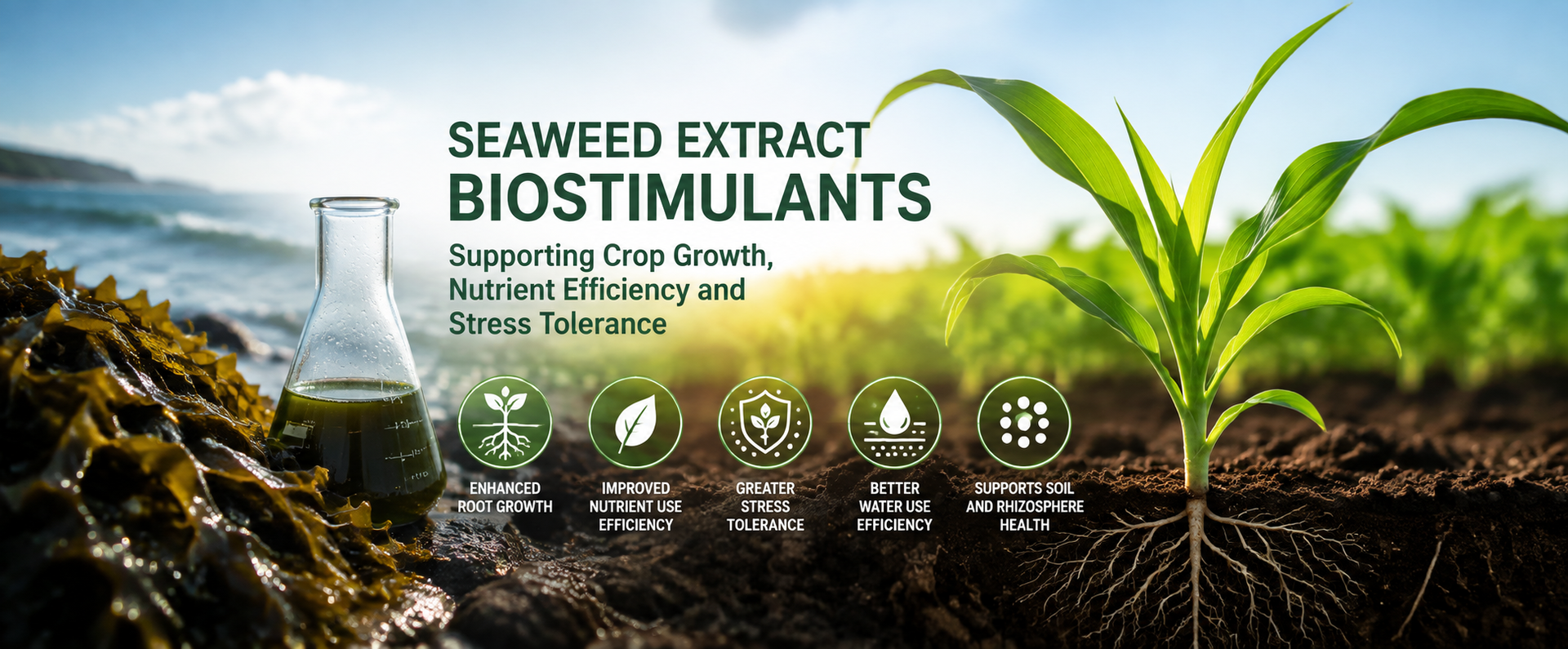
Seaweed Extract Biostimulants – Supporting Crop Growth, Nutrient Efficiency and Stress Tolerance
Seaweed Extract Biostimulants – Supporting Crop Growth, Nutrient Efficiency and Stress Tolerance
Introduction: A Growing Role for Plant Biostimulants
Modern agriculture is increasingly focused on improving crop productivity while using fertilizers, water, and other agricultural inputs more efficiently.
This has increased interest in
plant biostimulants—products that support plant nutrition processes without acting primarily as conventional fertilizers.
Under the European Union Fertilizing Products Regulation, a plant biostimulant is defined as a product that stimulates plant nutrition processes independently of its nutrient content, with the aim of improving nutrient use efficiency, tolerance to abiotic stress, quality traits, or the availability of nutrients in the soil or rhizosphere.
EUR-Lex
Among the most widely researched natural biostimulants are
seaweed extracts.
Seaweed-derived products contain complex mixtures of organic compounds, minerals, polysaccharides, amino acids, phenolic compounds, and other biologically active substances. These materials may influence plant growth, nutrient uptake, root development, and responses to environmental stress.
Seaweed extract biostimulants are now used across horticulture, greenhouse production, field crops, orchards, turf, and fertigation systems.
Their role is not to replace fertilizers. Instead, they are increasingly used to complement conventional crop nutrition programs and improve the efficiency of plant production systems.
What Are Seaweed Extract Biostimulants?
Seaweed extract biostimulants are agricultural products derived from marine macroalgae.
The principal commercial sources include brown, red, and green seaweeds.
Common genera used in agricultural products include:
- Ascophyllum
- Laminaria
- Ecklonia
- Sargassum
- Kappaphycus
- Ulva
Brown seaweeds are particularly common in commercial biostimulant formulations because of their diverse biochemical composition.
Scientific reviews report that seaweed extracts may contain:
- Polysaccharides
- Amino acids
- Minerals
- Phenolic compounds
- Betaines
- Vitamins
- Organic compounds associated with plant signaling
- Naturally occurring plant-growth-related compounds
The final composition depends strongly on the seaweed species, harvesting conditions, extraction method, formulation, and processing technology.
Frontiers
This variability is important because
not all seaweed extracts perform in the same way.
How Seaweed Extracts Work
Seaweed extracts do not generally operate through a single mechanism.
Instead, their effects appear to result from interactions between multiple compounds that influence plant physiology and soil processes.
Potential mechanisms include:
- Improved root development
- Enhanced nutrient uptake
- Changes in plant metabolic activity
- Improved antioxidant responses
- Regulation of stress-related pathways
- Support for photosynthesis
- Changes in rhizosphere and microbial activity
Recent research emphasizes that the effects of seaweed biostimulants are highly dependent on formulation and extraction method, making product characterization important.
Frontiers
Seaweed Extracts and Root Development
Root development is one of the most important areas associated with seaweed biostimulant research.
A larger or more active root system may improve a plant's ability to access:
- Water
- Nitrogen
- Phosphorus
- Potassium
- Micronutrients
Seaweed-derived compounds have been associated in research with increased root branching, root elongation, and root biomass in certain crops.
The practical significance is important: fertilizer cannot be used efficiently unless the plant has an active root system capable of absorbing nutrients from the soil.
Seaweed biostimulants may therefore indirectly support nutrient management by influencing root growth and nutrient uptake.
Supporting Nutrient Use Efficiency
One of the principal objectives of modern crop nutrition is improving Nutrient Use Efficiency (NUE).
NUE refers broadly to how effectively plants use the nutrients supplied through fertilizers and existing soil reserves.
Seaweed extracts have been investigated for their ability to improve:
- Nutrient uptake
- Root-zone nutrient acquisition
- Plant metabolism
- Fertilizer utilization
The EU regulatory definition of plant biostimulants specifically recognizes improved nutrient use efficiency as one of the functions these products may provide.
EUR-Lex
However, a biostimulant does not, by itself, eliminate the crop's nutrient requirements.
For example, applying a seaweed extract cannot replace the nitrogen needed for protein production or the potassium required for crop growth.
Its role is better understood as
supporting the plant's ability to use available resources more effectively.
Seaweed Extracts and Abiotic Stress
One of the most extensively studied applications of seaweed biostimulants is improving crop responses to abiotic stress.
Abiotic stresses include non-living environmental conditions such as:
- Drought
- Salinity
- High temperature
- Low temperature
- Nutrient stress
- Water deficit
A 2024 review in Frontiers in Marine Science found substantial research interest in seaweed extracts for improving plant responses to biotic and abiotic stresses, including salinity, drought, and temperature. Frontiers
Potential mechanisms include:
- Improved antioxidant activity
- Osmotic regulation
- Changes in stress signaling
- Improved water-use efficiency
- Protection of photosynthetic processes
These effects vary considerably by crop, product, dosage, and environmental conditions.
Drought Stress
Water scarcity is becoming increasingly important in many agricultural regions.
During drought, plants may experience:
- Reduced photosynthesis
- Reduced nutrient uptake
- Limited root activity
- Oxidative stress
- Reduced biomass accumulation
Seaweed extracts have been studied for their potential to support plant responses under water-limited conditions.
Certain studies report improvements in water-use efficiency, root growth, and physiological stress responses following treatment with specific seaweed-derived formulations.
Frontiers
These products should not be considered substitutes for irrigation, but they may form part of broader crop-management strategies designed to improve resilience.
Salinity Stress
High soil or irrigation-water salinity can restrict crop growth by interfering with water uptake and creating ionic stress.
This is particularly important in:
- Arid regions
- Coastal agriculture
- Greenhouse production
- Areas using saline irrigation water
Research has evaluated seaweed extracts from species such as
Ascophyllum and Sargassum for their potential to improve plant tolerance to salinity. Frontiers
Potential responses include improved antioxidant activity, osmotic adjustment, and maintenance of plant growth under stress.
Again, performance depends on crop species and product characteristics.
Seaweed Extracts in Foliar Application
Foliar spraying is one of the most common methods for applying seaweed biostimulants.
Advantages include:
- Application at specific growth stages
- Relatively low application volumes
- Integration with existing spraying operations
- Rapid contact with plant tissues
Foliar seaweed products are commonly used during:
- Early vegetative growth
- Flowering
- Fruit setting
- Stress periods
- Recovery after environmental stress
A 2024 review specifically highlighted foliar seaweed extracts as a potential tool for improving crop responses to abiotic stress. JSTAGE
Application timing, concentration, crop sensitivity, and weather conditions remain important.
Application Through Fertigation
Seaweed extracts can also be applied through irrigation systems.
This approach targets the:
- Root zone
- Rhizosphere
- Soil microbial environment
Fertigation allows biostimulants to be integrated with existing water-soluble fertilizer programs.
However, compatibility should always be verified before mixing seaweed products with concentrated fertilizers.
Possible problems include:
- Precipitation
- Sedimentation
- Changes in pH
- Irrigation-line blockage
A compatibility test is advisable before introducing a new formulation into a commercial fertigation system.
Seaweed Extracts vs Fertilizers
A common misunderstanding is that seaweed extracts are simply another type of fertilizer.
They are not.
| Feature | Seaweed Biostimulants | Conventional Fertilizers |
|---|---|---|
| Primary role | Stimulate plant nutrition processes | Supply essential nutrients |
| Nutrient content | Usually secondary | Primary function |
| Main objective | Efficiency, stress tolerance, quality | Nutrient supply |
| Application rate | Generally relatively low | Usually higher |
| Replaces NPK fertilizer | No | Not applicable |
EU legislation clearly distinguishes plant biostimulants from conventional fertilizers by defining their function independently of nutrient content. EUR-Lex
This distinction is important when designing crop nutrition programs.
Crops Using Seaweed Biostimulants
Seaweed extracts have been studied and used across a broad range of crops.
Horticultural Crops
Common applications include:
- Tomatoes
- Peppers
- Cucumbers
- Lettuce
- Potatoes
- Onions
Fruit Crops
Applications include:
- Citrus
- Grapes
- Apples
- Berries
- Bananas
Field Crops
Research and commercial applications include:
- Wheat
- Maize
- Soybean
- Rice
- Canola
Greenhouse Crops
Greenhouse systems offer especially precise control over nutrient, irrigation, and biostimulant programs.
A 2024 review of horticultural applications concluded that seaweed extracts have been widely studied for effects on crop growth, root development, plant vigor, and stress tolerance.
ScienceDirect
Do Seaweed Extracts Increase Yield?
This is one of the most important questions for growers.
The answer is:
they can, but not under every condition.
A large 2026 meta-analysis of
198 peer-reviewed studies, comprising 2,021 comparisons, reported an average yield increase of approximately
16.3% following the application of seaweed extract. However, the authors also found that responses depended heavily on application strategy, formulation, extraction method, crop type, stress conditions, and other factors. Frontiers
This is a good example of why biostimulants should not be marketed with universal performance claims.
Field performance depends strongly on:
- Crop
- Soil
- Climate
- Product composition
- Application timing
- Rate
- Stress conditions
- Management practices
Extraction Method Matters
One of the most important—and sometimes overlooked—factors is how the seaweed extract is produced.
Extraction methods may include:
- Water extraction
- Alkaline extraction
- Enzymatic extraction
- Mechanical processing
- Other proprietary processes
Extraction can influence the concentration and integrity of bioactive compounds.
Therefore, two products derived from the same seaweed species may have different agronomic effects.
Research increasingly emphasizes that
raw material alone does not determine performance; extraction and formulation also matter significantly.
Frontiers
Challenges and Limitations
Seaweed biostimulants have several limitations.
Product Variability
Different species, harvest conditions, processing methods, and formulations create significant differences between products.
Variable Crop Response
Not all crops respond equally.
Environmental Dependence
Products may provide greater value under certain stress conditions than under ideal growing conditions.
Application Timing
Poor timing may reduce the potential benefit.
No Replacement for Balanced Nutrition
Biostimulants cannot compensate for severe deficiencies of nitrogen, phosphorus, potassium, or other essential nutrients.
Need for Evidence-Based Claims
The EU Fertilizing Products Regulation requires plant biostimulants placed on the market under the relevant EU framework to demonstrate the effects claimed on their labels for the specified plants. EUR-Lex
This supports a move toward more scientifically validated and transparent products.
Seaweed Biostimulants and Sustainable Agriculture
The growing interest in seaweed extracts reflects a broader shift toward improving agricultural resource efficiency.
Potential contributions include:
- Improved nutrient-use efficiency
- Greater tolerance to environmental stress
- Better root development
- Reduced input waste
- Integration with precision agriculture
However, sustainable agriculture should not be interpreted as replacing fertilizers entirely.
Instead, the objective is increasingly to combine:
- Balanced fertilizer programs
- Efficient irrigation
- Biostimulants
- Soil-health management
- Crop monitoring
- Precision technology
This integrated approach provides a more realistic pathway toward efficient crop production.
This is paragraph text. Click it or hit the Manage Text button to change the font, color, size, format, and more. To set up site-wide paragraph and title styles, go to Site Theme.
The Future of Seaweed-Based Biostimulants
Research continues to improve understanding of how specific seaweed compounds interact with plants.
Future developments are likely to focus on:
- Better characterization of active compounds
- Standardized extraction methods
- Crop-specific formulations
- Improved stress-response products
- Integration with fertilizers and micronutrients
- More precise application recommendations
- Greater scientific validation of performance claims
The industry is moving from broad claims about “seaweed benefits” toward a more sophisticated understanding of
which extract, applied at what rate, to which crop, under which conditions, produces a measurable response.
This will be important for building grower confidence and increasing the long-term value of biostimulant technologies.
Conclusion: Supporting Crop Performance Through Biological Efficiency
Seaweed extract biostimulants represent an important and rapidly developing category of modern agricultural inputs.
Unlike conventional fertilizers, their primary role is not to supply large quantities of nutrients. Instead, they are used to stimulate processes associated with nutrient efficiency, root development, crop quality, and tolerance to environmental stress.
Scientific research supports the potential of seaweed extracts across many crops, but it also demonstrates substantial variability between products and application conditions.
For this reason, successful use depends on:
- Product quality
- Crop requirements
- Correct application timing
- Appropriate dosage
- Environmental conditions
- Integration with balanced fertilizer and irrigation programs
As agriculture becomes more focused on resource efficiency and climate resilience, seaweed-based biostimulants are likely to become an increasingly important complement to conventional plant nutrition.
References
- European Union – Regulation (EU) 2019/1009 on EU Fertilizing Products
- Frontiers in Marine Science – Seaweed Extracts: Enhancing Plant Resilience to Biotic and Abiotic Stresses (2024)
- Frontiers in Agronomy – Brown Macroalgae as Raw Material for Agricultural Biostimulants
- Scientia Horticulturae – Seaweed Extracts as Biostimulants in Horticultural Crops (2024)
- Frontiers in Plant Science – Crop Yield Responses to Seaweed Extract-Based Biostimulants: Meta-analysis (2026)
- Review of Agricultural Science – Foliar Seaweed Extracts for Abiotic Stress Management (2024)