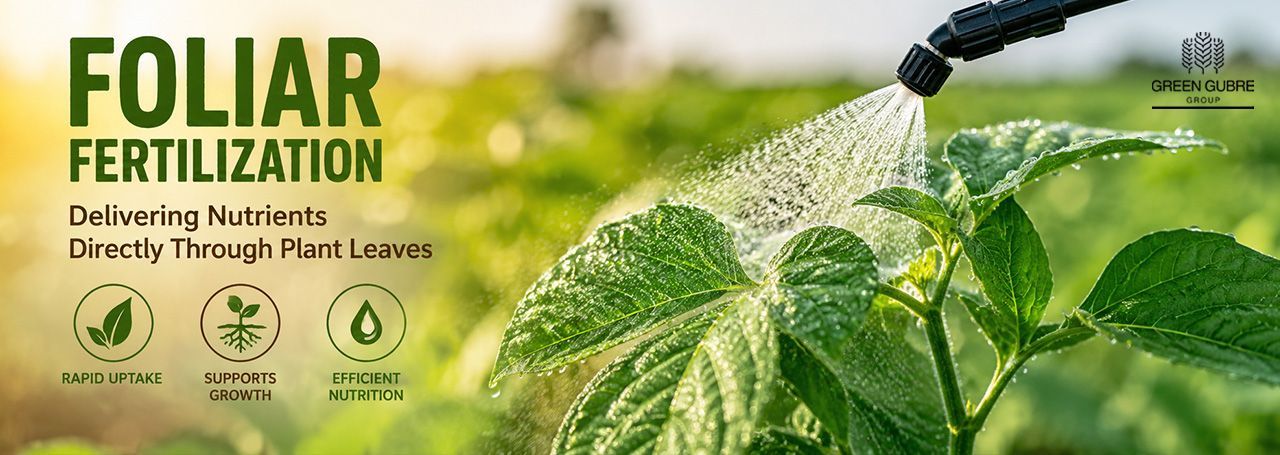
Foliar Fertilization – Delivering Nutrients Directly Through Plant Leaves
Foliar Fertilization
Delivering Nutrients Directly Through Plant Leaves
Introduction:A Complementary Approach to Crop Nutrition
Efficient crop nutrition depends on supplying essential nutrients in the right form, at the right rate, and at the right stage of plant development. Most fertilizer programs rely primarily on soil application because plant roots are responsible for most nutrient uptake.
However, soil conditions do not always allow nutrients to remain fully available to crops. High or low soil pH, nutrient fixation, root-zone stress, drought, excessive moisture, and other environmental conditions can temporarily restrict nutrient uptake.
Foliar fertilization provides an additional tool for managing these situations.
By applying nutrients directly to plant leaves in a dilute solution, foliar feeding can provide relatively rapid nutrient uptake and help address specific deficiencies during critical growth stages.
Foliar fertilization is not generally a replacement for a balanced soil fertility program. Instead, it is most effective as a
complementary nutrient-management strategy, particularly for micronutrients and targeted nutritional corrections.
What Is Foliar Fertilization?
Foliar fertilization is the application of dissolved plant nutrients directly to leaves and other above-ground plant surfaces.
After spraying, some nutrients can penetrate the leaf surface and enter plant tissues, where they may contribute to metabolic and physiological processes.
Foliar fertilizers may contain:
- Nitrogen (N)
- Phosphorus (P)
- Potassium (K)
- Calcium (Ca)
- Magnesium (Mg)
- Sulfur (S)
- Iron (Fe)
- Zinc (Zn)
- Manganese (Mn)
- Boron (B)
- Copper (Cu)
- Molybdenum (Mo)
The formulation and concentration depend on the crop, nutrient requirement, growth stage, environmental conditions, and intended purpose of the application.
How Do Plants Absorb Foliar Nutrients?
Plant leaves are covered by a protective outer layer known as the cuticle.
Although the cuticle helps limit water loss and protects plant tissues, it also influences the movement of applied nutrients into the leaf.
Following foliar application:
- Spray droplets reach the leaf surface.
- Nutrients dissolve within the aqueous film on the leaf.
- Some nutrient ions or molecules penetrate the leaf surface.
- Nutrients enter plant tissues.
- Depending on the nutrient's mobility, some may subsequently move to other parts of the plant.
Several pathways may contribute to foliar uptake, and absorption efficiency varies considerably between nutrients and plant species.
This is why formulation quality and application conditions are important.
Why Use Foliar Fertilizers?
Foliar feeding can be useful when crops require a rapid nutritional response or when soil conditions temporarily limit nutrient availability.
Rapid Nutrient Delivery
Foliar-applied nutrients can sometimes produce a faster plant response than soil-applied nutrients because they bypass several soil-related processes.
This can be particularly useful when correcting visible or diagnosed micronutrient deficiencies.
Targeted Nutrient Application
Foliar programs allow growers to apply relatively small quantities of specific nutrients during critical stages of crop development.
Reduced Interaction with Soil
Some nutrients can become less available after soil application because of chemical reactions with soil components.
Foliar application bypasses these soil interactions.
Complementing Soil Fertility Programs
Foliar feeding can supplement an established soil or fertigation program when additional nutritional support is required.
Micronutrients and Foliar Application
Micronutrients are among the most commonly applied nutrients via foliar sprays.
Plants require them in relatively small quantities, making targeted foliar application practical in many cropping systems.
| Micronutrient | Important Plant Functions |
|---|---|
| Zinc (Zn) | Enzyme activity and growth regulation |
| Boron (B) | Cell development and reproductive growth |
| Iron (Fe) | Chlorophyll formation and metabolic processes |
| Manganese (Mn) | Photosynthesis and enzyme activity |
| Copper (Cu) | Enzyme systems and plant metabolism |
| Molybdenum (Mo) | Nitrogen metabolism |
Foliar micronutrients should be applied according to confirmed crop requirements because excessive application can cause toxicity or leaf injury.
Foliar Fertilization vs Soil Fertilization
The two methods should generally be viewed as complementary rather than competing approaches.
| Feature | Foliar Fertilization | Soil Fertilization |
|---|---|---|
| Application | Directly to leaves | Soil/root zone |
| Nutrient quantity | Relatively small | Small to large |
| Response | Often relatively rapid | It depends on soil and root uptake |
| Micronutrient correction | Highly suitable in many cases | Suitable but affected by soil chemistry |
| Macronutrient supply | Limited | Primary method |
| Soil interaction | Minimal | Significant |
Soil fertilization remains the foundation for supplying large quantities of macronutrients such as nitrogen, phosphorus, and potassium.
Foliar fertilization is generally better suited to
supplementation and targeted correction.
Crops Commonly Using Foliar Nutrition
Foliar fertilizers are used across a wide range of agricultural systems.
Field Crops
Applications may be used in:
- Wheat
- Maize
- Rice
- Soybean
- Canola
- Cotton
Fruit Crops
Foliar nutrition is widely used in:
- Citrus
- Grapes
- Apples
- Berries
- Bananas
- Stone fruits
Vegetable Crops
Common crops include:
- Tomatoes
- Peppers
- Cucumbers
- Potatoes
- Onions
- Leafy vegetables
Greenhouse Crops
Controlled environments can allow more precise management of foliar nutrient applications alongside fertigation and root-zone nutrition.
Factors Affecting Foliar Nutrient Uptake
Successful foliar fertilization depends on more than simply spraying a fertilizer solution onto a crop.
Temperature
Very high temperatures can accelerate droplet evaporation and increase the risk of leaf damage.
Humidity
Moderate to high relative humidity may extend the time that spray droplets remain wet on the leaf surface, potentially supporting nutrient absorption.
Leaf Characteristics
Leaf age, surface structure, waxiness, and crop species can influence absorption.
Nutrient Concentration
Solutions that are too concentrated can damage plant tissue, while excessively dilute applications may provide insufficient nutrients.
Water Quality and pH
Spray-water characteristics can affect fertilizer solubility, stability, and compatibility.
Timing
Application timing should consider crop growth stage, weather, irrigation, rainfall, and the specific nutrient being applied.
Avoiding Leaf Burn and Crop Damage
One of the most important limitations of foliar fertilization is the possibility of phytotoxicity, commonly observed as leaf scorch or burn.
Risk can increase when:
- Fertilizer concentration is excessive
- Applications occur during high temperatures
- Water evaporates rapidly
- Incompatible products are tank-mixed
- Sensitive crops receive unsuitable formulations
Growers should always follow product recommendations and verify crop compatibility before broad application.
Where appropriate, a small-scale test application can help evaluate crop response before treating a larger area.
Foliar Fertilizers and Tank Mixing
Foliar nutrients are sometimes applied together with crop-protection products to reduce the number of field operations.
However, compatibility should never be assumed.
Improper mixtures may cause:
- Precipitation
- Reduced product performance
- Nozzle blockage
- Changes in solution pH
- Crop injury
Physical and chemical compatibility should therefore be confirmed before combining fertilizers with pesticides, biostimulants, or other agricultural inputs.
Diagnosing Nutrient Deficiencies Before Application
Effective foliar fertilization should be based on crop requirements rather than routine application without diagnosis.
Useful diagnostic tools include:
- Soil analysis
- Plant tissue analysis
- Visual crop inspection
- Historical field data
- Yield maps
- Remote sensing
- Agronomic recommendations
Plant tissue analysis can be particularly valuable because it provides information about nutrients actually present within plant tissues.
A yellow leaf, for example, does not automatically indicate a specific nutrient deficiency. Similar symptoms may result from disease, root damage, water stress, salinity, or several different nutritional disorders.
Accurate diagnosis helps prevent unnecessary fertilizer application.
Foliar Nutrition and Precision Agriculture
Digital agriculture is creating new opportunities for more targeted foliar nutrient management.
Technologies include:
- Multispectral imaging
- Drone crop monitoring
- Satellite imagery
- Variable-rate spraying
- Plant sensors
- GPS-guided application
- AI-supported crop diagnostics
These technologies can help identify spatial differences within fields and potentially allow nutrient treatments to be directed toward areas where they are most needed.
This represents an important transition from uniform foliar spraying toward
data-driven crop nutrition.
Environmental and Economic Considerations
Because foliar applications typically involve relatively small nutrient quantities, targeted use can reduce unnecessary fertilizer application when addressing specific nutritional requirements.
Potential benefits include:
- Precise micronutrient application
- Rapid correction of diagnosed deficiencies
- Reduced soil nutrient interactions
- Integration with existing field operations
- Improved crop quality under suitable conditions
However, economic performance depends on whether the crop actually requires the applied nutrient.
Routine foliar applications without demonstrated agronomic need may increase production costs without providing a meaningful return.
Challenges and Limitations
Foliar fertilization has several important limitations.
Limited Nutrient Quantity
Leaves cannot practically receive the same quantities of macronutrients that can be supplied through soil fertilization or fertigation.
Weather Dependency
Rain shortly after application may wash fertilizer off leaves, while hot, dry conditions may reduce absorption.
Risk of Phytotoxicity
Incorrect concentrations or formulations can damage crops.
Variable Nutrient Mobility
Once absorbed, nutrients differ in their ability to move within the plant.
Application Accuracy
Spray coverage, droplet size, equipment calibration, and application timing influence results.
For these reasons, foliar nutrition should form part of a broader crop-management strategy.
Foliar Fertilization and 4R Nutrient Stewardship
Foliar feeding can support the 4R Nutrient Stewardship framework when applied appropriately:
Right Source: Selecting a nutrient source suitable for foliar absorption.
Right Rate: Applying an effective concentration without causing crop injury.
Right Time: Targeting appropriate crop-development stages and suitable weather conditions.
Right Place: Delivering nutrients directly to the plant canopy where foliar uptake can occur.
The 4R approach reinforces an important principle: successful fertilizer management depends not simply on applying nutrients, but on applying them appropriately.
The Future of Foliar Nutrition
Future foliar fertilizer technologies are likely to focus on improved application efficiency and more precise crop targeting.
Developments include:
- Advanced chelated micronutrients
- Improved surfactant technologies
- Nano-scale nutrient research
- Sensor-guided spraying
- Drone-based applications
- Variable-rate foliar nutrition
- AI-assisted nutrient-deficiency detection
- Integration with precision agriculture platforms
As diagnostic technologies improve, growers may increasingly be able to identify nutritional stress earlier and respond with more targeted applications.
Conclusion: Targeted Nutrition When Crops Need It
Foliar fertilization is a valuable complement to soil fertilization and fertigation when crops require targeted nutritional support.
Its principal advantage is the ability to deliver relatively small quantities of nutrients directly to plant tissues, making it particularly useful for micronutrient management and rapid correction of certain diagnosed deficiencies.
However, foliar feeding should not be viewed as a universal substitute for root-zone nutrition. Its effectiveness depends on nutrient selection, concentration, crop physiology, environmental conditions, spray quality, and accurate diagnosis.
When integrated into a balanced crop nutrition program, foliar fertilization can provide growers with another precise tool for improving nutrient management and crop performance.