Fertigation – Improving Water and Nutrient Efficiency in Modern Agriculture
Fertigation - Improving Water and Nutrient Efficiency in Modern Agriculture
Introduction: Combining Irrigation and Crop Nutrition
Modern agriculture faces two closely connected challenges: supplying crops with sufficient nutrients and managing increasingly limited water resources.
Traditional fertilizer programs often apply relatively large amounts of nutrients in a small number of applications. However, crop nutrient demand changes throughout the growing season, and nutrients applied too early or in excessive quantities may be lost through leaching, runoff, volatilization, or other pathways.
Fertigation provides a more precise approach.
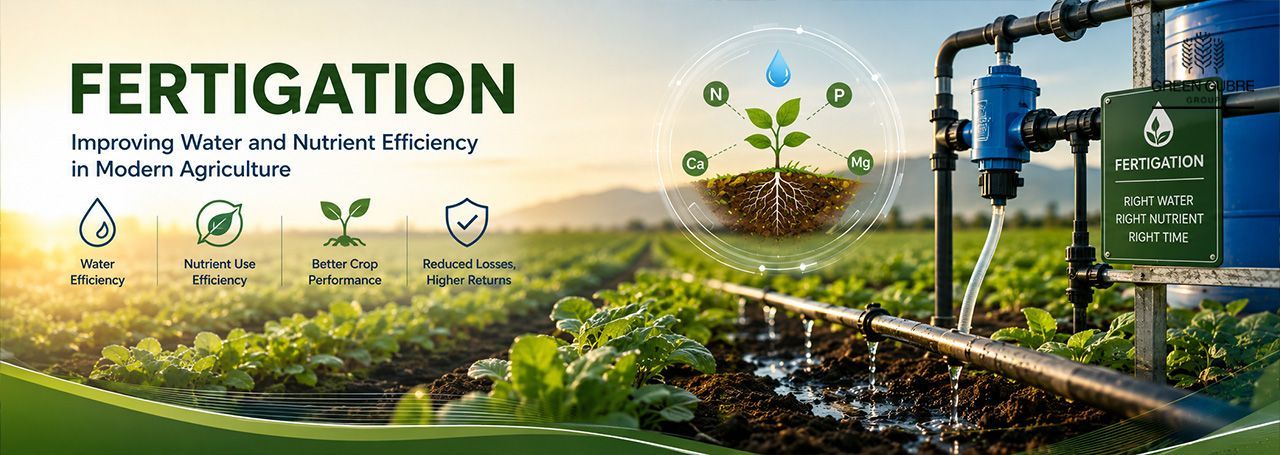
By applying soluble fertilizers through irrigation systems, fertigation allows growers to deliver water and nutrients directly to the active root zone. Nutrient rates can be adjusted according to crop growth stage, soil conditions, irrigation schedules, and production objectives.
When properly designed and managed, fertigation can improve nutrient use efficiency, support more uniform crop development, and reduce unnecessary fertilizer and water losses.
What Is Fertigation?
Fertigation is the application of fertilizers through an irrigation system.
Fertilizers are dissolved in irrigation water and distributed to crops through systems such as:
- Drip irrigation
- Micro-irrigation
- Sprinkler systems
- Center-pivot irrigation
- Greenhouse irrigation systems
Drip fertigation is particularly important because it can deliver relatively small quantities of nutrients directly to the root zone at frequent intervals.
Instead of providing most of the fertilizer requirement in one or two applications, growers can divide the nutrient program into multiple smaller applications throughout the crop cycle.
This approach is often described as
“little and often” nutrient management.
How Does Fertigation Work?
A typical fertigation system combines an irrigation network with fertilizer injection equipment.
The basic process involves:
1. Fertilizer preparation
A fully soluble or sufficiently compatible fertilizer is dissolved in water to prepare a nutrient solution.
2. Injection
The fertilizer solution is introduced into the irrigation system using an injector, dosing pump, or other suitable equipment.
3. Distribution
Irrigation water transports dissolved nutrients through the system.
4. Root-zone delivery
Water and nutrients are delivered to the soil area where active roots are concentrated.
5. Plant uptake
Plants absorb dissolved nutrients according to their physiological requirements and environmental conditions.
This combination of irrigation and fertilization enables growers to manage two major crop inputs simultaneously.
Why Fertigation Can Improve Nutrient Use Efficiency
One of the main advantages of fertigation is improved control over when, where, and how much fertilizer is applied.
Crop nutrient requirements are not constant.
Young plants generally require different nutrient quantities and ratios than crops during rapid vegetative growth, flowering, fruit development, or maturation.
A well-designed fertigation program can therefore adjust nutrient supply throughout the season.
Potential benefits include:
- More precise fertilizer application
- Better synchronization with crop demand
- Improved nutrient distribution
- Reduced nutrient losses
- Faster correction of some nutrient deficiencies
- Greater control over crop nutrition
However, fertigation itself does not guarantee higher efficiency. Results depend on appropriate fertilizer selection, irrigation design, water quality, soil characteristics, crop requirements, and management.
Fertigation and Water-Soluble Fertilizers
Water-soluble fertilizers are particularly well-suited for fertigation because they dissolve readily and provide nutrients in forms that can be transported through irrigation systems.
Common fertilizer sources used in fertigation include:
| Fertilizer | Main Nutrients |
|---|---|
| Urea | Nitrogen |
| Calcium Nitrate | Nitrogen + Calcium |
| Potassium Nitrate | Nitrogen + Potassium |
| Monoammonium Phosphate (MAP) | Nitrogen + Phosphorus |
| Monopotassium Phosphate (MKP) | Phosphorus + Potassium |
| Soluble Potassium Sulfate | Potassium + Sulfur |
| Water-Soluble NPK | N + P + K |
Micronutrients such as iron, zinc, manganese, boron, copper, and molybdenum may also be incorporated into crop nutrition programs when required.
Compatibility is essential. Mixing incompatible fertilizers can cause precipitation, potentially reducing nutrient availability and blocking irrigation equipment.
Fertigation vs Conventional Fertilizer Application
The two approaches can serve different agronomic situations.
| Feature | Fertigation | Conventional Soil Application |
|---|---|---|
| Application frequency | Frequent, smaller doses | Usually fewer applications |
| Nutrient placement | Targeted root-zone delivery | Broader soil distribution |
| Adjustment during the season | High | More limited |
| Irrigation infrastructure | Required | Not necessarily required |
| Automation potential | High | Moderate |
| Management requirements | Higher | Generally lower |
Fertigation should therefore be considered a management system rather than simply another fertilizer application method.
Crops Commonly Using Fertigation
Fertigation is particularly established in intensive and irrigated agricultural systems.
Vegetables
Common applications include:
- Tomatoes
- Cucumbers
- Peppers
- Potatoes
- Onions
- Melons
- Leafy vegetables
Fruit Crops
Fertigation is widely used in:
- Citrus
- Grapes
- Apples
- Berries
- Bananas
- Stone fruits
Greenhouse Production
Controlled-environment agriculture can benefit significantly from precise management of irrigation water, fertilizer concentration, pH, and electrical conductivity (EC).
Field Crops
Where suitable irrigation infrastructure is available, fertigation can also be incorporated into the cultivation of crops such as maize, cotton, sugarcane, and other irrigated field crops.
The Importance of Water Quality
Water quality is one of the most important factors in successful fertigation.
Irrigation water should be evaluated for characteristics including:
- pH
- Electrical conductivity (EC)
- Bicarbonates
- Calcium
- Magnesium
- Sodium
- Chloride
- Salinity
Poor water quality can affect nutrient availability, fertilizer compatibility, soil conditions, and irrigation equipment.
Regular water analysis therefore provides an important foundation for designing an effective fertigation program.
Preventing Precipitation and Emitter Clogging
Not all fertilizers can be mixed safely in concentrated solutions.
For example, concentrated calcium fertilizers should generally be kept separate from concentrated phosphate or sulfate sources because insoluble compounds may form.
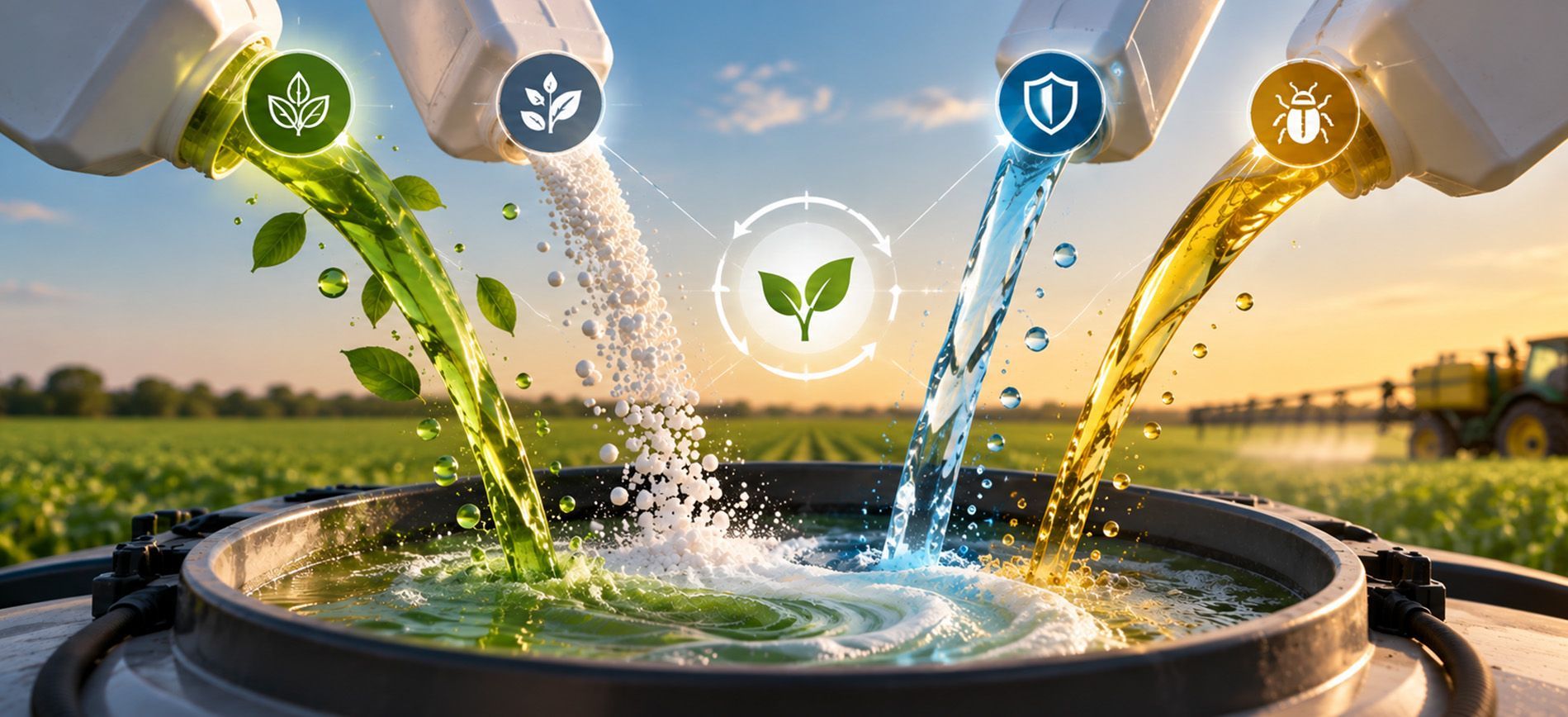
This is one reason commercial fertigation systems may use separate solutions in
Stock Tanks A and B.
Proper management should include:
- Checking fertilizer compatibility before mixing
- Using fertilizers suitable for fertigation
- Maintaining appropriate solution concentrations
- Monitoring water pH
- Cleaning filters regularly
- Flushing irrigation lines when necessary
These practices help maintain uniform nutrient distribution and protect irrigation infrastructure.
Fertigation and Precision Agriculture
Fertigation becomes particularly powerful when integrated with digital agriculture.
Modern systems can combine irrigation and fertilizer application with:
- Soil-moisture sensors
- Weather stations
- EC and pH sensors
- Flow meters
- Automated dosing systems
- Crop monitoring
- Remote irrigation control
- Decision-support software
This allows nutrient and water applications to respond more closely to actual field conditions.
The long-term direction is toward increasingly data-driven irrigation and crop nutrition management.
Environmental Benefits
Efficient fertigation can contribute to more sustainable nutrient management.
Delivering nutrients in smaller, targeted applications can help reduce the amount of fertilizer lost between application and crop uptake.
Potential environmental advantages include:
- Reduced nitrate movement below the root zone
- Lower nutrient runoff risk
- More efficient water use
- Reduced fertilizer waste
- Improved nutrient use efficiency
These benefits depend strongly on correct management. Excessive irrigation or fertilizer injection can still result in nutrient losses.
Challenges and Limitations
Fertigation also introduces additional technical requirements.
Initial Investment
Drip irrigation, filtration, fertilizer tanks, injectors, pumps, sensors, and automation equipment can require significant capital investment.
Management Expertise
Operators need to understand crop nutrition, irrigation scheduling, fertilizer compatibility, water chemistry, and equipment calibration.
Maintenance
Filters, emitters, pumps, and irrigation lines require regular inspection and maintenance.
Salinity Risk
Incorrect fertilizer concentration or inadequate irrigation management can increase salt accumulation around the root zone.
For these reasons, fertigation programs should be designed according to local agronomic conditions rather than applying a universal formula.
Fertigation and the 4R Nutrient Stewardship Framework
Fertigation can support the principles of 4R Nutrient Stewardship:
Right Source – selecting fertilizer sources suitable for the crop, water, and irrigation system.
Right Rate – supplying nutrients according to crop requirements.
Right Time – dividing fertilizer applications according to crop development.
Right Place – delivering nutrients directly to the active root zone.
This makes fertigation a practical example of how fertilizer management and precision agriculture can work together.
The Future of Fertigation
Fertigation is likely to become increasingly important as agriculture responds to water scarcity, higher input costs, environmental requirements, and the need for greater productivity.
Future developments are expected to include:
- Automated nutrient dosing
- Real-time soil and crop sensors
- Variable-rate fertigation
- Satellite and remote-sensing integration
- AI-supported irrigation scheduling
- Automated EC and pH management
- More precise crop-specific nutrient programs
The objective will increasingly be to determine not simply how much fertilizer a crop needs during a season, but
how much water and each nutrient should be supplied at a particular stage and location.
Conclusion: Delivering Water and Nutrients More Precisely
Fertigation combines two essential components of crop production—irrigation and plant nutrition—into a single management system.
When properly designed, it allows nutrients to be applied in smaller and more timely doses directly to the root zone. This can improve nutrient use efficiency, provide greater flexibility during the growing season, and support efficient irrigation water use.
Its effectiveness, however, depends on water quality, fertilizer compatibility, irrigation uniformity, crop requirements, and careful management.
As precision agriculture continues to develop, fertigation is likely to become an increasingly important tool for growers seeking to improve productivity while managing fertilizer and water resources more efficiently.