Fertigation: Improving Water and Nutrient Efficiency in Modern Agriculture
Fertigation: Improving Water and Nutrient Efficiency in Modern Agriculture
Introduction
Modern agriculture faces two critical challenges: producing more food while using water and fertilizers more efficiently. As freshwater resources become increasingly limited and fertilizer costs continue to fluctuate, growers are seeking technologies that improve crop performance without increasing production costs or environmental impact.
One of the most effective solutions is
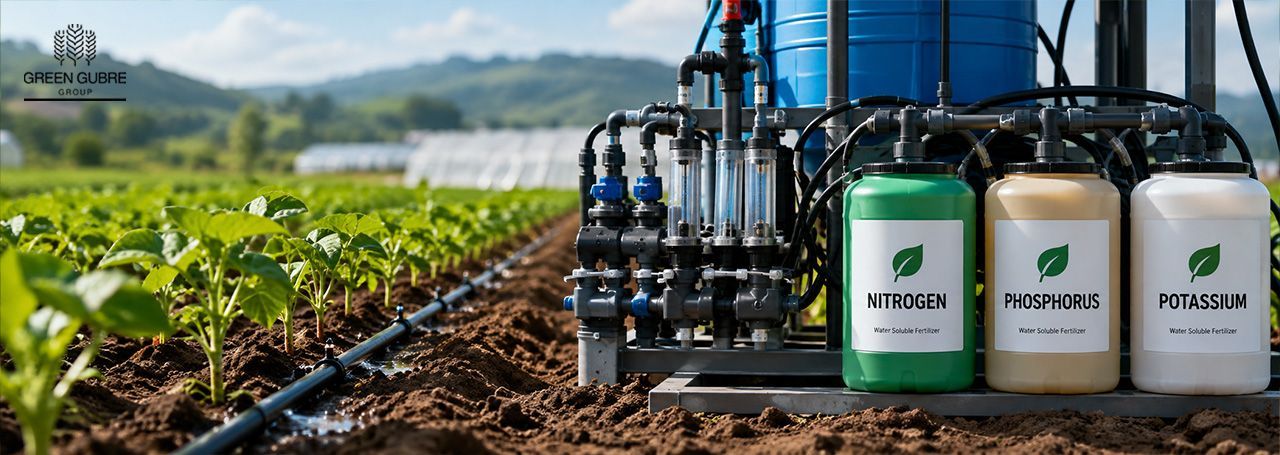
fertigation—the application of water-soluble fertilizers through an irrigation system. By delivering water and nutrients simultaneously, fertigation allows crops to receive the right nutrients at the right time and in the right place.
Compared with traditional fertilizer application methods, fertigation offers greater precision, improved nutrient use efficiency, and better control over crop nutrition throughout the growing season. Today, it is widely used in greenhouse production, orchards, vegetable farming, and irrigated field crops around the world.
What Is Fertigation?
Fertigation is the process of applying dissolved fertilizers through an irrigation system.
Instead of spreading fertilizer on the soil surface, nutrients are mixed with irrigation water and delivered directly to the plant's active root zone.
This approach combines two essential agricultural operations:
- Irrigation
- Fertilization
Fertigation is commonly used with:
- Drip irrigation
- Micro-sprinkler systems
- Sprinkler irrigation
- Center-pivot irrigation
- Hydroponic systems
Among these methods, drip irrigation provides the highest level of application precision because water and nutrients are supplied directly to the root zone with minimal waste.
How Fertigation Works
A fertigation system follows a simple process:
- A water-soluble fertilizer is dissolved in a fertilizer tank.
- An injector introduces the fertilizer solution into the irrigation line.
- The irrigation system distributes the nutrient solution evenly throughout the field.
- Plant roots absorb nutrients as irrigation water reaches the root zone.
Unlike conventional fertilization, which often supplies large amounts of nutrients at one time, fertigation allows nutrients to be applied in smaller, more frequent doses. This better matches crop demand during different growth stages and helps reduce nutrient losses.
How Fertigation Works
A fertigation system follows a simple process:
- A water-soluble fertilizer is dissolved in a fertilizer tank.
- An injector introduces the fertilizer solution into the irrigation line.
- The irrigation system distributes the nutrient solution evenly throughout the field.
- Plant roots absorb nutrients as irrigation water reaches the root zone.
Unlike conventional fertilization, which often supplies large amounts of nutrients at one time, fertigation allows nutrients to be applied in smaller, more frequent doses. This better matches crop demand during different growth stages and helps reduce nutrient losses.
Fertilizers Suitable for Fertigation
Not every fertilizer can be used in a fertigation system. Products must dissolve completely in water and remain stable without forming sediments that could clog irrigation equipment.
Common fertilizers used in fertigation include:
Nitrogen Fertilizers
- Urea
- Calcium Nitrate
- Potassium Nitrate
- Urea Ammonium Nitrate (UAN)
Phosphorus Fertilizers
- Monoammonium Phosphate (MAP)
- Monopotassium Phosphate (MKP)
- Phosphoric Acid
Potassium Fertilizers
- Potassium Nitrate
- Water-Soluble Potassium Sulfate
Complete Water-Soluble NPK Fertilizers
Balanced formulations such as:
- 20-20-20
- 19-19-19
- 15-5-30
- 13-40-13
are widely used for greenhouse crops, vegetables, fruit trees, and ornamentals.
Benefits of Fertigation
Improved Nutrient Use Efficiency
Because nutrients are delivered directly to the active root zone, crops can absorb a larger proportion of the applied fertilizer. This helps reduce nutrient losses caused by leaching or surface runoff.
Precise Nutrient Management
Growers can adjust fertilizer programs throughout the growing season according to crop development.
For example:
- Higher phosphorus during early root development
- Increased nitrogen during vegetative growth
- Higher potassium during flowering and fruit development
This flexibility is difficult to achieve with conventional fertilizer applications.
Reduced Labor and Application Costs
Combining irrigation and fertilization into a single operation reduces:
- Field passes
- Labor requirements
- Fuel consumption
- Machinery use
This can improve operational efficiency, especially on large farms.
Better Crop Uniformity
Uniform irrigation results in more even nutrient distribution, supporting consistent plant growth, crop quality, and yield.
Compatibility with Precision Agriculture
Modern fertigation systems can be integrated with:
- Automated irrigation controllers
- Soil moisture sensors
- EC and pH monitoring
- Climate monitoring systems
- Digital farm management software
This enables more accurate nutrient management and supports precision agriculture practices.
Fertigation vs. Conventional Fertilization
| Feature | Fertigation | Conventional Fertilization |
|---|---|---|
| Application | Through irrigation water | Soil application |
| Nutrient availability | Immediate | Depends on soil moisture |
| Precision | High | Moderate |
| Flexibility | Excellent | Limited |
| Application frequency | Frequent, small doses | Fewer, larger applications |
| Labor requirement | Lower | Higher |
While conventional fertilization remains suitable for many farming systems, fertigation offers greater flexibility where irrigation infrastructure is available.
Common Applications
Fertigation is widely used in high-value crops where precise nutrient management is essential.
Typical applications include:
Greenhouse Crops
- Tomatoes
- Cucumbers
- Peppers
- Lettuce
Fruit Orchards
- Citrus
- Grapes
- Apples
- Berries
Vegetable Production
- Potatoes
- Onions
- Melons
- Carrots
Hydroponics
Hydroponic systems depend entirely on nutrient solutions, making fertigation the primary method of supplying essential plant nutrients.
Water Quality Matters
Water quality has a direct impact on fertigation performance.
Before implementing a fertigation program, growers should evaluate:
- pH
- Electrical Conductivity (EC)
- Bicarbonate levels
- Calcium and magnesium content
- Water salinity
Poor-quality irrigation water may reduce fertilizer efficiency or cause mineral deposits that block irrigation emitters.
Regular water analysis helps maintain system performance and supports accurate nutrient management.
Best Management Practices
Successful fertigation depends on good management rather than equipment alone.
Recommended practices include:
- Use only fertilizers designed for fertigation.
- Analyze irrigation water regularly.
- Check fertilizer compatibility before mixing products.
- Monitor pH and EC during the growing season.
- Flush irrigation lines with clean water after fertilizer injection.
- Inspect filters and emitters regularly.
- Base fertilizer programs on soil and tissue analysis whenever possible.
Following these practices helps maximize nutrient efficiency while protecting irrigation equipment.
Challenges and Limitations
Despite its many advantages, fertigation also presents several challenges.
These include:
- Initial investment in irrigation equipment
- Dependence on reliable water supplies
- Need for technical knowledge
- Risk of emitter clogging if incompatible fertilizers are mixed
- Regular maintenance requirements
With proper design and management, these challenges can generally be minimized.
Green Gubre Group's Fertigation Solutions
Green Gubre Group supplies a wide range of fertilizers suitable for modern fertigation systems, including:
- Water-Soluble NPK Fertilizers
- Calcium Nitrate
- Potassium Nitrate
- Monoammonium Phosphate (MAP)
- Monopotassium Phosphate (MKP)
- Water-Soluble Potassium Sulfate
- Chelated Micronutrients
Working with trusted international manufacturers, we provide fertilizer solutions that support efficient nutrient management across greenhouse production, horticulture, orchards, and commercial agriculture.
Conclusion
Fertigation has become one of the most effective methods for improving water and nutrient management in modern agriculture. By combining irrigation and fertilization into a single process, growers can supply nutrients more precisely, improve fertilizer use efficiency, and respond quickly to changing crop requirements.
Although successful fertigation requires appropriate equipment, high-quality water-soluble fertilizers, and proper management, the long-term benefits often include improved crop performance, lower fertilizer losses, and more efficient use of water resources.
As precision agriculture continues to evolve, fertigation will remain a key technology for achieving productive, sustainable, and resource-efficient farming systems.
References
- Food and Agriculture Organization of the United Nations (FAO). Fertigation: A Tool for Efficient Fertilizer and Water Management.
- Food and Agriculture Organization of the United Nations (FAO). Integrated Plant Nutrient Management.
- International Fertilizer Association (IFA). Fertilizer Best Management Practices.
- International Fertilizer Development Center (IFDC). Improving Fertilizer Efficiency.
- ScienceDirect. Fertigation.
- University of Minnesota Extension. Applying Nitrogen with Irrigation Water (Chemigation).